Pledge Brand Guidelines
The Racine furniture polish S. C. Johnson introduced in 1958.
Aa
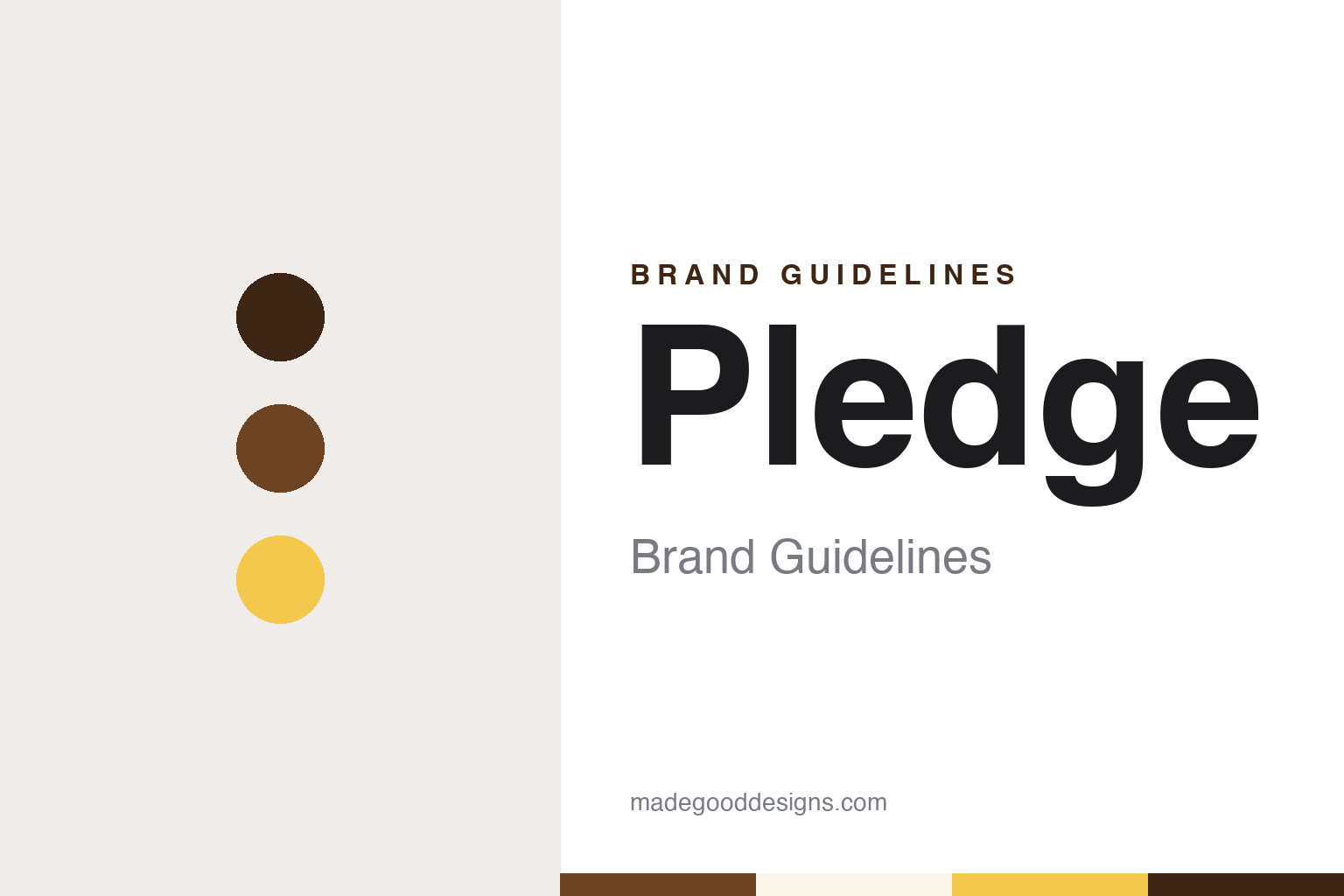
Two constants: a walnut, lemon and cream palette and a warm display serif register. Abstract homage — not a Pledge product or mark; no can, bottle or logo is reproduced.
Racine
A wax company, a Wright tower and a new aerosol.
Pledge belongs to S. C. Johnson & Son of Racine, Wisconsin, which has owned the brand since it introduced it in 1958. English Wikipedia traces the company to 1886, when Samuel Curtis Johnson bought the parquet-flooring division of the Racine Hardware Manufacturing Company and gave the business his own name. Parquet flooring was the main product at the outset, and floor-care lines such as Johnson’s Prepared Wax, Johnson’s Dance Wax and Johnson’s Wood Dye followed. The company is privately held and owned by the Johnson family; Wikipedia says H. Fisk Johnson, chairman and chief executive since 2004, is the fifth generation of the family to lead it.
Wax was the company’s business for decades. Wikipedia dates Johnson’s Glo-Coat floor finish to 1932 and the company’s sponsorship of the radio comedy Fibber McGee and Molly, officially called The Johnson Wax Program, to the years from April 1935 to May 1950. The company also commissioned architecture. English Wikipedia’s article on the Johnson Wax Headquarters says the Administration Building designed by Frank Lloyd Wright was completed in Racine in April 1939, and that Wright’s Research Tower, a laboratory building for the company’s research department, was completed beside it in November 1950.
The 1950s took the company beyond wax. Advertising Age, in its encyclopedia entry on S. C. Johnson published on 15 September 2003, says that during the decade the company moved into new product areas, entering the insecticide field with Raid and adding Off! insect repellent, a self-polishing floor wax called Klear and Pledge, which it describes as a pressurized furniture polish. English Wikipedia credits Sam Johnson, the fourth generation of the family to lead the business, with introducing Glade, Off! and Pledge within a few years of Raid.
Colour
A product committee, a chemist and names abroad.
The Pledge brand site tells the launch as a company story. S. C. Johnson says that in 1958 a product committee was reviewing the results of consumer tests on a new furniture polish developed by the company chemist Erland Muoio, looking for negative responses, and that the people testing it pointed out it could be used on wood, metal and plastic, and as a dusting aid. The company says Pledge was developed in the Wright-designed Research Tower, and that while dusting aids, waxes and polishes were all on sale at the time, Pledge combined the two kinds of product in one can.
Advertising followed the company’s agency arrangements. Advertising Age records that in 1978 S. C. Johnson gave the domestic business for Pledge furniture polish, together with Edge shaving gel and Step Saver floor wax, to J. Walter Thompson, handled through the agency’s Chicago office. The same entry describes a period in which the company moved accounts between several agencies, among them Needham, Foote, Cone & Belding and Benton & Bowles.
Outside the United States the product does not always carry the same name. English Wikipedia says Pledge is known as Pliz in France, Blem in Argentina and Pronto in several countries, and its S. C. Johnson article adds Bravo, Brilho, Pride and Glo-coat to the list of regional names. That article also lists older S. C. Johnson floor-care names, among them Klear, Future and Glo, as later merged into Pledge in some markets. The Argentine trade publication Adlatina reported in August 2017 that S. C. Johnson had launched a new Blem aerosol for screens and electronic devices there, with branded sampling at the UrbanStation coworking sites in Buenos Aires.
The range has also widened under the Pledge name. S. C. Johnson now describes Pledge as a brand of all-purpose cleaners, polishes and oils for household surfaces, and Wikipedia’s product list runs from furniture sprays and wipes to wood-floor cleaners, a revitalising oil and a pet-hair fabric sweeper.
Typography
Design and documentation.
Household-care brands live on the shelf under the sink as much as in the shop, and their packaging has to work in both places. A polish aerosol, a box of trash bags and a bottle of soap each carry a name, a colour and a few words of instruction, and the label is often the only piece of design a buyer handles every week. The same name may sit on a can, a refill pouch, a carton and a spray bottle, so the identity has to hold together across very different shapes and materials.
Many of these names have changed hands over the years, passing between family firms, larger consumer-goods groups and new owners, while the label on the pack stays familiar. That makes the plain questions worth asking: who started the brand, who owns it now and when that changed, and how its bottles, cans and boxes have been drawn over time.
Each guide separates what independent, dated sources record from what the company says about itself, and marks plainly where a statement rests only on the company’s own word.
Aa
A warm display serif — the register of a furniture showroom and a polished sideboard. (Specimen set in Fraunces, a serif STAND-IN; NOT the Pledge logo.)
Pledge
An everyday word, an aerosol can and a family company behind it.
Pledge’s identity sits inside a larger one. S. C. Johnson describes itself as a family company, and Wikipedia records that it adopted the tagline “A Family Company” in 1998 and changed it in April 2018 to “A Family Company at Work for a Better World”. Pledge sits in S. C. Johnson’s portfolio alongside Raid, Glade and Off! and brands it acquired later: English Wikipedia says the company bought Drackett, maker of Windex, in 1992, and Dow Chemical’s DowBrands division, which included Ziploc, Saran and Scrubbing Bubbles, in 1998.
The product’s form has been part of the brand from the start. Advertising Age describes the 1950s Pledge as a pressurized furniture polish, and the company’s own account places its development in a laboratory designed by Frank Lloyd Wright. In France, Argentina and several other countries the same product line travels under local names such as Pliz, Blem and Pronto, according to English Wikipedia.
Wikipedia’s product list also includes a lemon-scented furniture spray, and the brand has extended over time into wipes, floor products and multi-surface cleaners. In 1978 its American advertising moved to J. Walter Thompson in Chicago, part of a long sequence of agency changes recorded by Advertising Age for the wider S. C. Johnson portfolio.
For a design guide, Pledge shows how a one-word product name, introduced by a wax company in 1958, can grow into a household range while staying tied to its maker’s home town and its family ownership. Compare it with Windex, the glass cleaner S. C. Johnson acquired with Drackett, and Glade, the company’s home-fragrance name from the same post-war period. For this guide we use walnut, lemon and cream with a serif, an unofficial interpretation; no product or logo is reproduced.
Explore & save
Keep Pledge’s identity on hand — save it to a board in the Made Good inspiration library.
Pledge identity set
Pin the Pledge walnut, lemon and cream palette and the warm display serif register to your own board.
