Plymouth Yarn Brand Guidelines
The Pennsylvania family firm that sells only through the local yarn shop.
Aa
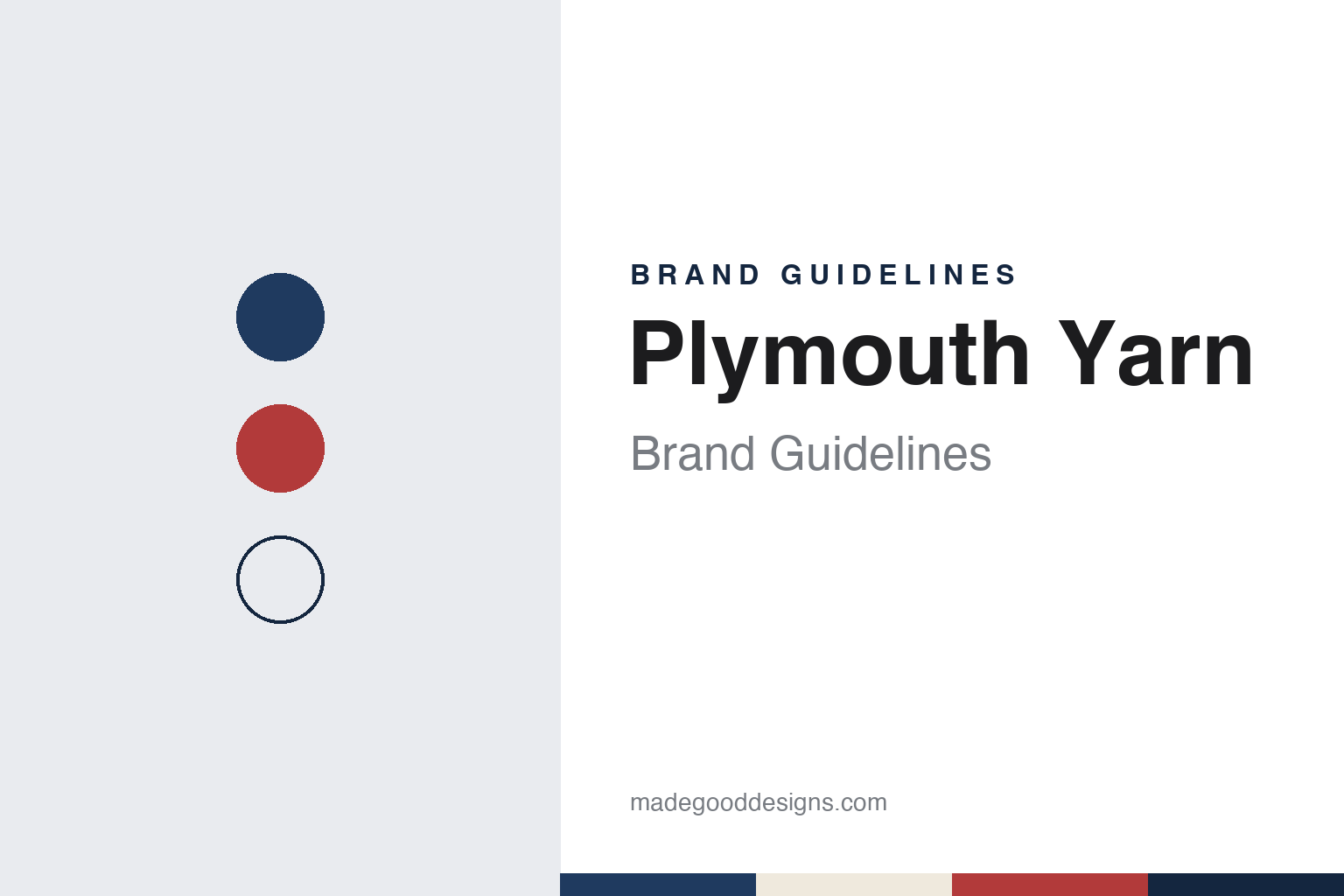
Two constants: a Plymouth Yarn navy, brick and natural palette and a plain American sans register. Abstract homage — not a Plymouth Yarn product or mark; no yarn, label or logo is reproduced.
Since 1964
A wholesaler on the Delaware.
Plymouth Yarn is the trading name of Plymouth Yarn Company, Inc., a yarn wholesaler based in Bristol, Pennsylvania, the old river town in Bucks County on the Delaware, upstream from Philadelphia. The company describes itself as “a family owned business since 1964,” and its LinkedIn company page gives the same founding year and lists it as privately held, in wholesale, with between 11 and 50 employees.
The family behind it is not named on the company pages we read in October 2026, and we did not find the founders named in other sources we checked, so we leave them out. Nor did we find any record of a sale: the company still calls itself family owned, and we give that as its own description.
What the company does say, repeatedly, is how it sells. Its banner reads “Providing Quality Yarns To Independent Yarn Shops For Over 50 Years.” Its home page says Plymouth Yarn “is available exclusively at your local yarn shop,” and its contact page is blunter: “We do not sell yarn direct to the knitting public.” Instead, a shop locator sends knitters to stockists, and a separate route invites new shops to carry the range.
That model — a wholesaler that designs, sources and markets yarn but sells only to retailers — is common in the American yarn trade, where independent shops have long depended on a handful of distributors for their shelves. Plymouth’s own phrase for its approach is that it sources “globally to bring yarn shops the most fashionable trendy yarns,” while keeping a core of “trusted staples” in stock.
Colour
Encore and the staples.
The best-known of those staples is Encore. The company calls Encore Worsted “America’s Best Selling Yarn, found exclusively at local yarn shops,” a claim we could not check against sales figures. Its product page describes a bouncy three-ply blend of 75 per cent acrylic and 25 per cent wool that can be machine washed and machine dried, sold in 100-gram balls and, the company says, “loved for” its range of colours and “proven dependability for decades.” Encore comes in several weights and finishes, including chunky, mega, tweed and colour-spun versions.
The home page names other staples. Baby Alpaca Grande is a pure baby-alpaca yarn; Galway is a pure-wool worsted; Dreambaby is a machine-washable blend of microfibre acrylic and nylon aimed at baby knits; and Fantasy Naturale is a mercerised cotton. A Plymouth Select merino superwash completes the list, and Homestead, an aran-weight yarn, is described as 100 per cent Peruvian Highland wool.
Patterns are part of the offer. Plymouth publishes a large numbered pattern library, much of it free, and links each yarn page to the designs written for it; the site also lists errata and books. For a wholesaler, the patterns do a retailer’s selling for it: a shop can stock a yarn knowing there are designs ready to hand to customers.
The company’s product pages are practical rather than promotional — contents, care, gauge, yardage, put-up and the collection a yarn belongs to — and that plainness is part of the brand’s character.
Typography
Design and documentation.
The seven brands in this group all make or sell yarn for hand knitting and crochet, and they come from five countries: Knitting for Olive from Denmark, Plymouth Yarn and Universal Yarn from the United States, Jamieson & Smith from Shetland in Scotland, Austermann and GGH from Germany, and Biscotte Yarns from Canada. Between them they show how differently a yarn brand can be built.
Some yarn brands are rooted in a single place — an island flock, a town, a regional wool tradition — and their colours and fibres grew out of what that place could supply. Others are names built around design and distribution, which develop yarns and colourways and may rely on mills elsewhere to spin them. And some are dyers, who buy undyed yarn and make their mark with colour alone, in batches small enough that no two skeins quite match.
Each guide separates what independent sources record from what the company says about itself — who founded it, who owns it now and where its yarn is spun or dyed — and marks plainly what rests only on the company’s own word.
Aa
A plain, sturdy American sans. (Specimen set in Libre Franklin, a sans STAND-IN; NOT the Plymouth Yarn logo.)
Plymouth Yarn
Its own label, and other makers’ yarns.
Plymouth sells more than its own label. Each product page names a “Collection/Brand,” and in the yarn pages we checked in October 2026 most were marked “Plymouth Brand,” with smaller groups called the Italian Collection, Alpaca Brand and Dye For Me. The rest carried other makers’ names: about twenty pages were marked Adriafil, the Italian yarn house, including its KnitCol self-patterning superwash wool; a handful were marked Nako, whose Denim yarn is labelled “Made in Turkey”; and one, a sock yarn, was marked Lane Cervinia.
The Dye For Me line takes an idea from the natural-fibre market: yarns sold in the undyed shades of the fibre itself. Its Yak yarn, a blend of superwash merino, mulberry silk and yak, brings “complex refined shade without any dyes at all,” the company says. The Alpaca Brand group leans on Peruvian fibre: Suri Stratus, for example, is a brushed blend of 68 per cent suri alpaca and 32 per cent nylon that the company suggests as a carry-along strand and as an alternative to mohair or wool. Sock yarns, cotton blends and novelty yarns such as the Italian Collection’s ruffle yarns fill out the rest of the catalogue.
On where its yarns are made, Plymouth says only that it sources globally, and most of its product pages do not name a country. Some do. Sea Glass, Cielo, Suri Stratus and the Dye For Me Yak are labelled “Made in Peru”; Mega Cakes and the Nako Denim are labelled “Made in Turkey”; and Shades Sockotta is labelled “Made in Italy.” We give those as the company’s labels and do not extend them to yarns whose pages are silent.
For a design guide, Plymouth Yarn shows how a wholesale brand builds recognition through a single reliable workhorse yarn and a deep pattern library rather than through retail. Compare Cascade Yarns, another American family firm built on a staple worsted, and Adriafil, whose yarns Plymouth carries. For this guide we use navy, brick red and a natural cream with a sans, an unofficial interpretation; no product or logo is reproduced.
Explore & save
Keep Plymouth Yarn’s identity on hand — save it to a board in the Made Good inspiration library.
Plymouth Yarn identity set
Pin the Plymouth Yarn navy, brick and natural palette and the plain American sans register to your own board.