Portillo’s Brand Guidelines
A trailer called The Dog House, a family name and a Chicago menu.
Aa
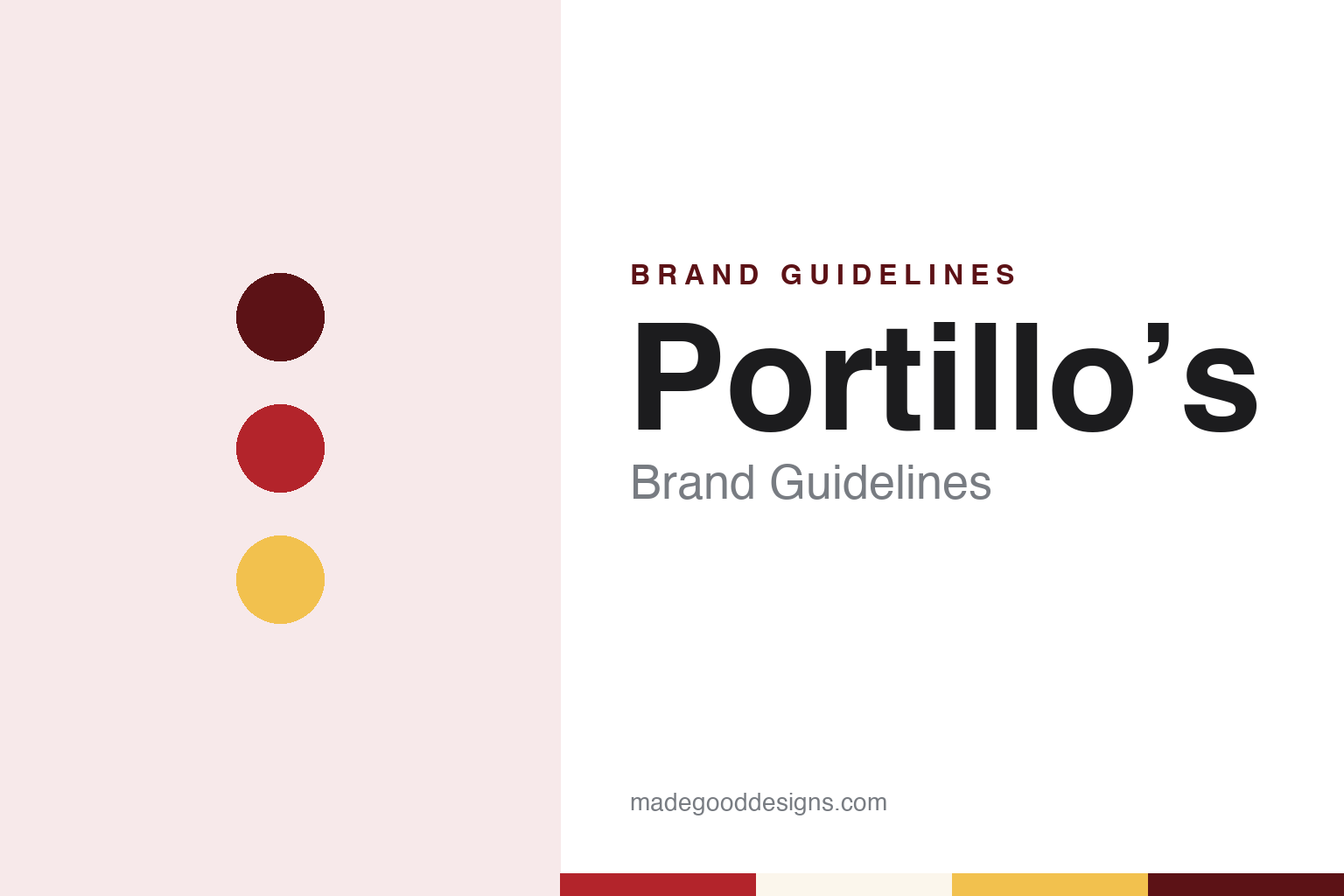
Two constants: a stand red, mustard and wax paper palette and a heavy roadside sans register. Abstract homage — not a Portillo’s product or mark; no sign, wrapper or logo is reproduced.
Portillo’s
A twelve-foot trailer in a Villa Park parking lot.
Portillo’s began with a single trailer. English Wikipedia says Dick Portillo opened a hot dog stand on 9 April 1963 in Villa Park, Illinois, a suburb west of Chicago, after returning from service in the Marines. He paid for it with his savings and an investment from his brother Frank, and the stand was a twelve-foot trailer with no restroom and no running water. It stood on North Avenue, and it was called The Dog House. The Chicago Tribune, writing in October 2021, described the same beginning: in 1963 Dick Portillo was selling hot dogs from a trailer called The Dog House in a parking lot in Villa Park.
The family name arrived four years later. Wikipedia says that by 1967 the business had moved into a larger trailer and was renamed Portillo’s. That change is the root of the present identity: a stand that had carried a generic roadside name took on its owner’s surname, with the apostrophe and the possessive that still sit in the wordmark today. From then on the brand was a person’s name rather than a description of what was sold.
Expansion came slowly and locally. Wikipedia records that in 1970 Portillo partnered with Harold Reskin and opened a second location in a shopping mall Reskin owned, that the chain opened its first drive-thru in Downers Grove in 1983, and that the first Portillo’s inside Chicago city limits opened in 1994 at the corner of Clark and Ontario streets in River North.
The menu that the name became attached to is the Chicago menu: Wikipedia lists hot dogs, Maxwell Street Polish sausage and Italian beef among its specialities, and the Tribune in 2021 mentioned chili cheese dogs, fries and a chocolate cake shake in a customer’s order. For a design guide those dishes matter less as food than as a vocabulary of colours and textures — yellow mustard, red peppers, wax-paper wrapping — that a palette can borrow from.
Colour
Side concepts, Berkshire Partners and a Nasdaq listing.
Dick Portillo built more than one name. Wikipedia says that between 1972 and 1989 he ran a second restaurant brand, Barney’s, built around barbecue, and that in 1993 he experimented with combining his concept stores Barney’s and Barnelli’s with a Portillo’s restaurant. It also lists a seafood concept, Key Wester Fish & Pasta House, opened in Naples, Florida, in 1995 and in Naperville, Illinois, in 1996; a restaurant called Luigi’s House in 2000; and the Honey-Jam Café in 2010.
Ownership changed in 2014. Wikipedia says Dick Portillo sold Portillo’s that year to the private equity firm Berkshire Partners, and the Chicago Tribune confirmed in October 2021 that Berkshire Partners had bought the chain in 2014. Wikipedia adds that Portillo kept buying land for new sites and leasing it back to the company after the sale.
The company then went public. The Tribune reported on 20 October 2021 that Portillo’s had priced its initial public offering and that its shares were trading on the Nasdaq Global Select Market under the symbol PTLO; it also reported that Berkshire Partners still owned the bulk of the company at that point. Wikipedia dates the start of Nasdaq trading to 21 October 2021. The same Tribune article noted that some of the new shares went to customers who wanted to own part of the company.
The listing changed the corporate frame but not the name. The trading symbol simply abbreviates Portillo’s, and the company still trades under the founder’s surname, the same word that went onto a larger trailer in 1967. Wikipedia notes a change of chief executive in September 2025; for the identity, the constant through all of these changes has been the family name and its possessive apostrophe.
Typography
Design and documentation.
The brands in this group are fast-casual names: restaurant chains where a customer orders at a counter and the food is made to order, served in a format that sits between a quick-service burger stand and a table-service dining room. A brand of this kind is met in a sequence of small physical things rather than in a single package, and each of them carries the name in a different way.
The storefront sign is usually the first of them, read from a car park, a mall corridor or a street, so a wordmark has to hold up at a distance and often against brick, glass or a shared façade. Inside, the menu board above the counter carries the brand’s type and colour at a much larger scale than anything else, while the cup, the bag and the wrapper take the same mark out of the building and into the street. Some chains add a mascot, which can appear on signs, packaging and advertising alike.
Each guide separates what independent sources record from what the company says about itself — its founding story, its owners over time and how its name, sign and visual identity have changed — and marks plainly what rests only on the company’s own word.
Aa
A heavy roadside sans — the register of a stand sign and a menu board. (Specimen set in Archivo Black, a sans-serif STAND-IN; NOT the Portillo’s logo.)
Portillo’s
A surname, a possessive and a regional following.
The core of the Portillo’s identity is a name rather than a picture. The word is a family surname with a possessive apostrophe, the form that replaced The Dog House in 1967, and it has carried through every later change of size and ownership. A brand named for its founder reads as a place belonging to someone, and the apostrophe does that work in a single character.
The brand has also spread beyond its restaurants. The Chicago Tribune reported in October 2021 that the chain had begun putting its name on a range of merchandise, including Portillo’s-themed swimsuits, pool floats and an alphabet book titled “G is for Giardiniera”, and that couples could book engagement photography sessions at its restaurants. The same article described customers buying shares in the IPO because they wanted a stake in a company they already knew as diners. Merchandise of that kind carries the name and the menu vocabulary off the tray and onto fabric and paper.
That vocabulary is regional. Hot dogs, Italian beef, giardiniera and chocolate cake are the words the Tribune and Wikipedia associate with the chain, and they tie the brand to the Chicago area, where it began in a Villa Park parking lot and where it opened its first city-limits restaurant in 1994. A design system for a name like this is less about inventing symbols than about letting a surname and a short list of dishes do the talking.
For a design guide, Portillo’s shows how a founder’s surname with a possessive apostrophe can carry a restaurant identity from a single roadside trailer to a listed company without changing the word itself. Compare it with Nathan’s Famous, another hot dog brand named for its founder, and with Chipotle, a counter-service chain built on a single word. For this guide we use stand red, mustard and wax paper with a heavy sans, an unofficial interpretation; no product or logo is reproduced.
Explore & save
Keep Portillo’s’s identity on hand — save it to a board in the Made Good inspiration library.
Portillo’s identity set
Pin the Portillo’s stand red, mustard and wax paper palette and the heavy roadside sans register to your own board.