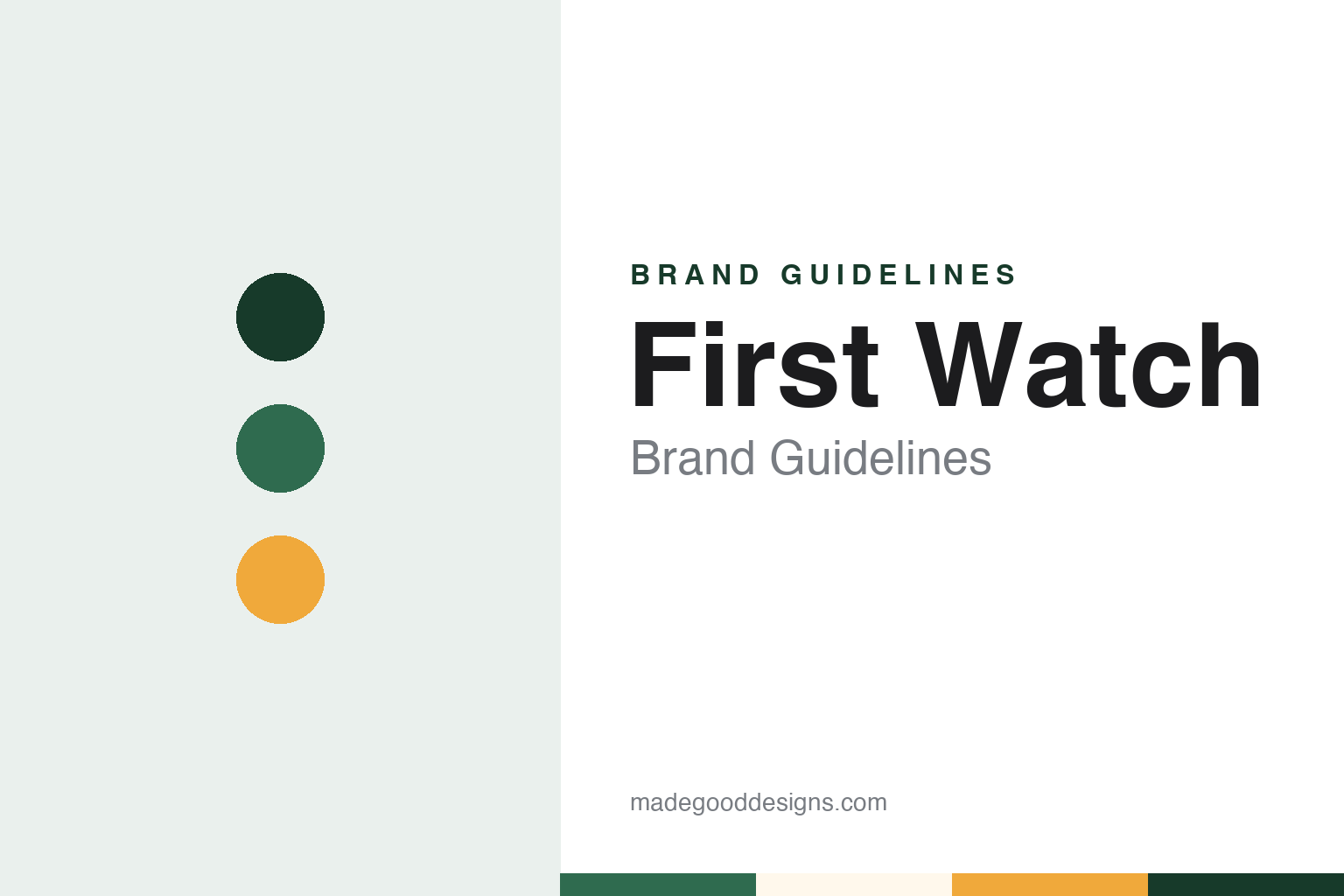
First Watch Brand Guidelines
A daytime café named for the first shift aboard a ship.
Aa
Two constants: a herb green, morning sun and cream palette and a warm café serif register. Abstract homage — not a First Watch product or mark; no sign, menu or logo is reproduced.
First Watch
Two restaurant managers, a Colorado detour and a Californian café.
First Watch was started by two restaurant managers. The Tampa Bay Times, in a profile published on 26 March 2012, reported that Ken Pendery and co-founder John Sullivan had been seafood and steakhouse chain veterans who in 1981 helped launch a breakfast-and-brunch chain in Colorado called Le Peep, and that after a falling-out with its owners they joined forces to start First Watch. The paper said the founders had tired of the long hours and frequent relocations that came with their management jobs at another chain, and liked the idea of serving only breakfast and lunch.
English Wikipedia places the first First Watch restaurant in Pacific Grove, California, and dates its opening to 1983. The company’s own history page, as archived in October 2017, also starts the story “back in 1983”, when the original First Watch opened from 7 a.m. to 2:30 p.m. Wikipedia says the founders moved their headquarters to Bradenton, Florida, in 1986. Later reports place it in the same part of Florida’s Gulf Coast: the Times in 2012 called it the Bradenton “daytime cafe” chain, the Sarasota Herald-Tribune in 2011 described it as Lakewood Ranch-based, and Restaurant Business in 2021 described it as based in University Park, Florida.
The hours are the brand. The Tampa Bay Times quoted Pendery recalling that the plan was to be open from 7 a.m. to 2:30 p.m. and “be on the golf course by 3”, and Restaurant Business reported in September 2021 that the restaurants still kept those hours as a single shift, which the company believed helped it recruit staff. The 2012 Times profile listed eggs Benedict, egg-white omelets, signature pancakes, crepes and sandwiches on the menu, and reported that the kitchens had no deep-fat fryers, microwaves or heat lamps. Wikipedia ties the choice of name to that same timetable.
Colour
Catterton, Freeman Spogli, Advent International and Nasdaq.
First Watch has passed through several private equity owners. Wikipedia says the private equity firm Catterton Partners invested in the company in 2004. The Sarasota Herald-Tribune reported on 23 December 2011 that First Watch Restaurants Inc. had been purchased by Freeman Spogli & Co., which bought it from Catterton. The paper noted that Freeman Spogli’s website listed stakes in consumer businesses such as Sur La Table and Petco and in the restaurant chain El Pollo Loco, and the Tampa Bay Times repeated the change of ownership the following March.
In 2017 the owner changed again. Reuters reported on 27 July 2017 that the private equity firm Advent International had taken a majority stake in the company, which its headline called a U.S. café operator, and Wikipedia records that Advent bought First Watch from Freeman Spogli.
Ownership changes have touched the supply side of the brand as well as the balance sheet. Wikipedia says that in 2018 First Watch began sourcing its coffee from the Huila region of Colombia, with the beans roasted by Royal Cup Coffee, an Alabama company, and it quotes the company describing the programme as support for women coffee growers and their families in Huila.
The company grew partly by buying other breakfast chains and converting them. Wikipedia says First Watch bought The Good Egg, an Arizona chain, in 2014, and acquired the Colorado-based Egg & I restaurants in May 2015, converting some locations of each to the First Watch name.
The company then listed its shares. Restaurant Business reported on 30 September 2021 that First Watch had priced its initial public offering and that its shares would begin trading the next day, a Friday, under the ticker symbol FWRG; Wikipedia records the Nasdaq listing in October 2021. Wikipedia also says the company owns a separate fast-casual café concept in Nashville, Tennessee, called Sun & Fork by First Watch, which carries the parent name as an endorsement.
Typography
Design and documentation.
The brands in this group are fast-casual names: restaurant chains where a customer orders at a counter and the food is made to order, served in a format that sits between a quick-service burger stand and a table-service dining room. A brand of this kind is met in a sequence of small physical things rather than in a single package, and each of them carries the name in a different way.
The storefront sign is usually the first of them, read from a car park, a mall corridor or a street, so a wordmark has to hold up at a distance and often against brick, glass or a shared façade. Inside, the menu board above the counter carries the brand’s type and colour at a much larger scale than anything else, while the cup, the bag and the wrapper take the same mark out of the building and into the street. Some chains add a mascot, which can appear on signs, packaging and advertising alike.
Each guide separates what independent sources record from what the company says about itself — its founding story, its owners over time and how its name, sign and visual identity have changed — and marks plainly what rests only on the company’s own word.
Aa
A warm café serif — the register of a menu card and a morning table. (Specimen set in Fraunces, a serif STAND-IN; NOT the First Watch logo.)
First Watch
A nautical name for a café that keeps morning hours.
The name is the starting point of the First Watch identity. Wikipedia says “First Watch” is a nautical reference to the first work shift aboard a ship, chosen because the restaurants open only in the morning and early afternoon. It is a name about a schedule: a watch is a block of duty time, and the café keeps a single block of trading hours, from 7 a.m. to 2:30 p.m., as both the company’s 2017 history page and Restaurant Business in 2021 recorded.
The company has also used a short tagline. Its archived 2017 “About Us” pages carry the line “Yeah, it’s fresh”, marked as a trademark, beside the history of the 1983 opening. The Tampa Bay Times profile in 2012 described the dining rooms from the operating side, quoting Pendery’s line about the golf course and describing free local newspapers and Wi-Fi for morning coffee drinkers.
The identity has had to absorb other names along the way. When First Watch converted Good Egg and Egg & I restaurants, the nautical name went up over buildings that had carried egg-themed names, and in Nashville the Sun & Fork concept uses “by First Watch” as an endorsement line.
For a design guide, First Watch shows how a borrowed nautical term can stand for a restaurant’s timetable and give a daytime café a name that explains its hours. Compare it with Sweetgreen and CAVA, two other listed restaurant brands built on a short, distinctive name. For this guide we use herb green, morning sun and cream with a serif, an unofficial interpretation; no product or logo is reproduced.
Explore & save
Keep First Watch’s identity on hand — save it to a board in the Made Good inspiration library.
First Watch identity set
Pin the First Watch herb green, morning sun and cream palette and the warm café serif register to your own board.