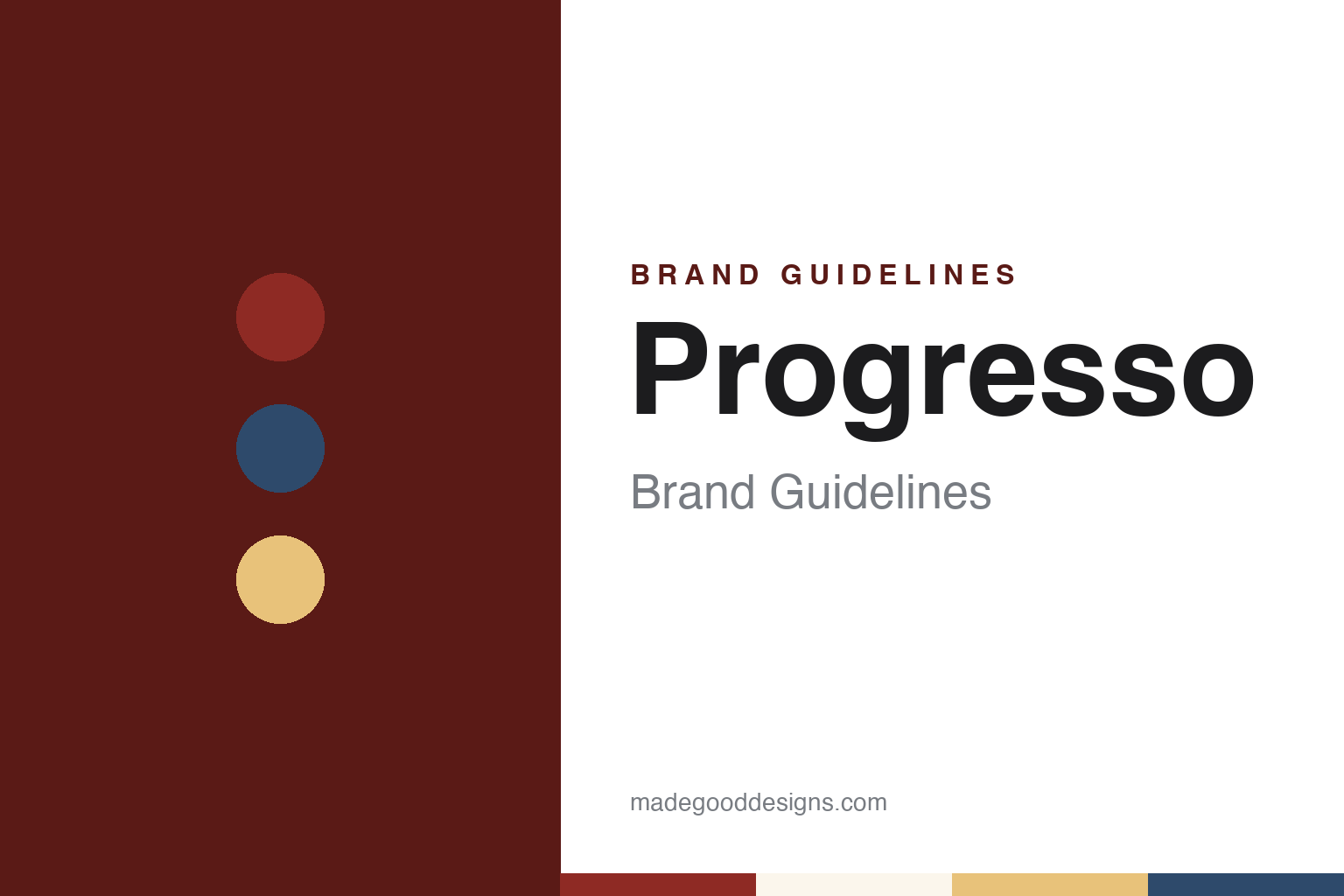
Progresso Brand Guidelines
Two Italian importing families in New Orleans, one name meaning “progress”.
Aa
Two constants: a tomato red, harbour blue and olive-oil gold palette and a bookish serif register. Abstract homage — not a Progresso product or mark; no can, label or logo is reproduced.
Importers before canners
Two family businesses in one port city.
Progresso began in the import trade of New Orleans. The brand’s own history, as published on a Progresso website in the early 2010s, says the Uddo and Taormina families emigrated from Italy to the United States and missed the foods of home so much that they began shipping olive oil from Italy, first for themselves and then for friends and family. The company says V. Taormina and Company was set up as an importing business in New Orleans in 1905, and that Joseph Uddo started his own importing business in the same city in 1913.
The two businesses joined forces in 1925. English Wikipedia gives that year as the brand’s founding and names Vincent Taormina and Giuseppe Uddo as the founders; the company timeline says the merger formed the Uddo and Taormina Corporation. The same timeline describes a second step in 1927, when the families opened another importing business in New York City that soon joined the New Orleans operation, and says that this was when the Progresso Italian Food Company was born. A summary on the same page calls Vincent Taormina “a young Sicilian” who first imported foods from Italy for Italian-American customers, and says the business merged in 1927 to become the Progresso Italian Food Corporation, “and the Progresso label was born”. Wikipedia dates the company to 1925; the company’s own account dates the name to 1927.
War changed the business from importing to packing. The company says that in 1942, when bringing goods across the ocean became extremely difficult, Progresso decided to pack products domestically, naming peppers, olives, eggplant caponata and beans, and delivered them door to door to neighbourhood shops. In the same year, the company says, the New York operation ran short of produce and manufacturing space, and Progresso moved to Vineland, New Jersey, a farming area the owners chose for its farmland, about a mile from the site of the plant the company was describing at the time. The company says many generations of the two families were involved in the day-to-day running of the plant.
Soup arrived after the war. The company timeline places Progresso’s first soups between 1949 and 1959 and credits them to “Mama Taormina”, naming Minestrone, Lentil, Mac and Bean (pasta e fagioli) and Escarole, recipes it says were written on the wall of the plant. The company says that from 1974 soup steadily replaced seasonal, co-packed and imported products, and that by 1983 Progresso had become known in the industry as a soup company with an Italian heritage.
Colour
From family firm to General Mills.
The families’ ownership ended in the late 1970s. English Wikipedia, citing a report in The New York Times of 27 February 1979, says the Ogden Corporation bought Progresso that year. By 1986 Progresso sat in a division called Ogden Foods: the Los Angeles Times reported on 21 October 1986 that Ogden Foods, which sold soups, sauces and other items under the Progresso, Hain, Hollywood and Las Palmas brands, was being bought for cash by IC Industries of Chicago, whose chairman said the deal would complement the specialty foods marketed by Pet Inc., which IC Industries had owned since 1978.
From Pet the brand moved to Pillsbury. Wikipedia, citing The Buffalo News, says Pet was acquired in 1995 by the Pillsbury Company, then a subsidiary of the British group Grand Metropolitan; the company’s own timeline gives 1996 as the year Pillsbury acquired Progresso. Grand Metropolitan later became part of Diageo, and The Guardian reported on 17 July 2000 that Diageo was expected to announce the merger of its Pillsbury food unit with General Mills. The company timeline says General Mills merged with Pillsbury in 2001, and Progresso has been a General Mills brand since then. Into the 2010s the Progresso website carried a copyright line in the name of Pet Incorporated alongside General Mills trademark notices; the current site carries a 2026 General Mills copyright.
The range has grown well beyond the early Italian soups. The company timeline records a move into broth in 2008, a panko bread crumb in the same year and a line of Mexican-inspired soups in 2010. Today’s Progresso website groups its products into soups, broth, bread crumbs and panko, beans, artichokes and clam sauce. General Mills also owns Old El Paso.
Typography
Design and documentation.
The brands in this group are American pasta-sauce, soup and broth names, the kind sold from the pantry aisle in jars, cans and cartons rather than made fresh in a kitchen. Many began with a person or a place — a family recipe, a restaurant, a hotel dining room or a small regional company — and several have since passed through large food groups, sometimes more than once.
On the shelf, these brands are usually recognised before they are read. A jar label with a family name or a painted scene, a can with a long-kept colour band, or a carton with a plain sans-serif name can carry a brand further than any single recipe. Many lean on a founding story, using a surname, a city or a restaurant to promise that what is in the pack still tastes as it did where it began.
Each guide separates what independent sources record from what the company says about itself — who founded the brand, who owns it now, where its products are made and how its labels and advertising have changed — and marks plainly what rests only on the company’s own word.
Aa
A bookish serif — the register of an Italian name set on a pantry label. (Specimen set in Libre Baskerville, a serif STAND-IN; NOT the Progresso logo.)
A seal and a word
A name chosen to mean forward motion.
The brand’s name was meant as a statement. In its own history the company says the company seal and the name Progresso, which it glosses as Italian for “progress”, were designed to communicate a vision of progress, which it calls a cornerstone of the Progresso philosophy. The company’s account places the name and seal in the 1920s, when the business still traded mainly in imported olive oil, tomatoes and other Italian staples rather than soup.
The company has also framed the brand around family cooking. Its timeline credits the first soups to recipes from the Taormina family kitchen and describes the same ingredients and methods being used in the plant as in homemade soup, with the recipes written up on a wall. That domestic story sits alongside the commercial history that took the brand from two importing families to Ogden, Pet, Pillsbury and finally General Mills.
The identity has had to stretch across a long product list. A brand that began as a seal on imported goods now appears on soup cans, broth cartons, bread-crumb canisters, beans, artichokes and clam sauce, and the current website organises the soups into named families of its own. The present-day site also lists a product bundle under the name “Homemade Never Tasted So Good”.
For a design guide, Progresso shows how a single Italian word chosen by two importing families in the 1920s can outlast four changes of corporate owner and a move from olive oil to soup. Compare it with Campbell’s, another American canned-soup name, and Old El Paso, a fellow General Mills brand. For this guide we use tomato red and harbour blue with olive-oil gold on paper with a serif, an unofficial interpretation; no product or logo is reproduced.
Explore & save
Keep Progresso’s identity on hand — save it to a board in the Made Good inspiration library.
Progresso identity set
Pin the Progresso tomato red, harbour blue and olive-oil gold palette and the bookish serif register to your own board.


