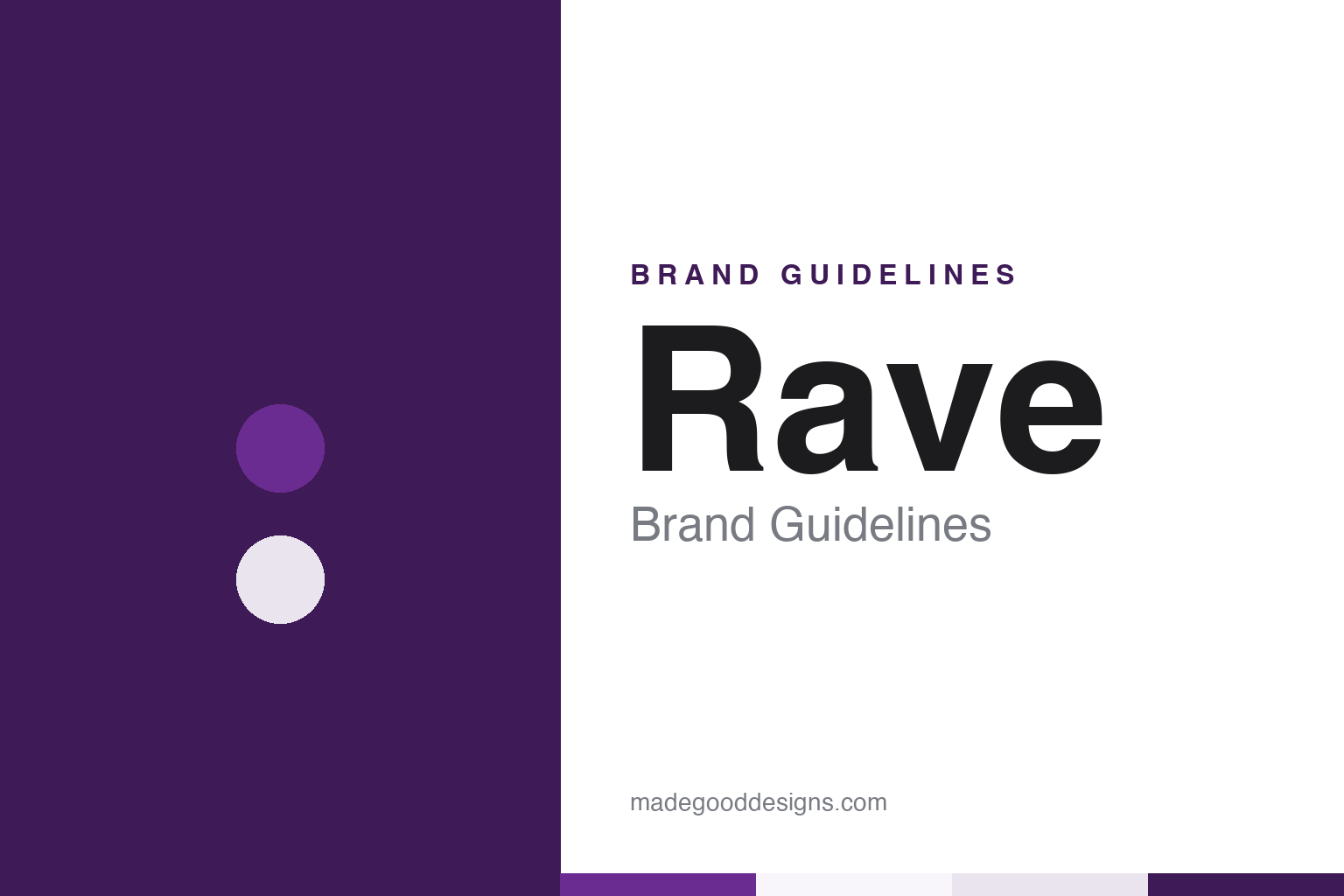
Rave Brand Guidelines
A Greenwich consumer-goods name for a home perm, later a hairspray brand traded between investors.
Aa
Two constants: a violet, plum and lilac palette and a heavy grotesque register. Abstract homage — not a Rave product or mark; no can, label or logo is reproduced.
Chesebrough-Pond’s
A petroleum-jelly company, a cold-cream company and a new hair name.
Rave began inside one of the older names in American toiletries. The International Directory of Company Histories (volume 8, St. James Press, 1994) traces Chesebrough-Pond’s to a merger in 1955 between the Pond’s Extract Company and Chesebrough Manufacturing Company, Consolidated. The same history dates Chesebrough Manufacturing to 1880 and says Pond’s had been trading since the 1870s, and it describes both businesses as having been started by chemists who set out to make household products. The merged company’s address in that history was in Greenwich, Connecticut, and its brands included Vaseline petroleum jelly, Pond’s creams and Q-Tips swabs.
The brand itself dates from 1978. The company history, written while Chesebrough-Pond’s was still trading under that name, says the company “had a knack for new products and promotions”, and it records that in 1978 Chesebrough released a home permanent product called Rave. In the same passage it describes the company’s work in the 1970s on Vaseline Intensive Care lotion, which places Rave among a group of personal-care launches from the same decade rather than as a stand-alone venture.
The name is a single, short English word. It carries no founder’s surname and no place, and it was attached at the start to a perm kit sold for use at home. Later owners used the same word for a range of hair-styling products, so the earliest meaning of the brand and its later meaning differ: what began as a home perm is now sold as a hairspray and mousse line. The word itself has stayed the same through each of those changes, and later owners built their advertising copy around it.
Ownership of Rave changed initially with its parent. The company history records that Chesebrough-Pond’s, weakened by its purchase of the Stauffer Chemical Company, agreed in December 1986 to a takeover bid from the Anglo-Dutch group Unilever, and it dates the takeover to that year. From then on, Rave was part of Unilever’s American personal-care business, alongside Vaseline and Pond’s, for roughly a quarter of a century.
Colour
From Unilever to High Ridge Brands and Sodalis.
The next sale came as a side effect of another deal. On 24 August 2011, The New York Times’ DealBook reported that Unilever had agreed to sell several hair-care brands to meet the United States Justice Department’s conditions on its purchase of Alberto-Culver. Unilever, the report said, was selling the Alberto VO5 brand in the United States and Puerto Rico, and the Rave brand globally, to Brynwood Partners, a private equity firm founded in 1984 and based in Greenwich, Connecticut. English Wikipedia’s Alberto-Culver article records that Unilever agreed to buy that company on 27 September 2010, citing Bloomberg News.
Brynwood held Rave through a portfolio company. A press release issued by Brynwood Partners VI and The Sun Products Corporation on 26 June 2012 explains that High Ridge Brands Co. was formed by Brynwood in January 2011 to buy the North American Zest soap brand from Procter & Gamble, and that in August 2011 High Ridge Brands acquired “the worldwide marketing and brand rights to the Rave brand” from Unilever. The same release records the company’s purchase of Coast from Henkel in March 2012 and announces its agreement to buy White Rain from Sun Products. High Ridge Brands’ chief executive, James Daniels, named Zest, Coast, Alberto VO5 and Rave as the portfolio White Rain would join.
Control of High Ridge Brands changed again within a few years. English Wikipedia’s Brynwood Partners article says the New York investment firm Clayton, Dubilier & Rice acquired a controlling stake in June 2016, and an archived High Ridge Brands brands page from October 2017 describes the company as a portfolio company of Clayton, Dubilier & Rice, based in Stamford, Connecticut. English Wikipedia’s Coast article records that High Ridge Brands filed for bankruptcy in 2019, and its White Rain article dates the sale of White Rain to International Wholesale to February 2021.
The current owner is Italian. On 16 September 2024, Sodalis Group announced that it had agreed to acquire the brands of High Ridge Brands, creating Sodalis USA and Sodalis Mexico, with a team based in Westport, Connecticut, and Mexico City; the group said manufacturing is outsourced to a network of contractors in the United States and Mexico, and it expected the deal to close by the end of October 2024. Sodalis has owned Rave since 2024: the Sodalis USA website lists Rave among its hair-care brands, with Alberto VO5, LA Looks, Salon Grafix, Thicker Fuller Hair and Pert.
Typography
Design and documentation.
The brands in this group belong to the bathroom shelf: deodorants and antiperspirants, hairsprays and face scrubs. Personal-care brands of this kind sit at many different points in the trade, from names that still carry the place or the people who started them to labels that have passed through several owners and now belong to much larger consumer-goods groups.
A brand of this kind is usually carried less by a single formula than by a container and a name: a twist-up stick, a pressurised can, a squeezable tube, each with a label that has to be read at a glance on a crowded shelf. The company behind the name may have changed hands, moved its production or redrawn its packaging several times. That makes the questions behind each name worth asking plainly: who started it, who owns it now, and how its cans, sticks and tubes have looked over time.
Each guide separates what independent sources record from what the company says about itself — its founding story, its owners over time and how its labels and advertising have changed — and marks plainly what rests only on the company’s own word.
Aa
A heavy grotesque — the register of a short, four-letter brand name set large on a can. (Specimen set in Archivo Black, a heavy grotesque STAND-IN; NOT the Rave logo.)
Get Rave reviews
A pun on the name, a hashtag and a small range of cans.
The brand’s recent voice is built on its own name. An archived copy of the Rave website from March 2018, then run by High Ridge Brands, carried the page title “Get Rave Reviews on Your Hair!” and invited shoppers to share their #RaveReviews on social media. The phrase turns the brand name back into the ordinary English idiom it comes from, so that the word on the can and the line in the advertising are the same word. The site’s menu, coupon pages and product pages all repeated the name rather than a separate slogan.
The range on that site was small and named plainly. The 2018 product menu listed Rave Aerosol, Rave Non-Aerosol, Rave Mega Freeze and Rave Mousse, and the home page announced a new Rave Volumizing Mousse. An archived High Ridge Brands page from October 2017 listed the brand in its sign-up form as “Rave Hairspray” and named a product line as Rave with ClimaShield. Those names describe the product by format — aerosol can, pump bottle, mousse — and leave the brand word at the front of every product name.
That pattern runs through the brand’s history. The word Rave was used, according to the company history, on a home permanent in 1978; under High Ridge Brands it was used on hairsprays and a mousse; and under Sodalis it sits on a list of hair-care names beside VO5 and Pert. The parent names have changed more often than the brand: Chesebrough-Pond’s, Unilever, High Ridge Brands under Brynwood Partners and then Clayton, Dubilier & Rice, and Sodalis USA. Across those owners, the sources describe one constant, the single word itself, used as a product name, a pun and a hashtag.
The brand also sits in a particular corner of the American shelf. The 2012 Brynwood release places Rave beside Zest, Coast, Alberto VO5 and White Rain, and the Sodalis USA website now groups it with other long-running hair-care names sold in mass-market stores. For a design guide, Rave shows how a one-word brand can travel from a home-perm kit to a hairspray can, and through several owners, while keeping the same word at the centre of its packaging and its advertising. Compare it with White Rain, which shared an owner with Rave from 2012 to 2021, and Aqua Net, another American hairspray brand. For this guide we use can violet and deep plum on mist lilac with a heavy sans, an unofficial interpretation; no product or logo is reproduced.
Explore & save
Keep Rave’s identity on hand — save it to a board in the Made Good inspiration library.
Rave identity set
Pin the Rave violet, plum and lilac palette and the heavy grotesque register to your own board.