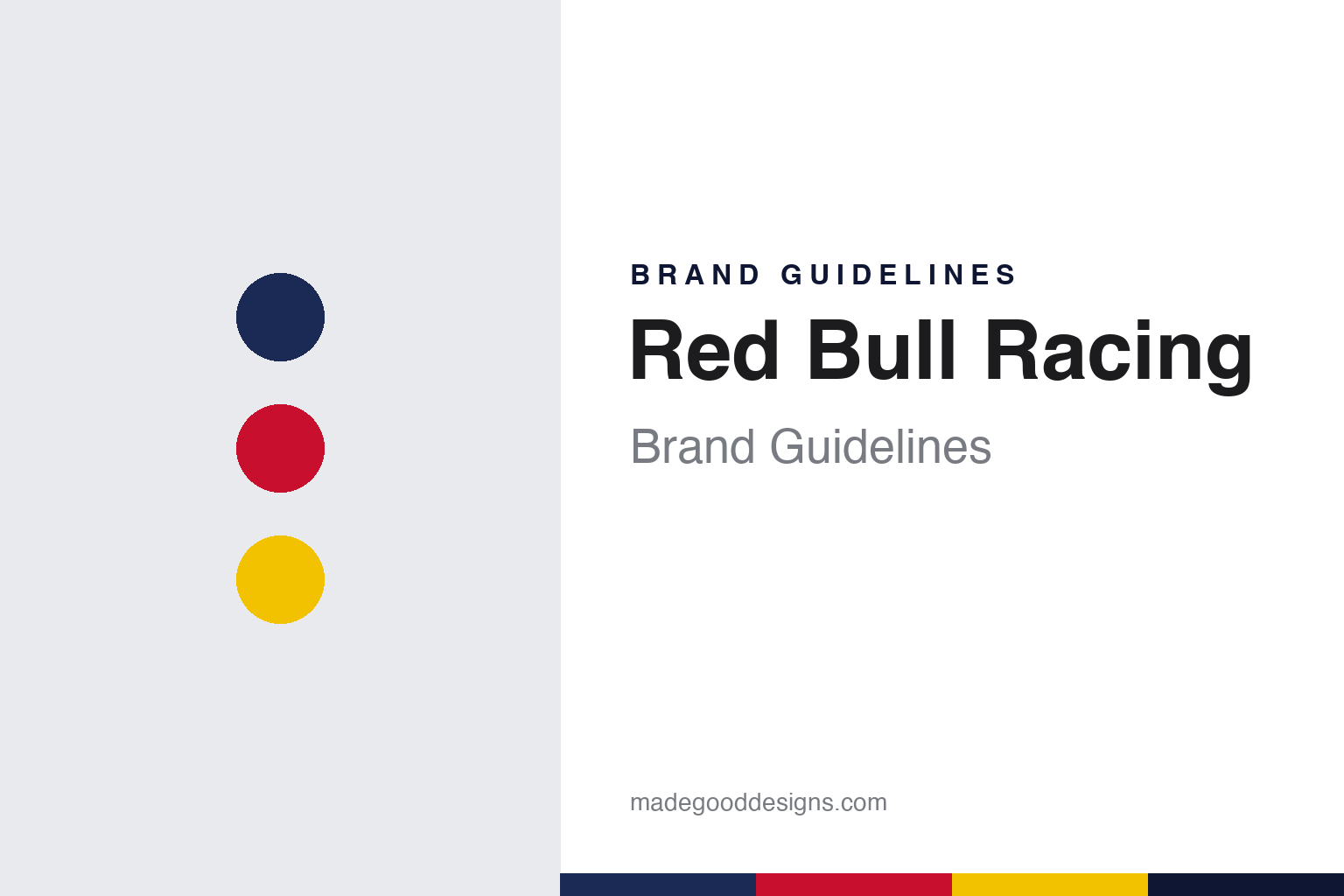
Red Bull Racing Brand Guidelines
An energy-drink name, a Jaguar team and a car that changes every winter.
Aa
Two constants: a livery navy, bull red and sun yellow palette and a condensed pit-board sans register. Abstract homage — not a Red Bull Racing product or mark; no car, livery or logo is reproduced.
Red Bull Racing
A team that has worn three names on the same site.
The team now known as Oracle Red Bull Racing did not start under the Red Bull name. English Wikipedia traces it back to Stewart Grand Prix, the outfit set up by Jackie Stewart that made its Formula One debut in 1997. Late in 1999 Stewart sold the team to the Ford Motor Company, which renamed it Jaguar Racing so that its British luxury marque would carry the entry. The Jaguar team was run from Milton Keynes, in England.
Ford then decided to leave. On 15 November 2004, Grandprix.com reported that the Austrian energy-drink company Red Bull had taken over Jaguar Racing. The report quoted Red Bull’s owner, Dietrich Mateschitz, telling the Austrian newspaper Salzburger Nachrichten: “It is true. We bought Jaguar Racing at the weekend.” The same report said the sale secured the future of the staff at Milton Keynes, that Mateschitz had no short-term plans to change the management, and that the team would keep its Cosworth V10 engines for the coming season. Wikipedia says the team, renamed Red Bull Racing, began racing under its new owner in 2005.
The purchase changed what the Red Bull name meant in Formula One. Before 2004 the drink had been a sponsor; Grandprix.com noted that the deal was bad news for Sauber, which now had to replace Red Bull as a backer. Afterwards the brand owned a team outright, and its colours, logos and marketing could run through the whole car rather than a set of stickers on someone else’s. Wikipedia describes the team today as one of two Formula One teams owned by the Austrian company Red Bull GmbH, the other being Racing Bulls.
The base has stayed where it was. Wikipedia lists the team at Milton Keynes, Buckinghamshire, and it races under an Austrian licence while working from England. For the drinks brand behind the team, see our Red Bull guide.
Colour
A navy car with the drink’s bulls on its flanks.
The Red Bull Racing livery borrows directly from the drink, built on the brand’s corporate blue, red and yellow. Because the team is owned by the drinks company, there is no conflict between the team brand and its main backer: that backer is the team’s parent, and the car works as a moving version of the can. The finish has changed over the years. Crash.net, in a report by Ollie Barstow on the livery unveiled in February 2016 for the RB12, said the team had dropped the purple shades of its recent cars for more of the brand’s corporate blue, red and yellow, that the chrome finishes of previous years had been replaced by a more understated matte finish with fluorescent detailing, and that Red Bull branding returned more prominently to the sidepods once Infiniti’s deal had ended. The same report named TAG Heuer, which was branding the team’s Renault engine, and Puma among the new partners on the car.
The team name, though, has been shared with other partners. Wikipedia says the Nissan group’s premium brand Infiniti joined as an official partner for 2011 and 2012, with Infiniti logos on the race car, the drivers’ overalls and team kit, and that for 2013 the team was renamed Infiniti Red Bull Racing after Infiniti became its title partner.
Aston Martin followed. Wikipedia says a technology partnership with Aston Martin was announced on 17 March 2016. Motoring Research, in a report by Richard Aucock dated 25 September 2017, said Aston Martin would become the team’s title sponsor from 2018, as Aston Martin Red Bull Racing, and that the two companies’ innovation partnership had already produced the Aston Martin Valkyrie hypercar. The same report said a new Advanced Performance Centre would open on the team’s campus in Milton Keynes. Wikipedia adds a piece of livery play from that period: at the 2019 British Grand Prix, logos for the film character 007 replaced the Aston Martin logos on the cars.
The current name dates from 2022. Raceweek, in a report by Andrew Rickert dated 11 February 2022, said the team had shown a tweaked livery and its new title sponsor, the software company Oracle, at its 2022 season launch, hosted from its technology campus in Milton Keynes. Motorsport Week reported that the team would officially be called Oracle Red Bull Racing from 2022, with large Oracle decals on the car, including the sidepods and rear wing.
Typography
Design and documentation.
A racing team’s identity has to work at speed and at a distance. The livery is the main canvas: a base colour chosen to read on a television screen, a handful of accent tones, and large flat areas where partner marks sit. Because the cars change shape from season to season, a livery is redrawn every year, and teams tend to keep the colour logic constant while the graphics move around the bodywork.
Sponsor placement follows the camera. The engine cover, the sidepods, the front and rear wings and the driver’s helmet are the spots often seen in broadcast and photographs, so title partners usually occupy them, while smaller marks fill the nose, mirrors and endplates. The same hierarchy carries over to race overalls, team kit and caps, where chest, sleeve and collar positions are allotted to partners in a similar order.
The team wordmark then ties the system together. It appears on the car, on garage back walls, pit boards, motorhome hospitality units, transporter trucks and merchandise, and it often has to accommodate a title sponsor’s name that may change with each new contract. In the garage, colour-matched panels, tool chests and floor graphics turn a working space into a branded set for the cameras.
Aa
A condensed pit-board sans — the register of a car number and a garage wall. (Specimen set in Barlow Condensed, a sans-serif STAND-IN; NOT the Red Bull Racing logo.)
Red Bull Racing
The parent brand on the bodywork, the partner in the name.
Red Bull Racing’s identity works in two layers. The visual layer belongs to the drink: its corporate blue, red and yellow and its Red Bull lettering return year after year, even as the shape of the car is redrawn under new technical rules. The naming layer belongs to the title partner of the day. Infiniti, Aston Martin and Oracle have each taken the space in front of “Red Bull Racing”, and each has had its logos on the car during its term, while the colour scheme underneath has stayed recognisably the same.
That arrangement is clearest at a season launch. Raceweek described the 2022 launch as showing a tweaked livery rather than a new one, with the change carried by Oracle’s logos. The car on show was a mule car carrying a new race number, and the event was staged from the team’s own campus, so the building, the car and the name all appeared together.
The engines have also carried names. Wikipedia lists the current constructor as Red Bull Racing-Red Bull Ford, reflecting a power-unit arrangement with the Ford Motor Company for the 2026 season. That puts the name of the company that once owned the team as Jaguar Racing back into the entry.
For a design guide, Red Bull Racing shows how a consumer brand can turn a sponsorship asset into a whole team identity, and then rent out the front of its own name without losing its colours. Compare it with the Red Bull drinks brand whose bulls it wears, the Formula 1 series identity, and the Williams Racing and Mercedes-AMG Petronas teams. For this guide we use livery navy, bull red and sun yellow with a condensed sans, an unofficial interpretation; no product or logo is reproduced.
Explore & save
Keep Red Bull Racing’s identity on hand — save it to a board in the Made Good inspiration library.
Red Bull Racing identity set
Pin the Red Bull Racing livery navy, bull red and sun yellow palette and the condensed pit-board sans register to your own board.