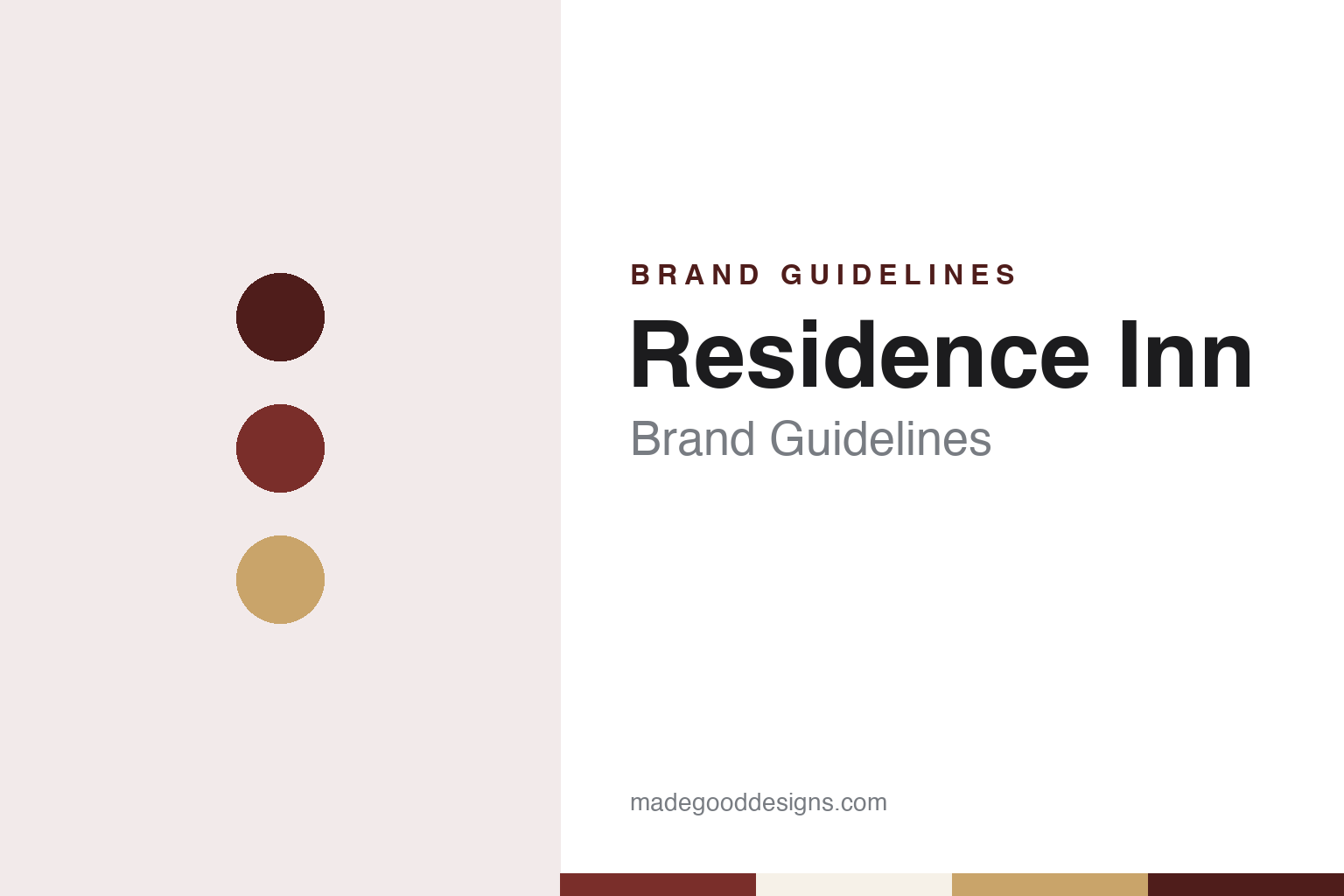
Residence Inn Brand Guidelines
The Wichita apartment idea that became a hotel brand.
Aa
Two constants: a brick red, prairie wheat and hearth cream palette and a domestic text serif register. Abstract homage — not a Residence Inn or Marriott asset; no sign, logo or building is reproduced.
The Residence
An apartment builder turns his flats into hotel rooms.
Residence Inn started as an apartment building. English Wikipedia says the chain traces its roots to 1975, when the Wichita, Kansas, developer Jack DeBoer found himself with apartment properties facing high vacancy rates. He converted the units in one building to monthly rentals and named it The Residence. DeBoer, who came from Kalamazoo, Michigan, had joined his father’s real-estate business after military service, and the two built homes before moving into apartments, according to Wikipedia’s article on him.
DeBoer described the logic himself in an interview with Business Jet Traveler in April 2010. “Apartments weren’t making money,” he told the magazine, and he reasoned that if he could build an apartment he could sell like a hotel, it would work. The magazine dated the first Residence Inn to 1975 and said he expanded it into a chain before selling it to Marriott in 1987. Wikipedia’s article on DeBoer dates the first Residence Inn in Wichita to 1976 and says he opened it with Robert L. Brock.
The partnership with Brock gave the chain its full name. Wikipedia’s article on the brand says DeBoer and Brock, a developer and Holiday Inn franchisee, formed a joint venture in 1981 to launch a chain called The Residence Inn. The hotels were aimed at guests staying five nights or more who did not need daily maid service in the conventional hotel manner, and Wikipedia says the guests were mainly business travellers on long work assignments, patients of nearby hospitals and people in need of temporary housing.
The connection to Holiday Inn ran through Brock and then through ownership. The International Directory of Company Histories (St. James Press, 1994) says that in 1985 Holiday Inns’ parent company, soon to be renamed Holiday Corporation, acquired a 50 per cent interest in what it calls the Brock Residence Inn chain, and that the company later sold its interest in Residence Inns. Wikipedia dates the Holiday purchase to January 1985.
Colour
Holiday Corporation, then Marriott.
Holiday Corporation did not keep its stake for long. The International Directory of Company Histories places the sale of its Residence Inn interest in the period after a 1986 recapitalisation, at the same time as it was opening a new casino at Lake Tahoe and preparing to found its own extended-stay chain, Homewood Suites, which it launched in March 1988. Wikipedia says DeBoer bought back Holiday’s interest in early 1987.
He then sold the whole company. Wikipedia’s article on the chain says DeBoer sold Residence Inn to Marriott on 7 July 1987, and its article on DeBoer says the chain was sold to the Marriott Corporation that year and renamed Residence Inn by Marriott. Business Jet Traveler also dates the Marriott sale to 1987. Marriott has owned the brand since that year, and it sits in Marriott’s portfolio alongside names such as Courtyard by Marriott.
DeBoer went on to build other chains in the same format. Wikipedia says he founded Summerfield Suites, later part of Hyatt, the Candlewood Hotel Company in 1995, Value Place in 2003 and WaterWalk, and Business Jet Traveler said in 2010 that he had co-founded the Summerfield Hotel Corporation a year after the Marriott sale and launched Candlewood in 1995. Wikipedia’s article on Residence Inn says the original Wichita property is still operated by DeBoer’s company under the WaterWalk name, now under the Wyndham flag.
DeBoer also wrote about his career. Wikipedia says he published a book in 2011, Risk Only Money: Success in Business Without Risking Family, Friends and Reputation, about the lessons of his business life. In the 2010 Business Jet Traveler interview he said the buyers of his chains had valued the businesses more highly than he had, which was his reason for selling them rather than keeping one and expanding it.
Typography
Design and documentation.
The hotel names in this group work at many different scales at once. A single brand can be read from a motorway sign at night, from a canopy over a front door, from a lobby wall and from a plastic key card that fits in a wallet, and each of those surfaces asks something different of the same mark. A name that sits comfortably in illuminated letters on a roofline has to survive being printed small on a door hanger or a folded room-service card.
A hotel brand’s identity is also carried by spaces as much as by graphics. Lobbies, corridors, room furnishings, uniforms and printed room collateral are all places where a name, a colour or a typeface can appear, and a hotel that carries a brand name may be built, owned or run by a company other than the one that owns the name. That makes the questions behind each name worth asking plainly: who started it, who owns it now, and how the name and its mark have changed over time.
Each guide separates what independent sources record from what the company says about itself — its founding story, its owners over time and how its signs and marks have changed — and marks plainly what rests only on the company’s own word.
Aa
A calm text serif — the register of a lease, a key card and a kitchen notice. (Specimen set in Source Serif 4, a serif STAND-IN; NOT the Residence Inn logo.)
A name in three stages
From an apartment block’s name to a hotel brand.
The Residence Inn identity can be read as a sequence of names, each added to the last. The first was The Residence, the name Wikipedia says DeBoer gave his converted Wichita apartment building in 1975. The second was The Residence Inn, the chain he launched with Robert L. Brock, according to Wikipedia in 1981. The third came with the sale of 1987, when the chain was renamed Residence Inn by Marriott and took on the endorsement of its new owner, as Wikipedia records in its article on DeBoer. The definite article dropped away along the way, while “Residence” stayed at the front of the name through every stage.
The rooms were planned for people staying a week or more, and Wikipedia describes the target guests as travellers on long work assignments, hospital patients and people needing temporary housing. DeBoer’s own account to Business Jet Traveler in 2010 put the idea in a single line: an apartment that could be sold like a hotel.
The brand also sits inside a wider family history. It shared an owner with Holiday Inn for a short period in the mid-1980s, when Holiday Corporation held half of the chain, and Holiday then built its own extended-stay chain, Homewood Suites, which later passed to Hilton. Since 1987 Residence Inn has been a Marriott brand.
For a design guide, Residence Inn shows how a hotel brand can carry the vocabulary of housing into hospitality: a name taken from an apartment block, rooms planned for long stays and an owner’s endorsement added at the end, with the original word left in first place throughout. Compare it with Marriott, its owner since 1987, and Westin, another Marriott hotel brand. For this guide we use brick red, prairie wheat and hearth cream with a serif, an unofficial interpretation; no product or logo is reproduced.
Explore & save
Keep Residence Inn’s identity on hand — save it to a board in the Made Good inspiration library.
Residence Inn identity set
Pin the Residence Inn brick red, prairie wheat and hearth cream palette and the domestic text serif register to your own board.