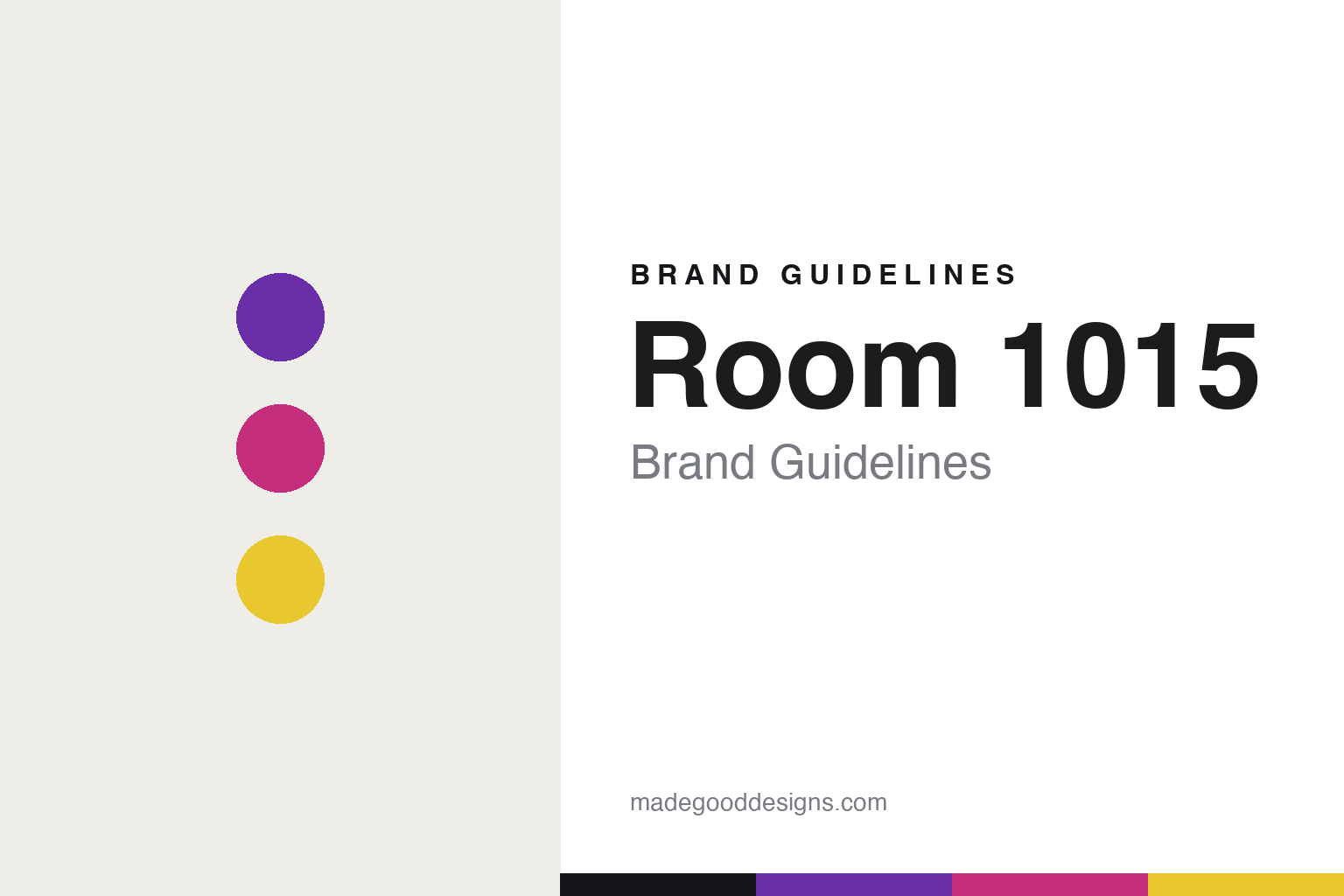
Room 1015 Brand Guidelines
Olfactory counterculture.
Aa
Two constants: a psychedelic purple palette and a rock-poster display spirit. Abstract homage — not the Room 1015 wordmark or bottle.
Olfactory counterculture
Room 1015 bottles rock-and-roll.
Room 1015 is a lesson in a subculture as a brand. Founded in 2014 (and launched in 2015) in Paris by Michael Partouche — “Dr. Mike,” a pharmacology PhD and former rock guitarist — it makes fragrance as “olfactory counterculture”: rock-and-roll, psychedelia and nostalgic freedom. Its origin scent, Electric Wood, captures the smell of a guitar case (wood, lacquer, metal).
The name is pure rock lore: Room 1015 of the Continental Hyatt House on LA’s Sunset Strip — the “Riot House,” where Led Zeppelin, The Who and the Rolling Stones stayed (and Keith Richards, legend has it, redecorated). The design matches: bold, provocative, psychedelic-rock, vintage-70s, album-art imagery, with purple and psychedelic tones recurring; an early discovery kit even came with a transparent vinyl record.
(Honest notes: Room 1015 is independent and founder-led, based in Paris (not Grasse), with perfumer collaborators. The Riot House / Keith Richards tale is rock legend, not documented history; and “Sweet Leaf,” despite the name, is an herbal-floral scent, not literally cannabis. No official brand hex is published.)
Colour
Room 1015 lives in psychedelic purple. Click a swatch to copy the hex.
Room 1015’s identity is bold, psychedelic and rebellious — a purple, a magenta, an acid yellow, an off-white, and a black. The palette is psychedelic purple with bold clashing brights and black, the register of 1970s rock posters and album art. It signals a counter-cultural, rebellious, music-driven world rather than luxury restraint. The honest caveat: with no published brand hex, these tones are an original, unofficial interpretation, not first-party values.
The lesson is psychedelic colour signals counterculture. Room 1015’s world is a 1970s rock poster. For designers, it is a reminder that bold, psychedelic colour — purples and clashing brights — plus album-art references can evoke a whole subculture and era. The takeaways: use psychedelic, clashing colour for rebellion; borrow from music/album-art visual language; and treat any single hex as unofficial — using a deep purple for small text so the brights stay loud.
Typography
The wordmark spirit is a rock-poster display — bold and rebellious.
Room 1015’s identity carries a bold, rebellious, rock spirit — psychedelic imagery and music references. A tall, condensed rock-poster display captures the mood: it is loud and graphic, the register of a gig poster or album sleeve. Set against psychedelic purple, the display type feels bold and rebellious — exactly the counterculture personality Room 1015 carries. It is loud rather than refined, mirroring 1970s rock design. (Room 1015’s real wordmark and bottles are trademarks and trade dress we describe but do not reproduce, and the exact typeface is not published, so we don’t assert it.) Because the specific mark is not ours to use, the honest description is “a rock-poster display spirit,” not the Room 1015 logo. The type behaves like the brand: bold, rebellious and rock.
Aa
A rock-poster display spirit — bold and rebellious. (Specimen set in Bebas Neue, a condensed display; NOT the Room 1015 logo, which is a trademark.)
A subculture, bottled
Room 1015 stands for rock-and-roll scent.
Room 1015 is a lesson in committing to a subculture. A rock-legend name, olfactory-counterculture concept, psychedelic album-art design and scents like “the smell of a guitar case” build a coherent rock-and-roll world — the subculture is the whole identity. The commitment is the differentiator. The differentiator is a fully-committed rock-and-roll world.
For designers and brand-builders, Room 1015 offers a clear takeaway: a subculture, fully committed, can be a brand. The lessons: pick a world (1970s rock) and commit every cue to it; use its visual language (album art, psychedelia, purple); and tie products to its stories (the guitar case, the Riot House). It is also a reminder to stay accurate: Room 1015 is Paris-based (not Grasse), the Riot House tale is legend, and its founder is a pharmacist-guitarist — with the palette here an unofficial interpretation. Room 1015 bottled a subculture — proof that commitment can be the difference.
Explore & save
Keep Room 1015’s identity on hand — save it to a board in the Made Good inspiration library.
Room 1015 identity set
Pin the psychedelic palette and the rock-poster spirit to your own board.