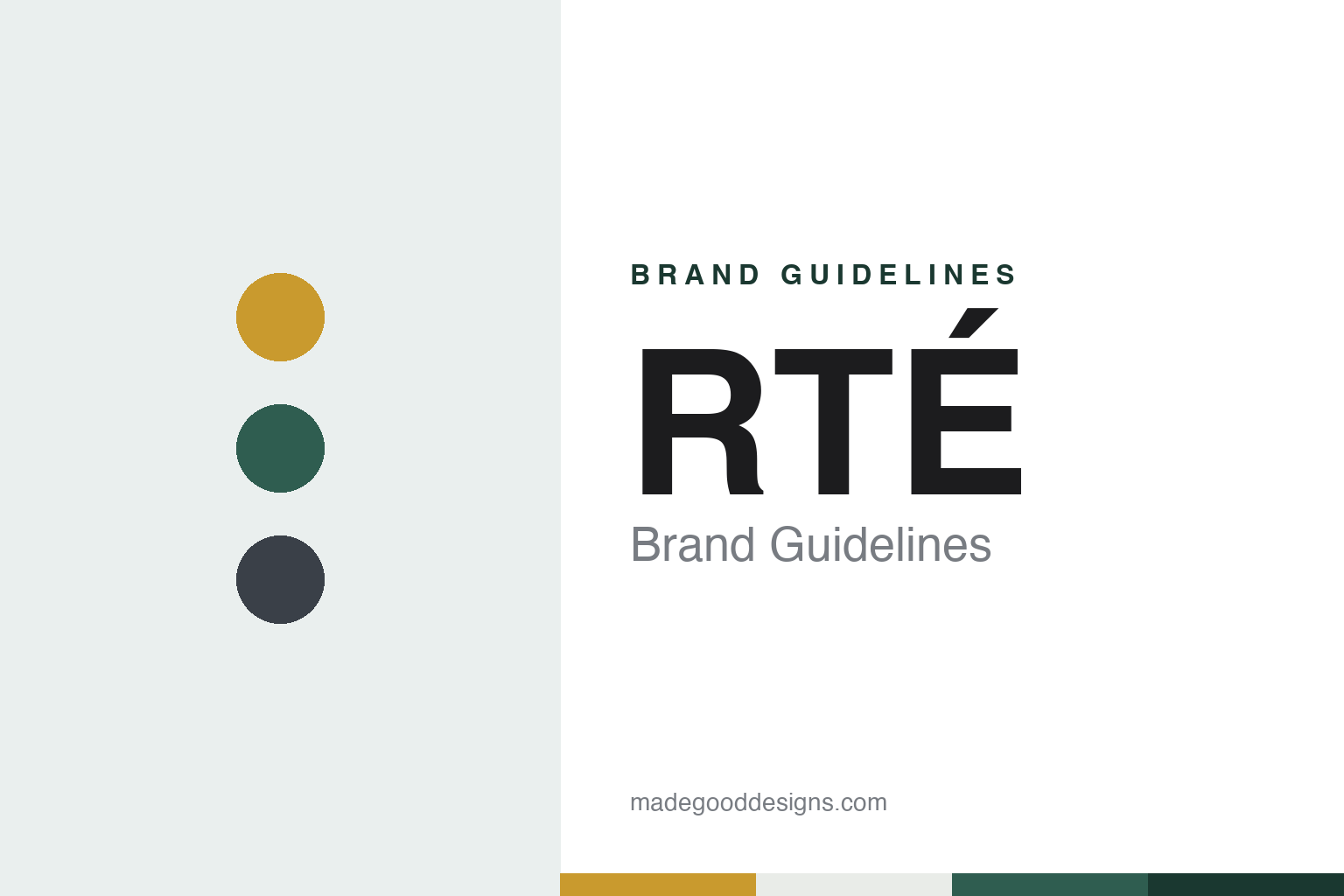
RTÉ Brand Guidelines
Radio from 1926, television from 1961, three letters throughout.
Aa
Two constants: a green, slate and gold palette and a humanist sans register. Abstract homage — not an RTÉ asset or mark; no logo, ident or screen graphic is reproduced.
From a Dublin call sign to a national broadcaster
2RN, Radio Éireann, Telefís Éireann and the joined name.
RTÉ stands for Raidió Teilifís Éireann, Irish for radio and television of Ireland, and the broadcaster’s history runs through several names. English Wikipedia says broadcasting in Ireland began with the radio station 2RN in Dublin. A test broadcast went out on 14 November 1925, when the station director Seamus Clandillon announced in Irish that this was Radio 2RN, Dublin, testing, and regular broadcasting began on 1 January 1926. The service later took the name Radio Éireann; The Irish Times dated that name to 1937 in 2009, while English Wikipedia gives 1938.
Until June 1960 the service was run as a section of the Department of Posts and Telegraphs, English Wikipedia says. On 1 June 1960 the Radio Éireann Authority was set up under the Broadcasting Authority Act 1960. It took over the radio service and was made responsible for the new television service, Telefís Éireann. Television began at 7pm on New Year’s Eve, 31 December 1961, from the Kippure transmitter site near Dublin, the same article says, and the opening night ended with a live concert from the Gresham Hotel in Dublin counting down to the new year.
The joined name came in 1966. English Wikipedia says an amendment act that year renamed the Authority Radio Telefís Éireann, and both the radio and television services became known as RTÉ. The same article says the radio service began moving in 1971 from the General Post Office in central Dublin, its home since 1928, to a purpose-built Radio Centre next to the Television Centre at Donnybrook, where the broadcaster has its headquarters.
The spelling of the full name was corrected decades later. The Irish Times, in a report by Genevieve Carbery dated 20 July 2009, said the name had changed from Radio Telefís Éireann to Raidió Teilifís Éireann under the Broadcasting Act 2009. The new forms followed the standard spellings of “raidió” and “teilifís” in Niall Ó Dónaill’s Irish-English dictionary of 1977 and Tomás de Bhaldraithe’s dictionary of 1959, the report said, quoting the president of Conradh na Gaeilge, Pádraig Mac Fhearghusa. An RTÉ spokeswoman told the paper that all on-air logos read simply RTÉ, so official documents and letterheads would change while the screen stayed the same, and that the broadcaster had its own in-house printing and graphic designer.
Colour
Celtic-script letters, a fada and a cross moved to the letterhead.
The three letters have their own lettering. English Wikipedia says the letters of the RTÉ logo are a modern take on Celtic script, and that in 1995 the logo dropped its Brigid’s cross and placed a fada, the Irish acute accent, on the E. The same article says the cross still appeared on many RTÉ One television idents until 2003 and remains on RTÉ’s headed paper, that a variation of a 1966 cross is used by the broadcaster’s graphic design department, and that since 2004 all RTÉ services have carried the mid-1990s logo as part of their identity.
Channel names moved around the mark. English Wikipedia says the second television channel opened in 1978 as RTÉ2, was rebranded Network 2 in 1988, was branded on screen as part of RTÉ until 1997, when it became N2, and was renamed RTÉ Two in 2004. On the radio side, RTÉ Radio 2 began on 31 May 1979 and is today’s 2fm. The Irish-language television service Teilifís na Gaeilge, later TG4, was launched from Galway in 1996 and was separated from RTÉ on 1 April 2007.
The second channel’s original name came back in 2014. The trade newsletter Promax Daily Brief, in a report by Max Follmer dated 19 September 2014, said RTÉ Two had dropped the word “Two”, used for the previous ten years, and returned to the RTÉ2 name it carried from 1978 to 1988, along with a refreshed on-screen look. The report said Red Bee Media developed a brand proposition summed up as “tells it like it is” and sent teams out to film the everyday lives of young people in Ireland for a new series of idents. Those idents set lines such as “keep one finger on escape”, “this is mine” and “top my week up” over a driving drum beat, with montages of animated 2s and scenes from urban Ireland. Donna Byrne, creative director at RTÉ, was quoted on choosing Red Bee for its broadcast industry knowledge. English Wikipedia places this within a rebrand of the network in September 2014, after a tender process opened that February.
The archive gained a look of its own. English Wikipedia says RTÉ Archives launched a new logo in 2015 that drew on the broadcaster’s 1969 lettering for the word “Archive”.
Typography
Three letters, one accent, many channel names.
A broadcaster’s mark has to work on a screen for a few seconds at a time, and it is often redrawn while its core stays put. German Wikipedia says the German shared channel Das Erste took a “1” as its logo with a new corporate design on 1 October 1984, gave it a ring in 2003, and from 28 February 2015 cut it out of a white circle. Horizont reported on 27 November 2008 that a revised on-air design for the channel kept its logo, colours and typography and changed the animated backgrounds around them, with new identity spots showing people in different landscapes and regions.
The initials can also hold steady while the words behind them change. The Irish Times reported on 20 July 2009 that RTÉ’s full name was respelled Raidió Teilifís Éireann, and quoted an RTÉ spokeswoman saying that all on-air logos read simply RTÉ. Idents can change with a channel’s name: Promax Daily Brief reported on 19 September 2014 that RTÉ Two returned to the name RTÉ2 with idents built from footage of young people in Ireland. When reading a broadcaster’s identity, look at which mark has stayed fixed, how long it has lasted, and what the idents and backgrounds around it have been asked to do.
Aa
A humanist sans — the register of three letters with a calligraphic memory. (Specimen set in Alegreya Sans, a sans STAND-IN; NOT the RTÉ logo lettering or any RTÉ typeface.)
RTÉ
Initials that outlasted every change to the full name.
Three letters and an accent are the constant. RTÉ has kept its initials through the move from 2RN and Radio Éireann to a joint radio and television authority in 1960, the joined name of 1966 and the corrected Irish spelling of 2009. The letterforms, a modern take on Celtic script, took the fada over the E in the mid-1990s, and the Brigid’s cross moved from the logo to the letterhead.
The channels have changed names faster than the mark. The second channel has been RTÉ2, Network 2, N2 and RTÉ Two, and in 2014 it went back to RTÉ2 with idents filmed among young people in Ireland. As an RTÉ spokeswoman told The Irish Times in 2009, the on-air logos read only RTÉ, so the respelling of the full name reached letterheads and documents rather than the screen.
The older marks have not been thrown away. The cross stayed on the headed paper, a version of the 1966 cross stayed with the graphic design department, and RTÉ Archives returned to lettering from 1969 for its own logo in 2015, according to English Wikipedia.
For a design guide, RTÉ shows how a broadcaster can let its full Irish name change while three letters and one accent carry the identity on screen, on paper and across its channels. Compare BBC, the neighbouring public broadcaster with a three-letter mark, and Channel 4, another broadcaster in these islands. For this guide we use a green, slate and gold palette with a sans serif, an unofficial interpretation; no product or logo is reproduced.
Explore & save
Keep RTÉ’s identity on hand — save it to a board in the Made Good inspiration library.
The RTÉ identity set
Pin the RTÉ green, slate and gold palette and the humanist sans register to your own board.