Rust-Oleum Brand Guidelines
The Evanston rust paint founded by a sea captain in 1921.
Aa
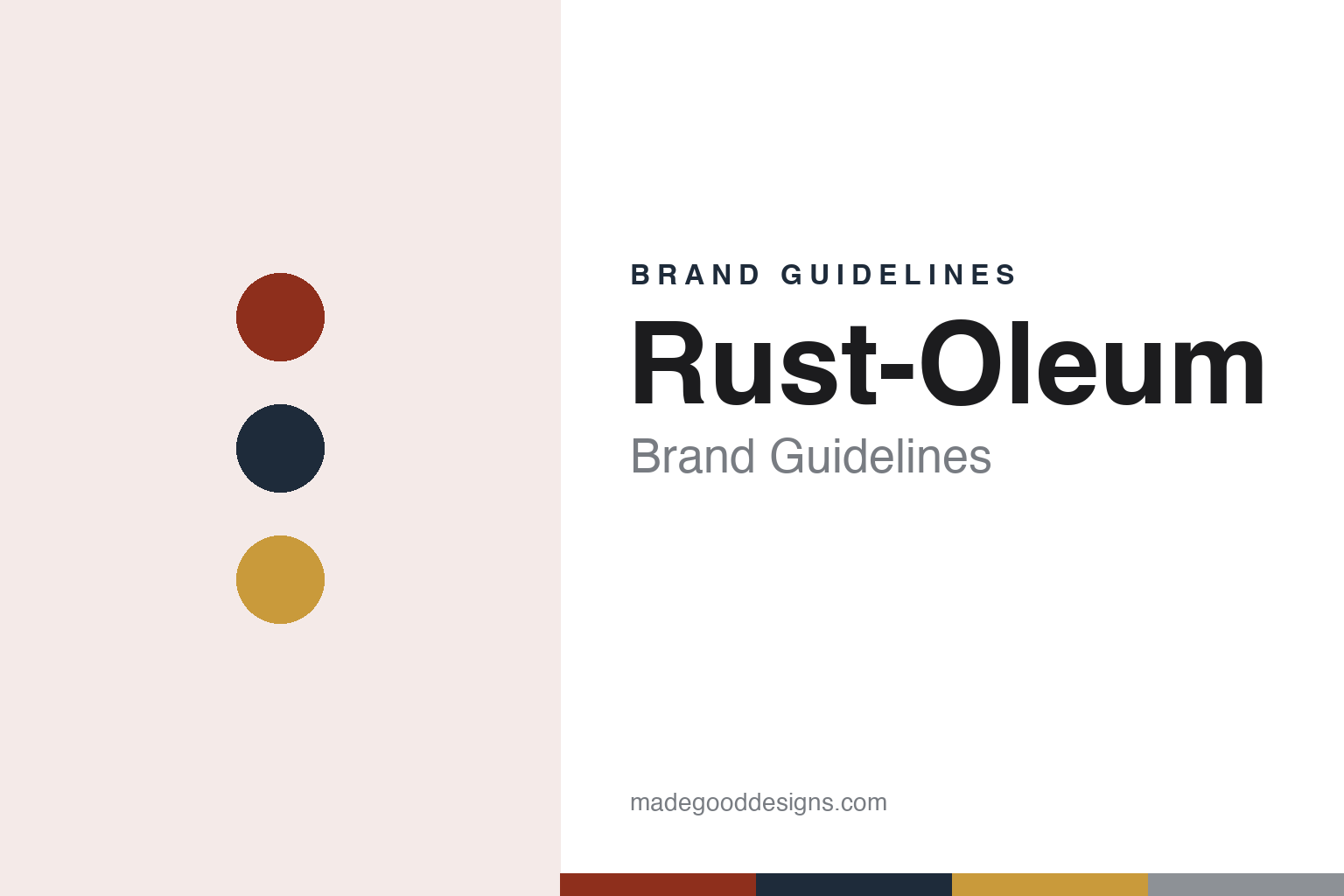
Two constants: an oxide red, deck navy and fish-oil amber palette and a heavy grotesque register. Abstract homage — not a Rust-Oleum product or mark; no can, label or logo is reproduced.
A captain’s deck
Fish oil, a rusty deck and a chemist.
Rust-Oleum traces its start to 1921 and to Robert Fergusson, a sea captain. The company’s own history page tells the story this way: Fergusson noticed that fish oil kept rust from forming on the metal deck of his ship, and, working with a chemist, he developed a rust-preventive paint. English Wikipedia places the founding in Evanston, Illinois, the lakeside city just north of Chicago, and adds that the observation was of fish oil spilled on rusty decks stopping corrosion from spreading.
The formula moved on quickly. English Wikipedia says Fergusson soon added whale oil to the mix, and that the products changed a great deal over the following decades: today’s coatings are built on resins such as alkyds, polyurethanes, epoxies and latex rather than marine oils. The company says it started out with 24 colours of paint,, and its name still joins the word rust to “oleum” with a hyphen.
For most of the twentieth century Rust-Oleum stayed with the founding family. English Wikipedia describes it as family-owned until 1994. The company’s slogan “Rust Never Sleeps” became famous well beyond the paint aisle in 1979, when, according to Jimmy McDonough’s biography Shakey, Neil Young took it as the title of an album after Mark Mothersbaugh of Devo suggested the phrase.
Colour
An Ohio parent, a steamboat headquarters and a widening family of brands.
In 1994 the family era ended. The Akron Beacon Journal reported on 4 May 1994 that RPM Inc., the Ohio coatings group now called RPM International, would buy Rust-Oleum’s US holdings, and RPM has owned the company since that year. Rust-Oleum became one of the consumer businesses inside the group, and its corporate offices sit in Vernon Hills, Illinois, a northern suburb of Chicago. The Chicago Tribune reported in 2014 that the headquarters building was designed by the architect Helmut Jahn and resembles a steamboat, with pipes running through its atrium.
Under RPM the company has grown by acquisition as well as by new products. English Wikipedia, citing RPM press releases and the Cleveland Plain Dealer, lists the purchase of the Synta wood deck and concrete restoration business in 2012, Krud Kutter and the Citadel floor-coatings business in 2014, and the concrete-sealer maker Seal-Krete in 2016. More recently, Rust-Oleum’s own newsroom reports that RPM completed the acquisition of The Pink Stuff, the cleaning brand, which now sits in the Consumer Group’s Rust-Oleum cleaners business.
The result is a house of brands rather than a single label. English Wikipedia names Stops Rust, Painter’s Touch, Universal, High Performance and NeverWet among the Rust-Oleum lines, alongside separate names such as Zinsser for primers, Varathane for wood stains and finishes, and Watco. The company’s site groups the range under small-project paints, primers, cleaners, automotive, industrial and high-performance coatings and wood care, and its footer adds names such as Modern Masters, Gator Finishing and Wipe New. English Wikipedia lists manufacturing in Pleasant Prairie, Wisconsin, Hagerstown, Maryland, Tulsa, Oklahoma and Lesage, West Virginia, among other sites in the United States and Europe, and the brand has separate European and UK websites.
New products still arrive under the older sub-brands as well as the parent name. The company’s newsroom has announced a Varathane Total Control Gel Stain for wood, and it promotes its spray paints through project galleries, how-to videos and colour guides aimed at do-it-yourselfers, alongside ranges for professional and industrial users.
Typography
Design and documentation.
The brands in this group sell the things that sit around a tin of paint rather than the paint itself: masking tape, brushes, primers, wood stains, clear finishes and spray paint. In a hardware aisle they compete for attention on crowded shelves, so their identities are carried by a few repeated signals — the colour of a roll of tape, the band of colour on a can, a label that customers can find again on the next visit.
Wood-finish brands also have to show colour that is not their own. A stain only makes sense once it is on wood, so swatch cards, sample boards and finished projects often do as much of the visual work as the logo. Tape brands, by contrast, can make the product itself the signature, with one colour of roll standing for the whole name.
Many of these names have changed hands over the years, and the business behind a familiar label may now be part of a much larger coatings group. Each guide sets out who started the brand, who owns it now and how it presents itself, and marks plainly what rests only on the company’s own word.
Aa
A heavy grotesque — a hardware-aisle, can-label register. (Specimen set in Archivo Black, a sans-serif STAND-IN; NOT the Rust-Oleum logo.)
Rust-Oleum
A hyphenated name, a slogan and a family of sub-brands.
The name does most of the brand work. Rust-Oleum is a compound that tells the buyer what the product is for and what it was first made from. The corporate name, Rust-Oleum Corporation, carries the same spelling, and the same word heads the brand’s websites in the United States, Canada, the UK and Europe.
Under that name the range is organised by job rather than by chemistry. Sub-brands such as Stops Rust, Painter’s Touch and Universal sit under the Rust-Oleum word, while acquired names such as Zinsser, Varathane and Watco keep their own identities inside the same company. The result is a two-level system: a parent word for rust protection and general-purpose paint, and separate names for specialist categories such as primers, wood finishes and floor coatings.
Advertising has leaned on the same story. “Rust Never Sleeps” was a company slogan before it became a Neil Young album title in 1979, and the founding image of a captain studying his ship’s deck still opens the company’s history page. The brand also turns up in public places: Vernon Hills High School’s football stadium has been called Rust-Oleum Field since a naming agreement reported by the Chicago Tribune in 2002, and the company now runs a “Spray It Forward” mural programme, which its newsroom presents as a community programme, with its newsroom highlighting murals painted in Kenosha.
For a design guide, Rust-Oleum shows how a name built from a problem and a material can anchor a long family of sub-brands, and how a founding anecdote can serve as the brand’s story for a century. Compare it with Zinsser, the primer brand inside the same company, and Krylon, the spray paint brand on the Sherwin-Williams side of the aisle. For this guide we use oxide red, deck navy and fish-oil amber with a sans, an unofficial interpretation; no product or logo is reproduced.
Explore & save
Keep Rust-Oleum’s identity on hand — save it to a board in the Made Good inspiration library.
Rust-Oleum identity set
Pin the Rust-Oleum oxide red, deck navy and fish-oil amber palette and the heavy grotesque register to your own board.