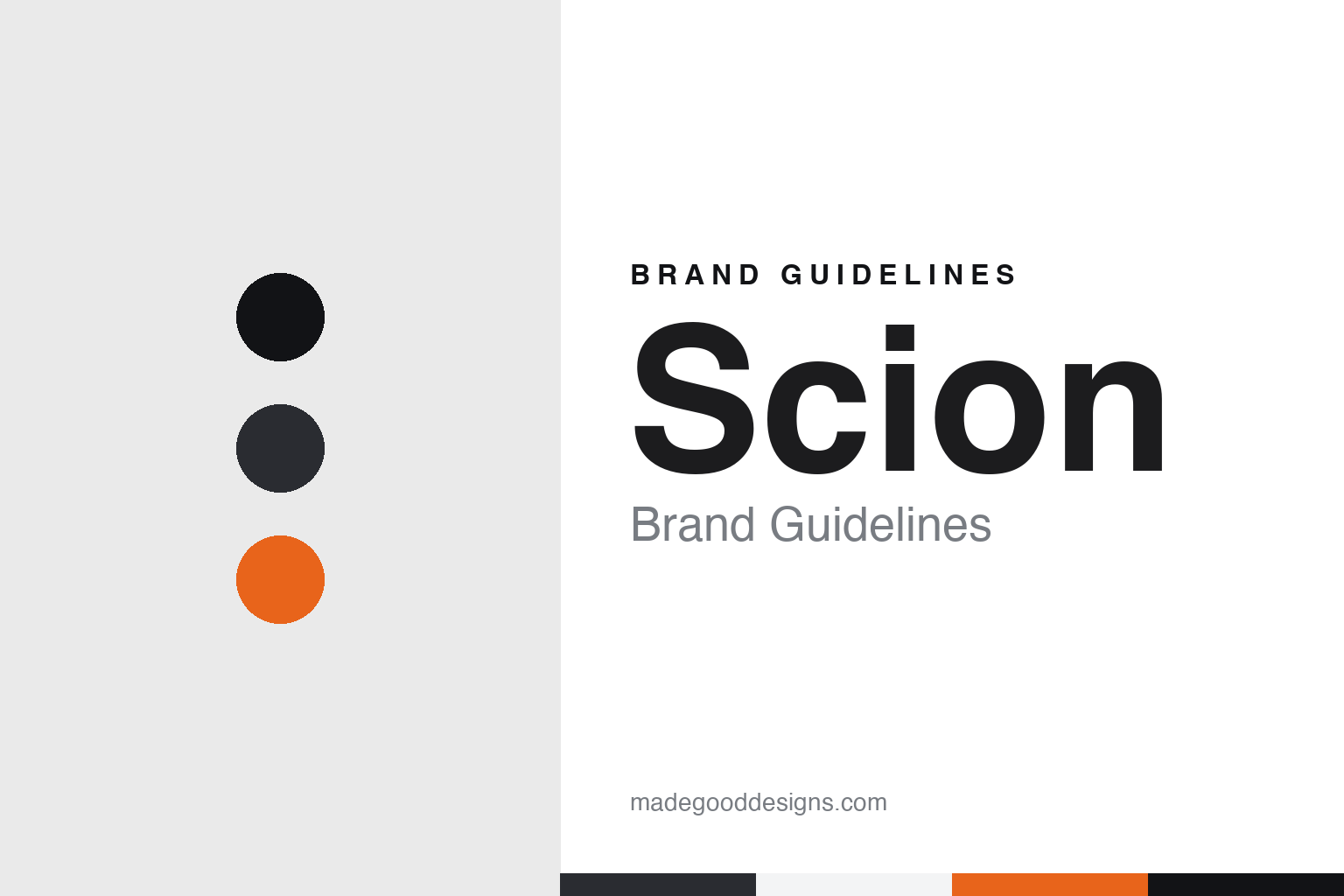
Scion Brand Guidelines
Toyota’s youth marque and its Pure Price experiment.
Aa
Two constants: a graphite, chrome and signal orange palette and a squared technical sans register. Abstract homage — not a Scion product or mark; no car, badge or logo is reproduced.
An heir to Toyota
A marque within a marque, named for a descendant.
Scion was Toyota’s youth marque for North America, announced at the New York International Auto Show in 2002 and put on sale in June 2003. Car Design News, reporting from the show that spring, quoted Toyota’s announcement: the name, pronounced “SY-en,” means a descendant or heir, and it was “designed to stand alone” as a new line of products and a new way of doing business while conveying “a clear link to the Toyota-brand heritage.” The stand carried the concept cars bbX and ccX, and the magazine noted that the bbX was based on a car sold in Japan as the “Black Box,” marketed there to young buyers as a blend of entertainment, art and basic transport.
The project came out of what Toyota called its genesis group. In the same announcement, Jim Lentz, then the Toyota Motor Sales vice president in charge of Scion, dated the group’s formation to 1998 and described Scion as “a complement to the Toyota-brand banner,” aimed at consumers who want product concepts “high in personal expression.” Jim Press, the company’s executive vice president, framed it as a way to connect with the “net-generation” then reaching driving age. Wikipedia says the cars went on sale on 9 June 2003 at Toyota dealers in California, reached the rest of the United States by June 2004, and arrived in Canada in September 2010.
Scion was sold inside Toyota showrooms rather than through a dealer network of its own, and the way it was sold was part of the brand. In a 2016 release, Toyota lists the practices it tested under the Scion name: Pure Pricing, under which the dealer set a price and the customer did not need to negotiate; Mono-Spec cars, offered with a choice of transmission and colour and nothing else; a large range of accessories for personalising each car; and limited-run Release Series editions. Wikipedia describes the same Pure Price idea as a posted price that applied whether it appeared on the car, in an advertisement or on a menu board in the dealership, and covered accessories as well as finance and insurance products.
Colour
Underground marketing and a toaster on wheels.
Scion’s marketing was built to avoid looking like car advertising. Writing for Automotive News in May 2006, in a report republished by Autoweek, Mark Rechtin described a brand that sought out “the obscure but hip.” It hosted nightclub events for rising musicians, ran its own record label for aspiring hip-hop artists, sponsored the X-Dance film festival and restricted its print buying to magazines such as Complex, Elemental and Mass Appeal. Mark Templin, then Scion’s vice president, told the paper: “We are becoming more offbeat. We want to pull people into the brand. We will never push the brand onto them.” Rechtin also reported a line of golf clothing made with the designers Blue Davis and Jupiter Destiny III.
Templin’s view of the badge was relaxed for a carmaker. “Everyone works so hard to control and define what their brand stands for, when they ought to just let the consumer do it,” he said in the same interview, comparing Scion to an energy drink that meant different things to different groups of people. Rechtin called Scion “a laboratory for new ideas,” and Toyota used the same word, laboratory, when it described the brand a decade later.
The cars carried the message too. The xB, a tall, square-edged hatchback, became the public face of the marque; the Chicago Tribune noted in 2016 that it was nicknamed the “toaster” and that the nickname stuck. The tC coupe, the xA and later xD hatchbacks, the iQ city car and the FR-S sports car joined the range over the following years, and the iA sedan and iM hatchback were its final new models. Wikipedia says the iA was a rebadged Mazda2 and the iM was based on the Toyota Auris sold in other markets.
Typography
Badges, signs and retirement.
A car brand lives in a handful of physical objects long before it reaches a screen. The badge on the grille and the tailgate, the script on a front wing, the hood ornament where one exists, and the emblem moulded into a steering-wheel hub are all small pieces of metal or plastic that have to read at a glance and survive weather, washing and years of handling. Each one is a design brief in miniature: a mark that works in chrome, in paint and in relief, at the size of a coin and at the size of a showroom sign.
Dealer signage carries the same mark at architectural scale. Pole signs, fascia lettering, service-bay headers and the colours of a showroom interior turn a badge into a place, and they are usually specified by the carmaker so that one dealership looks like the next. When a manufacturer retires a marque, that whole system has to be undone in stages: signs come down or are re-skinned for a sister brand, parts and service support continue for cars already on the road, and the badges themselves pass into the hands of owners, clubs and collectors. A retired marque often keeps a second life in that afterlife, carried by the people who still drive and restore the cars.
Aa
A squared technical sans — the register of a tailgate badge and a dealer menu board. (Specimen set in Saira, a sans-serif STAND-IN; NOT the Scion logo.)
Scion
An heir’s name, then a homecoming.
Toyota announced the end of Scion on 3 February 2016. In a release from Torrance, California, it said the brand, “established as a separate brand in 2003 as a laboratory” for new products and processes aimed at young customers, would transition back to Toyota. From August 2016, model-year 2017 Scions would be rebadged as Toyotas: the FR-S, iA and iM joined the Toyota line-up, the tC ended production after a final Release Series edition, and the C-HR, unveiled as a Scion concept, would launch as a Toyota. Lentz, by then chief executive of Toyota Motor North America, said: “This isn’t a step backward for Scion; it’s a leap forward for Toyota.” The company said service for Scion owners would continue at Toyota dealerships. Wikipedia gives the rebadged names as the Toyota 86, the Yaris iA and the Corolla iM.
Coverage that day tied the decision to the brand’s identity. In Forbes, Dale Buss argued that Toyota had moved away from the early design distinctiveness of cars such as the boxy xB and had let the customisation theme fade. Robert Duffer of the Chicago Tribune summarised Scion as a brand aimed at young urban buyers, with distinct styling and experiential marketing, and quoted Doug Murtha, a former Scion vice president: “When we launched, the brand proposition to the majority of customers was if mom and dad do it, I want to do exactly the opposite. And that’s changed.”
For a design guide, Scion shows how a carmaker can run a sub-brand as an open experiment: an ordinary English word with a family meaning, a badge fitted to cars sold in the parent’s own showrooms, marketing aimed at small scenes rather than mass audiences, and a scheduled handover when the experiment closed. Compare Toyota, the parent marque that took over its models, and Lexus, Toyota’s other separately badged line. For this guide we use graphite, chrome and signal orange with a squared technical sans, an unofficial interpretation; no product or logo is reproduced.
Explore & save
Keep Scion’s identity on hand — save it to a board in the Made Good inspiration library.
Scion identity set
Pin the Scion graphite, chrome and signal orange palette and the squared technical sans register to your own board.