Scotts Brand Guidelines
A Civil War veteran’s seed business that became a lawn brand.
Aa
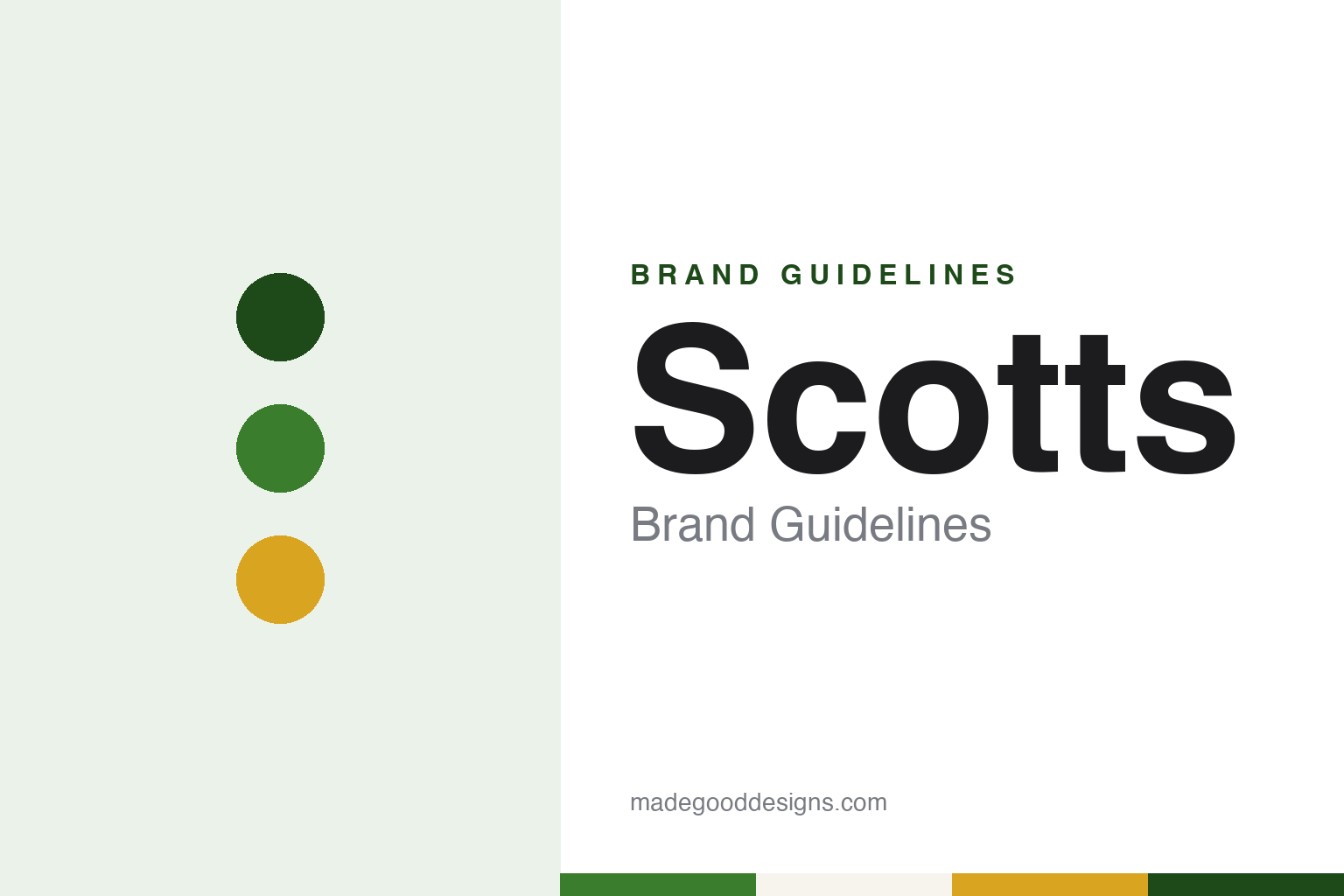
Two constants: a turf green and seed gold palette and a heavy lawn-bag sans register. Abstract homage — not a Scotts product or mark; no bag, spreader or logo is reproduced.
O.M. Scott and Sons
A seed cleaner in a small Ohio town.
The name on the Scotts bag belongs to Orlando McLean Scott, and the town where he started is still the company’s home. English Wikipedia’s article on The Scotts Miracle-Gro Company says Scott began selling seed in Marysville, Ohio, in 1868, and the company gave the same year on its own history page in 2008, describing the original business as a premium seed company serving American agriculture. When the company launched a heritage line in 2025, the advertising trade site shots reported in March 2025 that it described Scott as a Civil War veteran who in 1868 started providing weed-free grass seed in Marysville.
The International Directory of Company Histories, in an entry written in the late 1990s, gives a fuller timeline. It says Scott moved to Marysville in 1866, worked at a seed elevator and then bought a business of his own, a hardware store, in 1870. In that account his dislike of weeds led him into a sideline for local farmers: sorting weed seeds out of crop seed. The directory adds that grass seed was part of the offer early on, but that it did not become an important line for the business until the twentieth century.
The next generation turned a farm-seed business toward the home lawn. The directory says Scott’s sons Dwight and Hubert joined the company in the 1900s, and it credits Dwight with launching a mail-order grass seed business in 1906, which carried the family name to customers in Pennsylvania, Virginia, Kentucky and West Virginia. The company’s own brand page from 2008 dates the introduction of the Scotts brand to homeowners to 1907, when, it says, Dwight Scott began offering grass seed by mail. The directory also records a commercial sale to the Brentwood golf course on Long Island in 1916, and Wikipedia’s list of corporate milestones says the business was incorporated as The O.M. Scott & Sons Company in 1914. Wikipedia gives that as the company’s name until 1992.
Colour
From a family firm to ITT and Scotts Miracle-Gro.
The product that still carries the brand on store shelves arrived in 1928. The company’s 2008 brand page says that Scotts, having decided that grass has nutritional needs of its own, introduced Turf Builder that year, and the International Directory of Company Histories describes the original formula as a mix of soybean and cottonseed meals. The same entry says the company started a promotional magazine of its own, Lawn Care, in 1928, and that it brought out a reformulated Turf Builder in 1956.
Weed products followed in the postwar years. The directory lists 4-XD, a broadleaf herbicide, in 1945, then Scutl, Clout and Halts for crabgrass in the 1950s, and describes a research complex at Marysville named after Dwight Scott. By 2008 the company’s brand page named Turf Builder, Starter, Halts and Bonus S among its lawn products, alongside broadcast, drop and hand-held spreaders and a line of Nature Scapes mulch.
Family control ended in the 1970s. The directory says the company had become closely held after the war and was acquired by the conglomerate ITT in 1971; Wikipedia gives the same year. In 1986 a management group led by president and chief executive Tadd C. Seitz bought the business back from ITT in a leveraged buyout financed by the investment firm Clayton Dubilier, the directory says. Scotts bought the soil company Hyponex in 1988, went public as The Scotts Company in 1992 and acquired the spreader maker Republic Tool and Manufacturing that same year.
In 1995 Scotts merged with Stern’s Miracle-Gro, the plant-food company built by Horace Hagedorn and Otto Stern, whose story is told in our Miracle-Gro guide. Wikipedia says the company bought the Ortho lawn and garden business from Monsanto in 1999, took on the marketing of consumer Roundup in several countries, and has been called The Scotts Miracle-Gro Company since 2005. It lists Scotts among the brands the company makes in the United States, and the parent company remains in Marysville, where its headquarters stand.
Typography
Design and documentation.
Lawn-care and household pest-control brands sit on garden-centre shelves, in hardware aisles and under kitchen sinks, and they reach shoppers through packs more than through advertising. A fertiliser bag, a shaker of garden dust, an aerosol of insect repellent and a card of bait stations all have to name the product, say what it is for and carry required label text, often within a small space and alongside rival packs.
Many of these names have changed hands more than once, passing from the chemical or consumer-goods companies that started them to other groups, so the name on a pack can be older than the company that now owns it. That makes the plain questions behind each name worth asking: who started it, who owns it now, and how its packs and marks have changed over time.
Each guide sets out what independent, dated sources record and what the company says about itself — its founding story, its owners over time and how its packs have looked — and marks plainly what rests only on the company’s own word. Products are described by name and category only.
Aa
A heavy lawn-bag sans — the register of a product name set large on a fertilizer bag. (Specimen set in Libre Franklin, a sans-serif STAND-IN; NOT the Scotts logo.)
Scotts
A family surname, a 1928 product name and a heritage revival.
Scotts is a family surname used as a brand, and its range has long been organised around a handful of product names rather than a single product. The company’s 2008 brand page called Scotts the company’s original brand and grass seed its continuing focus, with Turf Builder as the name carried across a family of lawn feeds, including a Southern Turf Builder and versions combined with weed or insect control. Spreaders, seed and mulch sat under the same name, so the word Scotts did the work of tying a bag of seed, a bag of lawn food and a push spreader together.
Recent advertising has given the brand a face. shots reported in March 2025 that the Turf Builder range would again be represented by a character called Scott for Scotts, played by the actor Kristofer Hivju, and that the 2025 campaign paired him with real homeowners talking about their lawns. According to the trade site, that campaign was developed by Scotts with support from the agency Wondersauce, produced by MullenLowe and directed by the filmmaker Nicolas Heller.
The same announcement introduced O.M. Scott & Sons, a separate line named after the founder’s firm, with grass food and grass seed products such as Natural Grass Food and Clover Seed. shots said the line’s creative strategy and launch campaign came from the independent agency D/CAL in Detroit, co-founded by the skateboarder Tony Hawk, and that Scotts worked with HiFi Brands and Paul Demyanovich on packaging that balances heritage elements with a modern look and feel. The campaign cast O.M. Scott himself as the original “Yard GOAT,” turning a nineteenth-century seed merchant into a mascot for a present-day product line.
For a design guide, Scotts shows how a founder’s surname, a Marysville address and a product name from 1928 can be carried through family ownership, a conglomerate, a buyout and a merger, and how a company can draw on its own past to build a heritage sub-brand. Compare it with Miracle-Gro, the plant-food brand it merged with in 1995, and Ortho, its stablemate since 1999. For this guide we use turf green and seed gold on bag white with a sans, an unofficial interpretation; no product or logo is reproduced.
Explore & save
Keep Scotts’s identity on hand — save it to a board in the Made Good inspiration library.
Scotts identity set
Pin the Scotts turf green and seed gold palette and the heavy lawn-bag sans register to your own board.