Sherwin-Williams Brand Guidelines
A Cleveland partnership, a logo from 1905 and a Color of the Year.
Aa
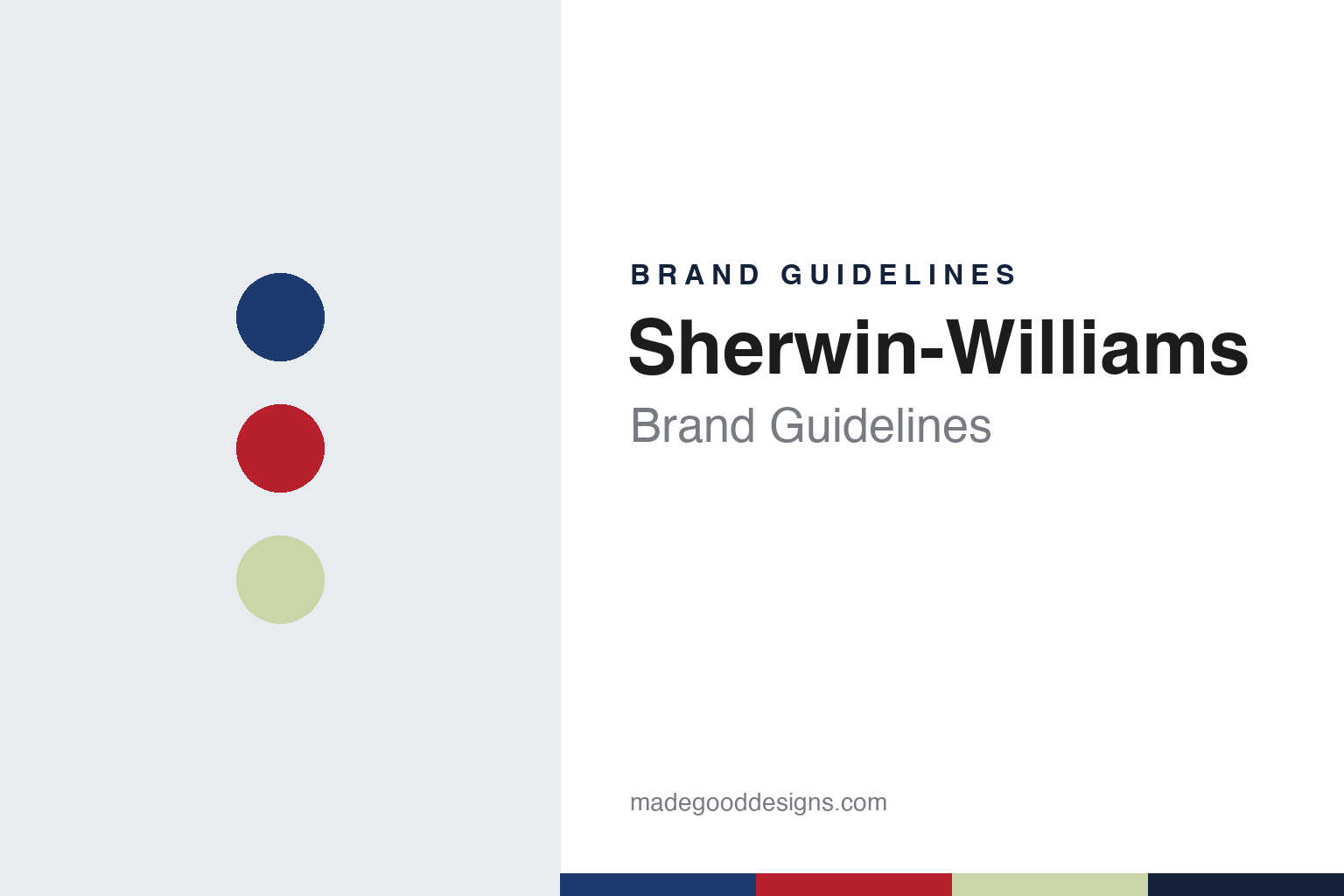
Two constants: a globe blue, pour red and celery palette and a sturdy industrial sans register. Abstract homage — not a Sherwin-Williams product or mark; no logo, can or colour card is reproduced.
From Cleveland
A bookkeeper’s investment, a three-man partnership and a factory in an old cooperage.
Sherwin-Williams dates itself to 1866 in Cleveland, Ohio. English Wikipedia tells the story in two steps. In 1866 Henry Sherwin, a Cleveland bookkeeper, invested in Truman Dunham & Co., a paint distributorship. When that partnership was dissolved in 1870, he formed Sherwin, Williams & Co. with Edward Williams and A. T. Osborn. The company’s own history timeline compresses this into a single line, saying that in 1866 Henry A. Sherwin and Edward P. Williams first established the business, and that in 1870 Sherwin became its first chief executive.
Manufacturing followed quickly. Wikipedia says that in 1873 the company acquired a former cooperage in Cleveland from Standard Oil for its first factory, and that it was incorporated in Ohio on 16 July 1884, two years after Osborn sold his interest while keeping the retail side. The two main sources differ slightly on one early milestone. The company’s timeline dates a ready-mixed oil paint, sold as “Guaranteed Strictly Pure Raw Umber in Oil,” to 1873, while Wikipedia places the start of ready-mixed paint sales in 1875. Before then, as Wikipedia explains, customers bought the ingredients and mixed paint themselves.
The company’s timeline marks the other early steps. It says Sherwin-Williams patented a resealable paint can in 1877, hired the chemist Percy Neyman in 1884, and bought the Calumet Paint Company of Chicago in 1888, which gave it a plant outside Cleveland. A merger with the Walter H. Cottingham Co. in 1892 took the business to Montreal, and a London office followed in 1903. In 1909, the timeline says, Walter H. Cottingham succeeded Henry Sherwin as chief executive on Sherwin’s retirement.
Colour
Kem-Tone, a roller, a colour-mixing machine and the arrival of Valspar.
The middle of the twentieth century brought the products that shaped how Americans painted at home. Wikipedia says the company moved its headquarters to Cleveland’s Midland Building in 1930. In 1941, according to both the company and Wikipedia, its chemists introduced Kem-Tone, a fast-drying, water-based interior paint, together with the Roller-Koater applicator. The company’s timeline adds the Kem Colormeter mixing machine in 1959, which let customers have colours mixed to order, and a paint can shaker in 1961. It lists the company on the New York Stock Exchange from 1964.
Later decades were built on stores and acquisitions. Wikipedia describes a difficult 1970s, a takeover attempt by Gulf and Western that the company fended off, and a run of purchases in the 1980s and 1990s alongside the sale of businesses outside coatings. Its acquisitions section lists Duron in 2004, M. A. Bruder & Sons in 2007, Leighs Paints of Bolton in 2011 and the US and Canadian divisions of Comex in 2013. A major change came with Valspar: Wikipedia says the deal was announced in March 2016 and completed on 1 June 2017, and the company’s timeline records the acquisition under 2017.
Sherwin-Williams now works through three segments, which Wikipedia names as the Paint Stores Group, the Consumer Brands Group and the Performance Coatings Group. The consumer side holds brands sold through other retailers, among them Dutch Boy, Krylon, Minwax and Valspar. In 2020, the company’s timeline says, it announced plans for a new global headquarters in downtown Cleveland and a research and development centre in nearby Brecksville. The timeline names Heidi G. Petz as the company’s tenth chief executive, from 2024.
Typography
Design and documentation.
The paint brands in this group sit at very different points in the trade. Some are long-established manufacturers whose names have passed through several owners, and whose cans are sold through hardware chains, dedicated stores and trade counters; others are younger companies that sell mainly online or from a handful of showrooms, often built around a short, edited list of colours rather than a vast library.
A paint brand’s identity is carried by more than a logo. It lives in the can and its label, in the fan deck and the swatch card, in the names given to colours, in the store or website where people choose them, and in programmes that pick out a colour for the year. Because the company behind a name may have been sold, merged or closed, and because paint can be made far from where it is marketed, the plain questions are worth asking: who started it, who owns it now, and where the paint is actually made.
Each guide separates what independent sources record from what the company says about itself, and marks plainly what rests only on the company’s own word.
Sw
A heavy, workmanlike sans in the spirit of a paint-store fascia. (Specimen set in Archivo, a sans STAND-IN; NOT the Sherwin-Williams logo.)
Sherwin-Williams
A logo that has stayed put for more than a century, and a colour system that changes every year.
The central piece of the Sherwin-Williams identity is its “Cover the Earth” logo. The company’s history timeline dates it to 1905 and says it replaced an earlier mark, a chameleon. The company’s timeline itself calls the logo iconic. The same timeline shows how early the company used printed guidance as part of the brand: in 1923 it introduced a Household Painting Guide, a decorating guide that promised to help readers “stop making mistakes in painting.”
Colour itself has become the brand’s most visible annual act. The company’s Color of the Year archive presents Celery SW 6421, a light green, as its choice for 2027, and Universal Khaki SW 6150 for 2026. It says the picks are drawn from its Colormix trend forecast. Both picks are published with a name and an “SW” colour number. The company’s timeline says the ColorSnap Visualizer app, launched in 2018, lets people try colours on their own walls and match colours to a photograph.
The brand also reaches people through media and sport. The timeline says Sherwin-Williams became an official sponsor of Major League Baseball in 1994, supplying coatings for new ballparks including Jacobs Field in Cleveland, and that in 1995 it sponsored its own television show, Room by Room, on the Home and Garden network. In 2014, it says, it launched HGTV Home by Sherwin-Williams, a paint line launched for exclusive sale in Lowe’s stores.
For a design guide, Sherwin-Williams shows how a single pictorial mark can carry a company through acquisitions and new segments while the colour system does the yearly talking. Compare Benjamin Moore, the paint house sold through independent dealers, and Valspar, which Sherwin-Williams has owned since 2017. For this guide we use globe blue, pour red, celery tint and can navy with a sans, an unofficial interpretation; no product or logo is reproduced.
Explore & save
Keep Sherwin-Williams’s identity on hand — save it to a board in the Made Good inspiration library.
Sherwin-Williams identity set
Pin the Sherwin-Williams blue, red and celery palette and the sturdy industrial sans register to your own board.