Sherwood Brand Guidelines
The Sherbrooke stick name made from a town and a woodshop.
Aa
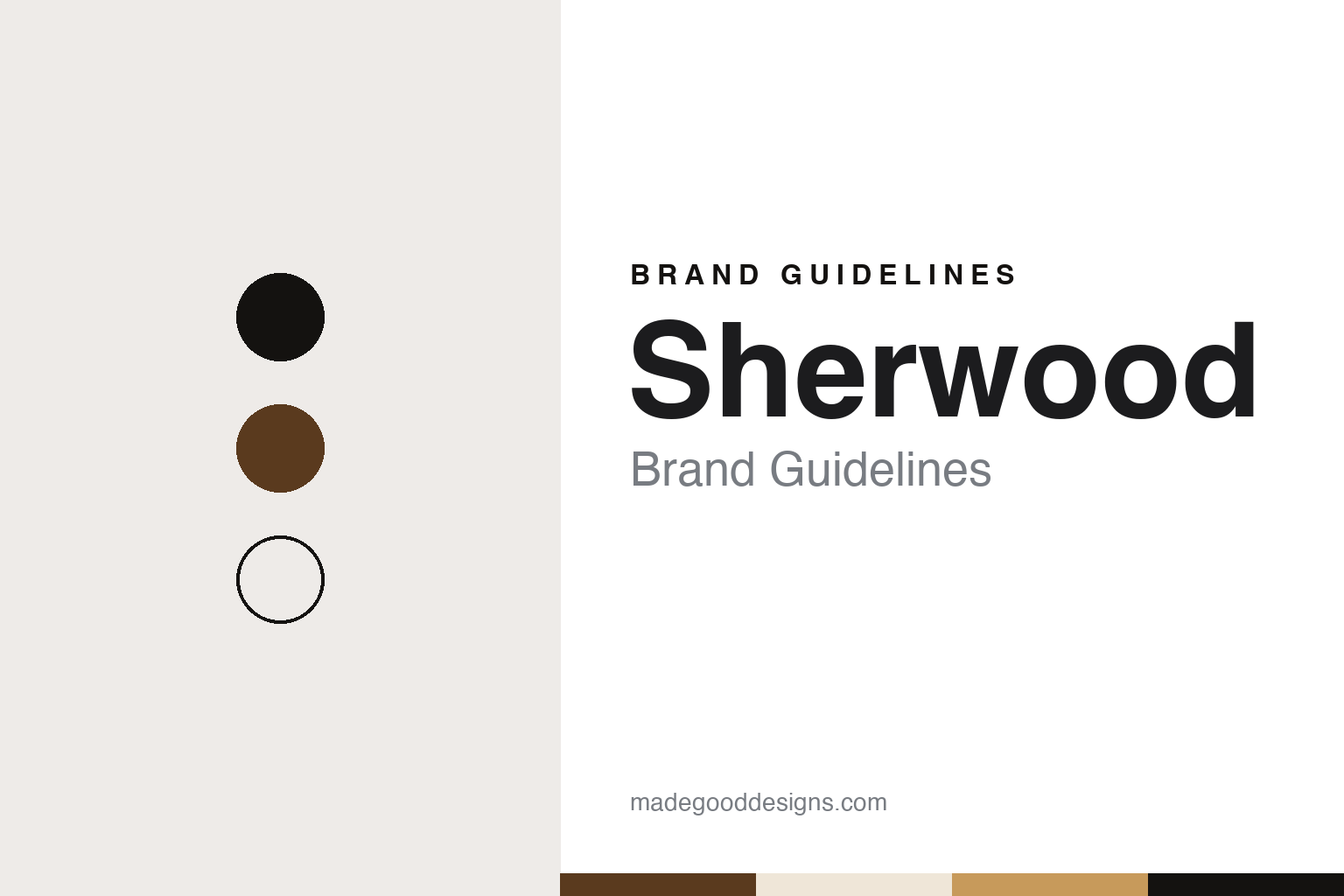
Two constants: a blade walnut, ash white and tape tan palette and a stick-shaft condensed sans register. Abstract homage — not a Sherwood product or mark; no stick, glove or logo is reproduced.
Sherbrooke Woodcraft
A town, a woodshop and a hyphenated name.
Sherwood began in Sherbrooke, Quebec, in 1949. English Wikipedia says Léo Paul Drolet founded Sherbrooke Woodcraft there that year and that the business made the original sticks; French Wikipedia gives the founder’s name as Léopold Drolet. The brand name was a contraction. Sher-Wood joined the “Sher” of Sherbrooke to the “Wood” of Woodcraft, and Wikipedia notes that the city’s own name came from John Coape Sherbrooke. The brand’s website still carries the line “Sherwood Hockey since 1949”.
The business grew in stages. In 1961, Wikipedia says, Drolet formed a second company, Sher-Wood Hockey Sticks, and in 1969 he merged it with Sherbrooke Woodcraft to form Sherwood-Drolet. In the early hours of 17 July 1969, while the plant was shut for the summer holidays, a fire destroyed the factory; Wikipedia cites two reports in the Sherbrooke Daily Record of 17 and 18 July 1969. Because insurance covered just part of the damage, Drolet sold control of the company to pay for rebuilding.
The buyer was American. The Bilan du siècle, the Quebec history chronology of the Université de Sherbrooke, says the company passed to Figgie International in 1969. English Wikipedia says an 80 per cent stake was sold to Rowan Industries of Oceanport, New Jersey, in the spring of 1970, and that Figgie International of Cleveland then acquired Rowan’s stake. The Bilan du siècle adds that Drolet and his sons continued to manage the company under its new owner and long wanted to regain control.
That happened in 1994. Wikipedia says Léo’s son Denis Drolet became president in 1991 and moved the company beyond sticks into protective equipment. On 1 December 1994, the Bilan du siècle records, the Sherbrooke stick maker was sold to the Groupe Drolet, formed by the brothers Michel and Denis Drolet together with their father. The group also owned Inglasco, a maker of pucks and hockey promotional items, and Sport-Lam, which made street-hockey sticks, so Sherwood was once again a Canadian-owned company.
Colour
Carpe Diem, Gracious Living and Canadian Tire.
The range kept changing under the family. French Wikipedia says the company began making hockey skates in 2000 and that in December 2007 it ended regular production of wooden sticks, while still filling special orders at Sherbrooke for NHL players who used wood. Sherwood-Drolet filed for bankruptcy in May 2008. A month later its assets were bought by Carpe Diem Growth Capital through a new company, Sher-Wood Hockey Inc., and French Wikipedia, citing La Tribune of 20 June 2008, says the head office stayed in Sherbrooke.
The new owner built the group up again. English Wikipedia says Sher-Wood Hockey bought the assets of Inglasco from the Groupe Drolet in September 2008, and in December 2008 acquired the TPS Sports Group, the former hockey division of Hillerich & Bradsby. In 2011, citing the Victoria Times Colonist of 8 April that year, Wikipedia says Sher-Wood moved the bulk of its production from Sherbrooke to Asia. At some point before 2014, the same source says, ownership passed to Callidus Capital.
A furniture company came next. In September 2014 the Gracious Living Corporation of Woodbridge, Ontario, bought the assets of Sher-Wood Hockey and Inglasco, Wikipedia says, and reorganised Sher-Wood as the Sherwood Athletics Group, with a manufacturing arm and a separate licensing arm. Inglasco remained with Gracious Living after the later sale of the Sherwood name.
In February 2018 the Canadian Tire Corporation bought all of Sherwood’s trademarks from Gracious Living. Wikipedia, citing the Victoria Times Colonist of 15 February 2018, says the purchase was made by INA International, a Calgary-based subsidiary of FGL Sports, which is itself owned by Canadian Tire, and that since then Sherwood has existed as a brand rather than as a separate company. It sits in Canadian Tire’s group of hockey brands with Hespeler and Victoriaville. The legal page of the Sherwood website, read in October 2026, names Canadian Tire Corporation, Limited, and its subsidiaries and affiliates as owner of the site and of the SHERWOOD and SHERWOOD Hockey trademarks.
Typography
Design and documentation.
Protective and playing equipment gives a logo very little room and a great deal to compete with. A helmet is curved in two directions, carries vents, clips and face guards, and may also have to hold a team’s own crest, numbers and stripes. A stick or shaft is long and narrow, so a name usually runs along its length and is read sideways, often from across a field or a rink. A skate boot offers a heel, a tongue and a quarter panel, each seen from a different angle, while a ball is round, scuffed and spinning, and its print is broken up by panels and seams.
Brands working on these surfaces tend to lean on a short word or a simple symbol that survives being stretched, shrunk, repeated or partly hidden. Colour matters too: a mark has to read against team colours it does not control, under floodlights and on television.
Each guide that follows sets out who started the brand, who has owned it since, and how its name and mark have appeared on equipment, separating what independent sources record from what a company says about itself.
Aa
A stick-shaft condensed sans — the register of a printed shaft and a glove cuff. (Specimen set in Oswald, a sans-serif STAND-IN; NOT the Sherwood logo.)
Sherwood
A compound name, with and without its hyphen.
The Sherwood identity begins with a coined compound. Sher-Wood took one syllable from a city and one from a woodworking business, and the hyphen marked the join. Wikipedia notes that the brand is sometimes styled Sher-Wood and sometimes Sherwood; the brand’s current website writes Sherwood as a single word, while its domain, sher-wood.com, keeps the hyphen, and its legal page lists SHERWOOD and SHERWOOD Hockey among the trademarks.
The name still points to wood. Sherbrooke Woodcraft made wooden sticks, French Wikipedia records that regular production of wooden sticks ended in December 2007, and the brand’s website today groups its range into sticks, gloves, protective equipment, apparel and accessories. On the website the current family is named REKKER, with products such as the Rekker Morph Pro stick, and the home page invites visitors with the line “Let us reintroduce ourselves. We are Sherwood.” The present-day copy leans on the founding year: “Sherwood Hockey since 1949” sits on the home page as a heading.
Ownership has changed what the name is. Under the Drolets, Sherwood-Drolet was a Sherbrooke manufacturer with its own factory; since the 2018 purchase of the trademarks, Wikipedia says, Sherwood exists as a brand within a retailer’s group, beside Hespeler and Victoriaville. The website’s legal page reflects that arrangement, placing the marks with Canadian Tire Corporation and its subsidiaries.
For a design guide, Sherwood shows how a compound place-and-trade name can survive a fire, a series of owners and a change of material, and still lead with its founding year. Compare it with CCM and Bauer, two other Canadian hockey names that have passed through many hands. For this guide we use blade walnut, ash white and tape tan with a sans, an unofficial interpretation; no product or logo is reproduced.
Explore & save
Keep Sherwood’s identity on hand — save it to a board in the Made Good inspiration library.
Sherwood identity set
Pin the Sherwood blade walnut, ash white and tape tan palette and the stick-shaft condensed sans register to your own board.