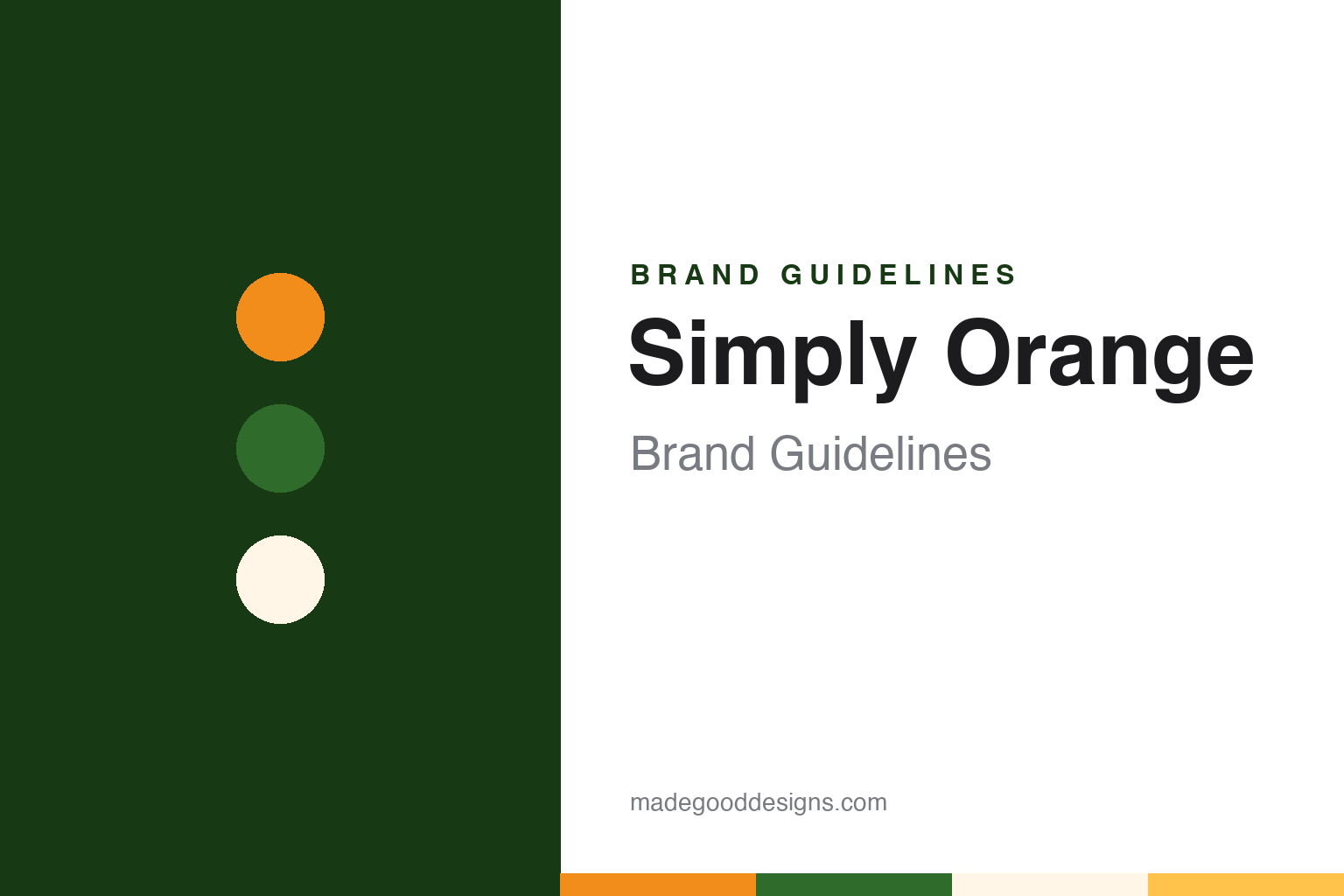
Simply Orange Brand Guidelines
A clear carafe, a green cap and orange juice that is never from concentrate.
Aa
Two constants: a juice orange, grove green and carafe cream palette and a rounded light sans register. Abstract homage — not a Simply Orange product or mark; no bottle, cap or logo is reproduced.
A new juice company in central Florida
Coca-Cola, Minute Maid and a not-from-concentrate orange juice in 2001.
Simply Orange is an American brand of chilled, not-from-concentrate orange juice, and the name that started the wider Simply range of juices and lemonades. It was created inside The Coca-Cola Company, which has owned it since its launch.
The Coca-Cola Company says the Simply brand was founded in 2001 in Apopka, Florida. The brand’s website as archived in January 2003 carried a copyright line in the name of the Simply Orange Juice Company, dated 2001, and the same company name appeared on the archived site in December 2006. The Atlanta Journal-Constitution, reporting on 24 October 2008, described the Simply Orange Juice Co. as part of Atlanta-based Coca-Cola, and said Simply was introduced in 2001 with not-from-concentrate orange juice.
The brand came out of Coca-Cola’s juice business. English Wikipedia says the company was founded on 29 July 2001 by Minute Maid, the frozen-concentrate brand that Coca-Cola had bought decades earlier, and that it launched three varieties of Simply Orange in the north-eastern United States. Bloomberg Businessweek reported on 31 January 2013 that Coca-Cola bought Minute Maid in 1960, and that Minute Maid had been founded during the Second World War to make orange juice concentrate for a military contract.
The same Wikipedia article says the brand expanded to the south-eastern United States and reached national distribution by 2003, and that the juice was sold in Canada as “Minute Maid Simply Orange” before taking the plain Simply Orange name there in 2006. The step from a single orange juice to a family of drinks followed quickly. The Atlanta Journal-Constitution said in October 2008 that Simply had steadily expanded to include lemonade, limeade, apple, grapefruit, orange with pineapple and orange with mango, and that the company would add Simply Lemonade with Raspberry, with shipments to retailers starting in February.
Colour
Coca-Cola, Auburndale and the Black Book model.
Simply Orange has had one owner. The Coca-Cola Company has owned the brand since its launch in 2001, and the company today lists Simply among its juice brands next to Minute Maid, with alcoholic Simply Spiked drinks listed separately under its ready-to-drink brands.
What sets the brand apart on the production side is how Coca-Cola makes the juice taste the same through the year. Bloomberg Businessweek, in an article by Duane Stanford published on 31 January 2013, described Simply Orange as the product of a sophisticated industrial juice system that includes satellite imagery, data algorithms and even a juice pipeline. “You take Mother Nature and standardize it,” Jim Horrisberger, director of procurement at Coca-Cola’s juice packaging plant in Auburndale, Florida, told the magazine. “Mother Nature doesn’t like to be standardized.”
The method has a name. Businessweek said Coca-Cola had developed a methodology it calls Black Book, which it described not as a secret formula but as an algorithm. According to the article, the model holds detailed data on the flavours that make up an orange and on consumer preferences, matches them to a profile of each batch of raw juice, including acidity and sweetness, and tells Coca-Cola how to blend batches to repeat a taste and consistency, down to the pulp content. Another part of the model takes in weather, expected crop yields and costs so that supplies can be planned well ahead. The consultant Bob Cross of Revenue Analytics was named as its architect. “We basically built a flight simulator for our juice business,” Doug Bippert, a Coca-Cola vice president, told Businessweek.
The oranges pass through a partner before they reach the carafe. Businessweek said Coca-Cola’s Brazilian partner Cutrale processes the oranges used in Coca-Cola’s juice brands, owns storage tanks near the Auburndale plant, uses satellite imaging to monitor crops in Brazil, and built with Coca-Cola an underground pipeline from its Orlando-area processing operation to Coca-Cola’s packaging plant. The two companies, the article said, buy oranges from Florida growers and educate them on growing to Coca-Cola’s specifications.
English Wikipedia adds that Simply Orange buys Florida oranges but also imports orange juice from Brazil and Mexico, and uses a computer-modelled system to blend the sources for a uniform taste through the year.
Typography
Design and documentation.
The brands in this group sell everyday things from the grocery aisle: microwave popcorn, hot cocoa, apple juice, applesauce, orange juice and iced tea. Their packaging comes in very different forms, from flat paper bags that open out in a microwave and tins or canisters of cocoa powder to juice cartons, plastic bottles and boxes of tea bags, and each format gives a designer a different surface to work with.
A bag, a canister, a carton and a box all have to carry the same few things: a name that can be read from a distance, a picture or colour that signals the flavour, and the instructions and legal text a food label needs. How those elements share the space says a good deal about how a brand wants to be seen on the shelf.
Each guide separates what independent sources record from what the company says about itself — who started the brand, who owns it now, where its products are made and how its packaging has changed — and marks plainly what rests only on the company’s own word.
Aa
A rounded, light sans — the clean, plain-spoken register of a chilled juice. (Specimen set in Quicksand, a rounded sans STAND-IN; NOT the Simply Orange logo.)
A clear bottle and a one-word name
A carafe that shows the juice, a green cap and a name that became a range.
The package is the identity. The Coca-Cola Company describes Simply’s juices as coming in its “signature transparent carafe”, and English Wikipedia describes the bottle as clear plastic with a green twist top and a large green seal, with a wide body that tapers to a narrow neck above the label.
The name does similar work. It began as a description of a single product and became the name of a range. The Coca-Cola Company now presents Simply Orange, Simply Lemonade and Simply juice drinks under one Simply brand, and English Wikipedia records that the company behind them is also known as Simply Beverages. The Atlanta Journal-Constitution’s 2008 list of flavours shows how early that stretch began, seven years after launch.
The words on the early website were few. The brand’s homepage as archived in December 2006 carried the phrase “Gently Pasteurized”, and the corporate copyright line carried the name of the Simply Orange Juice Company.
Later extensions kept the one-word prefix. The Coca-Cola Company lists Simply Spiked among its alcohol ready-to-drink brands, and English Wikipedia records Simply Spiked Lemonade from 2022 and a line of shelf-stable prebiotic sodas called Simply Pop from 2025.
For a design guide, Simply Orange shows how a plain word and a clear bottle can carry a brand from one juice to a whole range, with the product’s own colour doing much of the work. Compare it with Minute Maid, its older sibling within Coca-Cola, and Tropicana, another chilled orange juice name. For this guide we use juice orange, grove green, pulp gold and carafe cream with a rounded sans, an unofficial interpretation; no product or logo is reproduced.
Explore & save
Keep Simply Orange’s identity on hand — save it to a board in the Made Good inspiration library.
Simply Orange identity set
Pin the Simply Orange juice orange, grove green and carafe cream palette and the rounded light sans register to your own board.