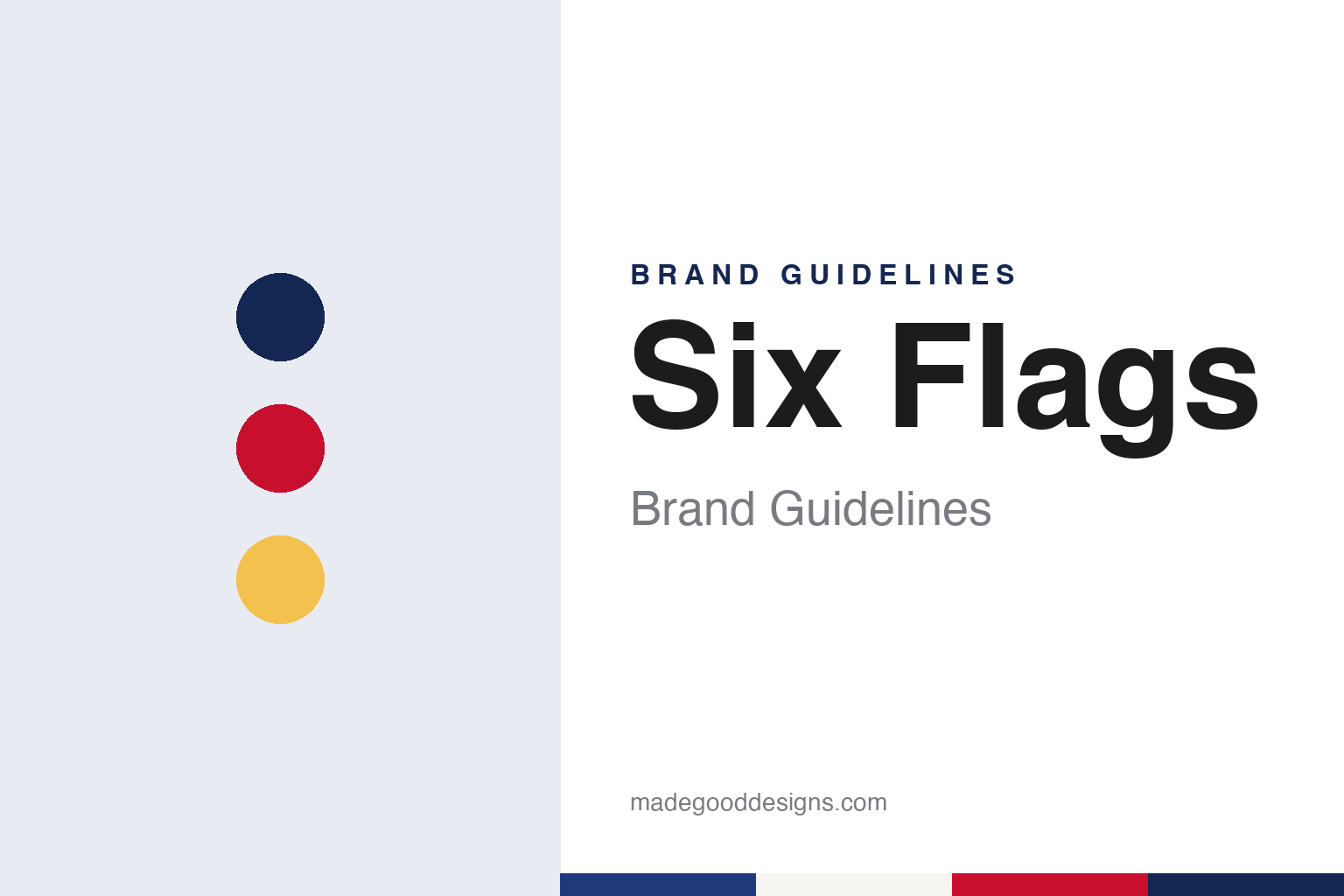
Six Flags Brand Guidelines
The Texas park named for six national flags.
Aa
Two constants: a flag blue, pennant red and fairground gold palette and a heavy midway sans register. Abstract homage — not a Six Flags mark; no logo, flag or character is reproduced.
Six Flags Over Texas
An industrial district, a family trip and a name taken from history.
Six Flags began as a single park between Dallas and Fort Worth. The Handbook of Texas, published by the Texas State Historical Association (entry published in 1976 and revised in October 2021), says Six Flags Over Texas opened in Arlington on 5 August 1961 and was originally owned and operated by the Great Southwest Corporation. It calls the park the brainchild of Angus G. Wynne Jr., a Navy veteran of the Second World War who, with business partners, had built a real-estate development business after the war.
The park was not the original plan. According to the Handbook, the construction of the Dallas–Fort Worth Turnpike in the mid-1950s led Wynne to buy land in the Arlington and Grand Prairie area for a large industrial park, which he called the Great Southwest Industrial District. When the district struggled in its early years, he proposed a sporting complex to bring visitors to the area. During the planning, Wynne and his family visited Disneyland in Anaheim, California, and the Handbook says the visit persuaded him to build a theme park instead — one with a distinctly Texan spin. Construction began in August 1960 on a tract between Arlington and Grand Prairie.
The name came directly from that theme. The Handbook explains that Six Flags Over Texas was chosen to represent the six flags that have flown over the state: those of Spain, France, Mexico, the Republic of Texas, the Confederate States of America and the United States. The park was laid out to match, with areas built around periods of Texas history. Within months of opening, the Handbook says, the owners were planning a new “city” depicting the Spindletop oil-boom era, along with a larger lake, more live entertainment and a jungle-themed area called Skull Island.
History stayed part of the setting. The Handbook records Texas Historical Commission markers placed at the park’s replica of Fort St. Louis, at a “Boom Town” displaying oil rigging and tools of the 1920s, at an antique hand-carved carousel and at a demonstration of Texas railroads that includes narrow-gauge track from the nineteenth century. It also describes evening concerts at the Music Mill Theater and a festival called Holiday in the Park, held between Thanksgiving and New Year’s Eve.
Colour
From a railroad’s holding to a merged company that kept the name.
The single park became a chain. English Wikipedia says the Pennsylvania Railroad took a controlling stake in the Great Southwest Corporation, after which new parks were built and independently owned parks were bought over the following two decades. Wikipedia also says that after the company bought Marriott Corporation’s Great America park in Gurnee, Illinois, in 1984, it gained the rights to feature Warner Bros.’ Looney Tunes characters at its parks, and that Time Warner later bought much of the company and was its sole owner from 1993 to 1995.
The next change came from Oklahoma. Wikipedia describes Premier Parks as an Oklahoma-based real-estate firm and park operator that began as Tierco, which bought the Frontier City park in Oklahoma City in 1982. On 1 April 1998, Wikipedia says, Premier Parks acquired Six Flags Theme Parks; it then began applying the Six Flags name to several of its existing properties in North America and Europe and took the name for the whole company in 2000. The company filed for Chapter 11 protection in 2009 and, according to Wikipedia, re-emerged as Six Flags Entertainment Corp. on 3 May 2010.
The latest change joined two long-standing competitors. Wikipedia says Cedar Fair — the Sandusky, Ohio, operator built around Cedar Point — and Six Flags announced a merger on 2 November 2023. The Associated Press, in a report carried by FOX 4 Dallas–Fort Worth on 2 July 2024, said the merger had been completed that week, creating a combined company named Six Flags Entertainment Corporation. The AP report said the new company is headquartered in Charlotte, North Carolina, keeps significant finance and administrative operations in Sandusky, and holds intellectual property including Looney Tunes, DC Comics and Peanuts. It quoted the announcement as saying each park would keep its legacy branding, with no changes to park names planned.
That decision means the Six Flags name now sits above parks that never carried it. Wikipedia says Cedar Fair had bought Knott’s Berry Farm in 1997, gaining the licence to use the Peanuts characters in its parks, and that at the merger the company said all properties would keep their pre-merger names. Wikipedia adds that the company’s administrative offices are in Sandusky and Arlington as well as its Charlotte headquarters. Wikipedia also says that in February 2025 the company signed an agreement with Qiddiya Investment Company to provide operational support and brand licensing to parks in the Qiddiya City project in Saudi Arabia, including one named Six Flags Qiddiya City.
Typography
Design and documentation.
A theme-park identity is read on the move. Visitors meet it first on a highway sign or a car-park pole, then at the entrance gate, and the same name has to work at the size of a building and the size of a ticket stub. That is why park marks tend to be built from bold, simple shapes that survive distance, glare and a quick glance from a moving car.
Inside the gates, the park map becomes the identity’s busiest document. It has to sort themed areas, paths, food stops and facilities into something a family can follow with one hand, so colour coding, numbered keys and a small set of pictograms usually carry more weight than the logo itself.
Characters and mascots add a second layer. A costumed figure, a cartoon on a cup or a face on a plush toy gives the brand a personality that a wordmark alone cannot, and it travels well onto merchandise.
Ride and area signage then borrows the theme of each zone, from rough timber lettering to bright fairground type, while souvenir packaging, bags and photo folders carry the main mark home. For designers, the lesson is a system that flexes by zone but still reads as one place.
Aa
A heavy midway sans — the register of a park gate, a pennant and a ride sign. (Specimen set in Archivo Black, a sans-serif STAND-IN; NOT the Six Flags logo.)
Six Flags
A name that began as a history lesson.
The Six Flags identity starts with a phrase rather than a picture. The name of the original park, as the Handbook of Texas explains it, refers to the six national flags that have flown over Texas, and the park itself was organised around the periods those flags stand for. Its name describes a piece of regional history, and the original park used replicas, historical markers and themed areas to tell that history to visitors arriving from Dallas and Fort Worth.
As the company grew, the name travelled far beyond Texas. Wikipedia says Premier Parks applied the Six Flags name to parks it already owned after 1998 and adopted it for the whole company in 2000, so the brand came to stand for a chain of parks in many states rather than a single place. The licensed characters became part of the identity at the same time: Wikipedia ties the arrival of Looney Tunes characters to the 1984 purchase of Great America, and the AP’s 2024 report listed Looney Tunes, DC Comics and Peanuts among the intellectual property held by the merged company. Seasonal events are a further layer; the Handbook describes Holiday in the Park at the Arlington park running from Thanksgiving to New Year’s Eve.
The 2024 merger added another layer of naming. The AP report quoted the combined company as saying each park would keep its legacy branding, so the Six Flags name now works on two levels: as the name over the gates of the parks that already carried it, and as the corporate name above parks such as Cedar Point and Knott’s Berry Farm that keep their own signs and histories. For a designer, that separation between a corporate name and the names guests actually see at each park is the central fact of the current brand.
For a design guide, Six Flags shows how a regional name taken from history can grow into a chain-wide brand, and then into a corporate umbrella over parks that keep their own identities. Compare it with Cedar Point, the Ohio park at the centre of the former Cedar Fair, and Knott’s Berry Farm, another park that kept its own name after the 2024 merger. For this guide we use flag blue, pennant red and fairground gold with a sans, an unofficial interpretation; no product or logo is reproduced.
Explore & save
Keep Six Flags’s identity on hand — save it to a board in the Made Good inspiration library.
Six Flags identity set
Pin the Six Flags flag blue, pennant red and fairground gold palette and the heavy midway sans register to your own board.