Tecate Brand Guidelines
The Baja California border lager in the red can.
Aa
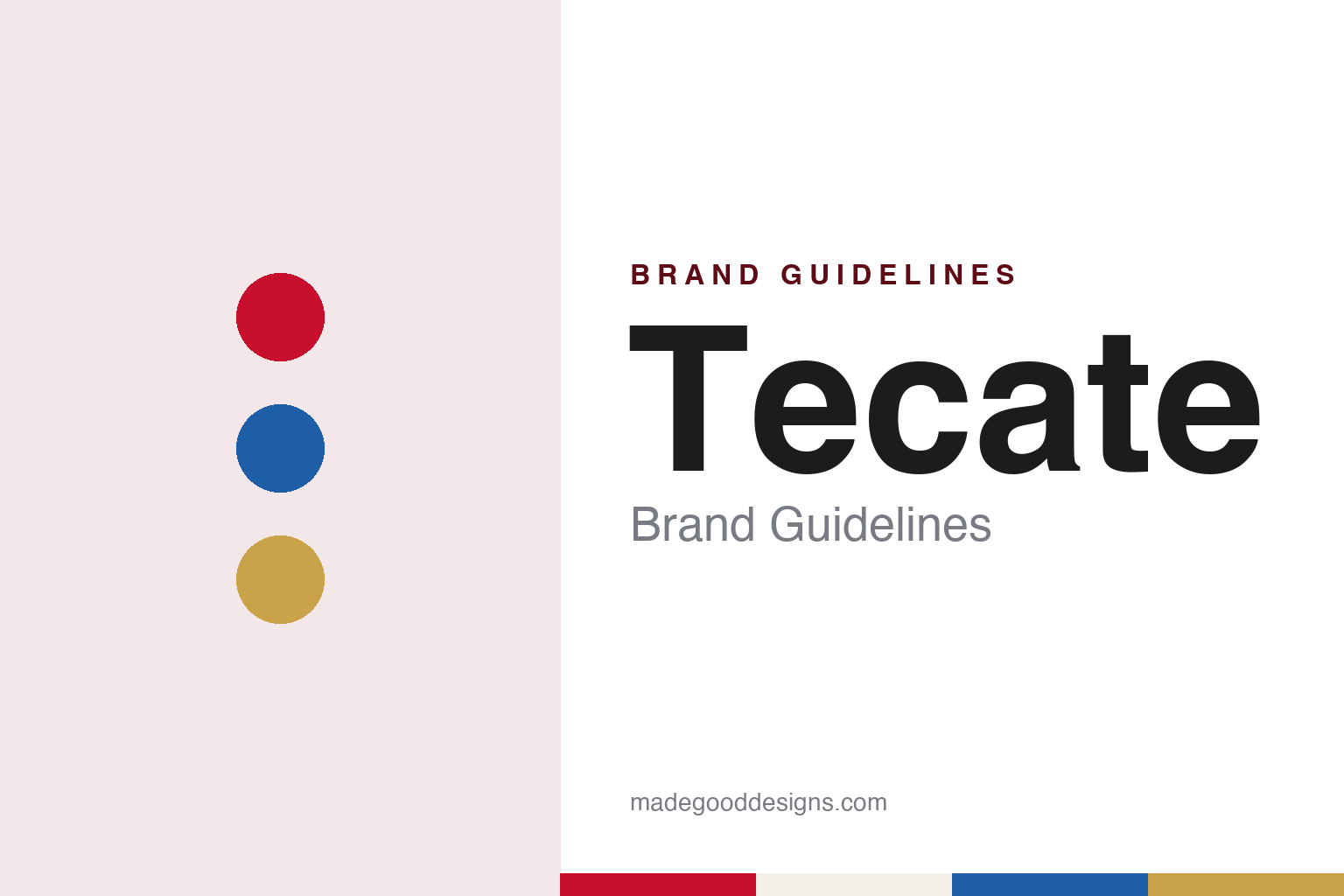
Two constants: a can red, light blue and lager gold palette and a condensed bold sans register. Abstract homage — not a Tecate product or mark; no can, label or logo is reproduced.
A brewery on the border
An oil mill, a malt trader and a town’s name.
Tecate takes its name from Tecate, a city in Baja California that sits on the Mexico–US border, opposite the small town of Tecate, California. The business behind the beer, the Compañía Cervecera de Tecate S.A., opened in 1944, according to Spanish Wikipedia’s article on the brewery; Heineken México and the brand’s US website give the same year. English Wikipedia, and Spanish Wikipedia’s article on the city, give 1943 instead.
The founder was Alberto Aldrete, the company says. Spanish Wikipedia, citing the Mexicali city government and a 2015 article in the history journal Meyibó, describes Aldrete as a former municipal president of Mexicali who from the late 1920s ran a company selling malt and hops to breweries, the Compañía Mexicana de Malta, and who in 1939 started a vegetable-oil mill in Tecate. For the brewery, Spanish Wikipedia says, the company took over the oil factory’s building, which dated from 1929, and bought second-hand brewing machinery in the United States.
Exports started early. The brand’s US website says that in 1947 the brewery began shipping beer to Asia and the United States, with demand growing in states including Colorado, New Mexico, Arizona and Texas; Spanish Wikipedia also says much of its output that year went to Asia. Then the brewery changed hands. In 1954 it was bought by Cervecería Cuauhtémoc of Monterrey, Heineken México and the US website both say, and Spanish Wikipedia gives the same year, citing El Economista in 2017. Cuauhtémoc had been founded in Monterrey in 1890 by a group of local businessmen that included José A. Muguerza, Isaac Garza, Francisco G. Sada and Joseph M. Schnaider, according to English and Spanish Wikipedia. The US website says Tecate became the second most important beer brand in Mexico during the 1950s.
Colour
The first cans, a light beer and a bilingual voice.
Tecate’s story is closely tied to the can. Heineken México says Tecate was the first beer sold in a can in Mexico, and Spanish Wikipedia dates that first canned beer to 1953, the year before the Cuauhtémoc purchase. Heineken México says that after 1954 Cuauhtémoc developed the brand nationally with a particular focus on new packaging. Accounts of the next step differ: Spanish Wikipedia puts an easy-open can in 1957, while the brand’s US website says that in 1964 Tecate launched the first “easy open” can in Mexico, one that needed no can opener. English Wikipedia describes Tecate as sold in distinctive red and blue aluminium cans and in twist-top bottles; in Mexico, Heineken México also lists the large caguama bottle.
The range grew slowly. Tecate Light followed in the 1990s: the company dates it to 1994 and calls it the first light beer made and sold in Mexico, while English Wikipedia gives 1992. Heineken México says an alcohol-free Tecate 0.0 was launched in 2023.
In the United States, Tecate advertised first in Spanish-language media and later in English, English Wikipedia says. A 2008 campaign, which the trade site Hispanic Marketing & Public Relations described as the brand’s first bilingual multimedia campaign, carried the line “Con Carácter” (“With Character”), and another used “It’s not beer, it’s cerveza.” Sport has been a constant. Tecate was the main sponsor of the Mexican driver Adrián Fernández in CART racing, the Los Angeles Times reported in 2003, and English Wikipedia says the brand moved into boxing in the mid-2000s, partnering with Golden Boy Promotions from 2006, then Top Rank, then Golden Boy again from 2016, the year it signed the boxer Canelo Álvarez. In February 2020 Tecate launched “Mexico Is in Us”, a campaign about Mexican-American roots, according to the company’s press release, and MediaPost and Marketing Dive reported that the brand was moving away from macho messaging.
Typography
Design and documentation.
The seven brands in this group are all drink names from France and Mexico: Orangina, Vittel, Teisseire, Peñafiel, Boing!, Sidral Mundet and Tecate. French and Mexican drink brands in general sit at many different points in the trade, from family firms that still carry a founder’s name to names that now belong to much larger food and drink groups, and a single brand can be sold everywhere from a corner shop to a supermarket shelf.
A drink brand’s identity is usually carried less by a single product than by a bottle, a can, a name and the moment of drinking it promises, because the company behind the name may have changed hands, moved its production or grown far beyond the place where it started. That makes the questions behind each name worth asking plainly: who started it, who owns it now, and where its drinks are actually made and packed.
Each guide separates what independent sources record from what the company says about itself — its founding story, its owners over time, where its drinks are made and how its packaging has changed — and marks plainly what rests only on the company’s own word.
Aa
A condensed bold sans for a border lager sold in a red can. (Specimen set in Oswald, a sans STAND-IN; NOT the Tecate logo.)
Tecate
Monterrey, FEMSA and Heineken.
Tecate’s owner has itself changed shape several times. In 1985 the Monterrey group then known as VISA brought Orizaba’s Cervecería Moctezuma alongside Cuauhtémoc, adding Dos Equis, Superior, Sol and Noche Buena to a stable that already held Carta Blanca, Tecate, Bohemia and Indio, English Wikipedia says; Spanish Wikipedia says the two were merged as Cervecería Cuauhtémoc Moctezuma in December 1988. The beer business then sat inside FEMSA, formed in 1988 as VISA’s main subsidiary. Canada’s Labatt bought 22% of the brewer in 1994, and FEMSA bought back the 30% held by Labatt’s owner in 2004, according to Spanish Wikipedia and a FEMSA statement from August 2004. On 11 January 2010 the Dutch brewer Heineken announced that it would take over FEMSA’s beer business, including Cuauhtémoc Moctezuma, the BBC reported, with FEMSA receiving a 20% stake in Heineken in exchange, Spanish Wikipedia says.
Under Heineken the brand has been pushed abroad. In April 2017 Heineken said Tecate would be exported worldwide, the trade site Portada reported, and Heineken México now calls Tecate its leading brand in Mexico. English and Spanish Wikipedia list Cuauhtémoc Moctezuma breweries in Monterrey, Guadalajara, Toluca, Orizaba, Navojoa, Tecate and Meoqui, Chihuahua, where a new plant opened in February 2018, El Diario de Chihuahua reported. For the United States, the brand’s website says Tecate is brewed and packaged by Cuauhtémoc Moctezuma in Monterrey, and that 24-ounce cans of Tecate and Tecate Light are also brewed and packaged by Cervezas Mexicanas in Irwindale, California. For the lettering on the can, see our separate guide to the Tecate font.
For a design guide, Tecate shows how a beer named after one border town can carry that town’s name, and a red can, across two countries for eight decades. Compare Red Stripe, another lager now owned by Heineken, and Jumex, the Mexican juice maker known for its little blue can. For this guide we use a can red, a light blue and a lager gold with a condensed sans, an unofficial interpretation; no product or logo is reproduced.
Explore & save
Keep Tecate’s identity on hand — save it to a board in the Made Good inspiration library.
Tecate identity set
Pin the Tecate can red, light blue and lager gold palette and the condensed bold sans register to your own board.