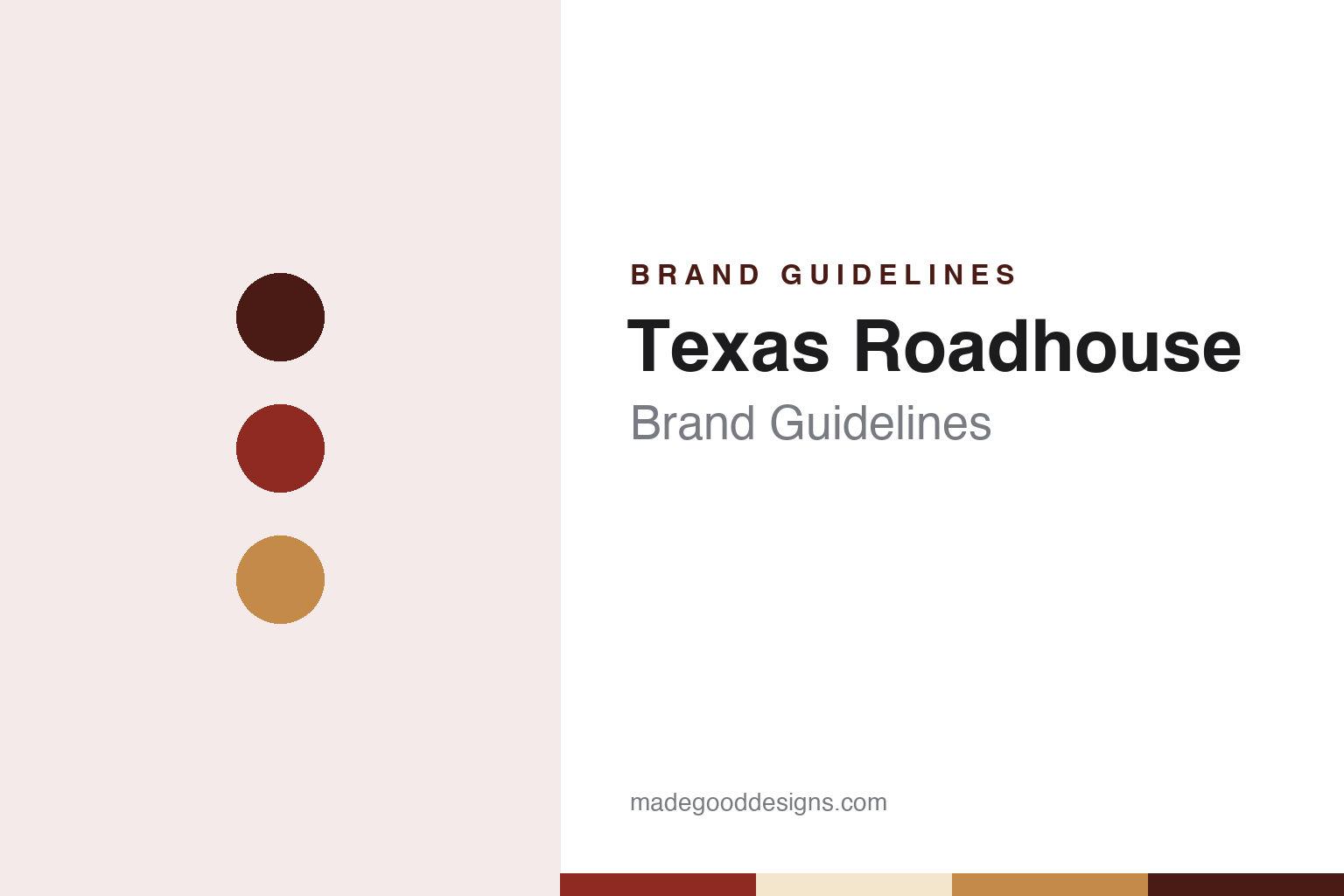
Texas Roadhouse Brand Guidelines
The Kentucky steakhouse with a Texas name.
Aa
Two constants: a barn red, pine plank and neon cream palette and a western display serif register. Abstract homage — not a Texas Roadhouse product or mark; no sign, armadillo or logo is reproduced.
Clarksville
A Louisville restaurateur, a Texas name and a mall across the river.
Texas Roadhouse was never a Texas business. English Wikipedia says the original restaurant opened on 17 February 1993 at the Green Tree Mall in Clarksville, Indiana, just across the Ohio River from Louisville, Kentucky, the founder’s home town. That founder was W. Kent Taylor, who, Wikipedia says, had worked in nightclubs and restaurants in Colorado before returning to Louisville in 1990 and taking a job as a Kentucky Fried Chicken manager.
The restaurant before the Roadhouse shaped it. FSR magazine, in a long profile published on 1 September 2021, says Taylor’s debut was Buckhead Hickory Grill (later Buckhead Mountain Grill), which opened in 1991; Wikipedia says former Kentucky governor John Y. Brown Jr. backed that venture before the partnership fell apart. Taylor then went looking for money for a new steakhouse idea. Wikipedia says he sketched it for a customer, Dr. John Rhodes, on loose sheets of paper and cocktail napkins, and that Rhodes and colleagues agreed to invest in 1992. FSR says Taylor sold his interest in the Buckhead restaurant in 1994, a year after launching Texas Roadhouse.
The name came from the road. According to FSR, it was inspired by trips Taylor took through Dallas while working for the Bennigan’s chain: the culture of the state hooked him, along with the idea of a restaurant on the side of a highway where travellers stopped for a good meal. Because the restaurant was in Indiana, Taylor rented a post office box in Dallas and printed that Texas address on the comment cards to lend the brand some credibility, the magazine reports. It adds that Texas Roadhouse did not open a restaurant in Texas until 1997, in Grand Prairie, and that the store was managed by Jerry Morgan, who would later succeed Taylor as chief executive.
The early years were uneven. Wikipedia says a second restaurant opened in Gainesville, Florida, in 1993, and that sites in Cincinnati, Clearwater and Sarasota opened in 1994 and later closed, which led Taylor to rethink training, building design and decor. FSR says he kept photographs of the closed stores on his office wall throughout his career.
Colour
A prototype, a public company and a change of leadership.
The building came next. FSR says that by 1996 Taylor had connected with George Lask to develop a ground-up prototype restaurant for the brand’s home base of Louisville, and that apart from kitchen upgrades and a bar remodel the stores opening today remain a near replica of it. The magazine describes the hallmarks of that design as sightlines that let guests see from front to back as they walk in, with the manager placed as a central focus of the room. Taylor, it says, saw no reason to stray from the format.
Wikipedia records the corporate milestones. Texas Roadhouse became a public company in 2004, listing on Nasdaq under the symbol TXRH, and in September 2011 it opened a restaurant in Dubai, in the United Arab Emirates. The parent company, Texas Roadhouse, Inc., is headquartered in Louisville and also runs two other restaurant concepts, Bubba’s 33 and Jaggers.
Taylor ran the business in a style of his own. FSR describes him in cowboy hats, American flag boots and camouflage hoodies, and says the company banned coats and ties at its headquarters, keeping scissors handy to cut neckties off visitors. It also explains the managing-partner model he kept, in which restaurant operators invest in their own store and share in its results, an approach the magazine says the company did not invent.
The Associated Press reported on 22 March 2021 that Taylor, founder and chief executive, had died; FSR gives the date of his death as 18 March 2021. Jerry Morgan, whom Taylor had promoted to president the previous December, became chief executive, FSR says. Taylor’s book, Made From Scratch: The Legendary Success Story of Texas Roadhouse, was published posthumously in late August 2021, and the magazine reported that the company planned a museum in his honour inside its home office, where his desk had already been placed in the stairwell he once joked was all the space he could afford.
Typography
Design and documentation.
Grill rooms, steakhouses, burger counters and roadside family restaurants have long carried their names on the building itself as much as on a menu. A sign on a pole beside the road, lettering along a roofline, a painted wall or a neon tube above the door can all serve as the first piece of a restaurant’s identity that a passing driver sees, before anyone has stepped inside or opened a menu.
Inside, the same name is repeated in smaller forms: on printed menus and table cards, on paper placemats, cups and carry-out bags, on staff uniforms and caps, and in the fabric and colour of booths, counters and stools. Some of these chains have redrawn their buildings and dining rooms several times as owners changed, while others have kept an older storefront or interior in use for decades.
Each guide separates what independent, dated sources record from what the company says about itself — the founding story, the owners over time, the buildings and the advertising — and attributes each claim to its source, so that a reader can see where every fact comes from.
Aa
A western display serif — the register of a roadside sign and a wooden menu board. (Specimen set in Rye, a display serif STAND-IN; NOT the Texas Roadhouse logo.)
Texas Roadhouse
A motto, an armadillo, a song and a dance.
The brand’s words were settled early. Its mission statement, quoted by both Wikipedia and FSR, is “Legendary Food, Legendary Service”, and Jerry Morgan told the magazine the phrase was never meant to confuse anybody: it was about the greeter at the front door, the knowledge of the server and the hospitality in the room. The company’s employee relief fund carries the name of the mascot, Andy’s Outreach Fund, and Wikipedia identifies Andy as an armadillo.
Performance is part of the identity. Wikipedia says waiters, waitresses and hosts break into line dances through the evening, and FSR traces the tradition to a regional partner, Neal Niklaus, who started it at the restaurant in Ashland, Kentucky. The magazine also lists other habits from Taylor’s book that shape what guests see: an in-house bakery making rolls in each store and a resident meat cutter on site, with managers “in the window” and leaders at the door.
Music completes the picture. Wikipedia says each restaurant had a table called “Willie’s Corner”, decorated with pictures and memorabilia of Willie Nelson, and that Nelson signed a deal in 2002 to become an official partner of the chain, after which he promoted it, including on a Food Network special. Inside, the format Taylor and George Lask settled on in the mid-1990s still governs the look of each store, according to FSR.
For a design guide, Texas Roadhouse shows how a brand can borrow a whole state’s imagery — the name, the armadillo, the country music and the dancing — and make it convincing from a mall in Indiana and an office in Louisville. Compare it with LongHorn Steakhouse, the Atlanta chain built on a Texas honky-tonk idea in 1981, and Sizzler. For this guide we use barn red, pine plank and neon cream with a serif, an unofficial interpretation; no product or logo is reproduced.
Explore & save
Keep Texas Roadhouse’s identity on hand — save it to a board in the Made Good inspiration library.
Texas Roadhouse identity set
Pin the Texas Roadhouse barn red, pine plank and neon cream palette and the western display serif register to your own board.