Ruby Tuesday Brand Guidelines
The Knoxville restaurant named for a Rolling Stones song.
Aa
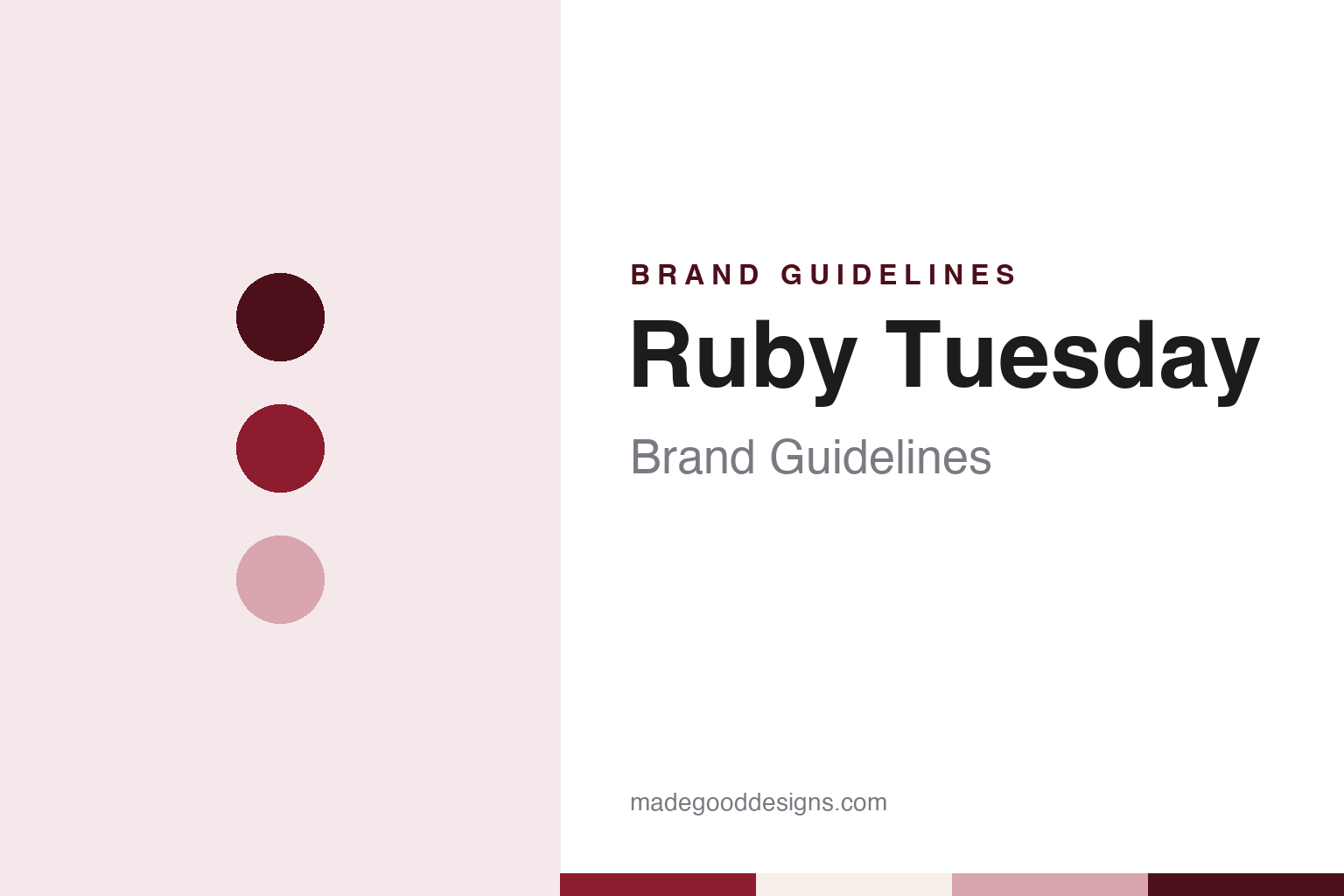
Two constants: a ruby, rose quartz and linen palette and a contrast display serif register. Abstract homage — not a Ruby Tuesday product or mark; no sign, menu or logo is reproduced.
Knoxville
A student, his fraternity brothers and a song title.
Ruby Tuesday is named after a song. English Wikipedia says the concept was started in 1972 by Samuel E. (Sandy) Beall III, then connected to the University of Tennessee, and that the original restaurant opened next to the university’s Knoxville campus. The building still stands, Wikipedia says, although the restaurant in it has closed.
The money and the name came from Beall’s circle. Wikipedia says he received backing from a friend who operated several Pizza Hut restaurants, and that he and a group of University of Tennessee fraternity brothers put together further funds as co-investors. One of those fraternity brothers suggested the name, which Beall took from the Rolling Stones song “Ruby Tuesday”.
The concept spread steadily through the 1970s. Wikipedia says a new location opened roughly every nine months over the following decade, and that in April 1982 Beall sold the chain to Morrison Inc., a food-service company. The sale made Beall president of a newly formed specialty restaurant division built around Ruby Tuesday, according to Wikipedia, and the brand became a central part of Morrison’s restaurant business through the rest of the decade.
In 1992, Wikipedia says, Morrison Inc. was renamed Morrison Restaurants Inc., its dining division was realigned under the name Ruby Tuesday Group, and Beall became chief executive of the whole company. On 9 March 1996 shareholders approved splitting Morrison Restaurants into three companies: Ruby Tuesday Inc., Morrison Health Care Inc. and Morrison’s Fresh Cooking Inc. Ruby Tuesday Inc. became the legal successor to the old Morrison business, so a restaurant named after a song ended up as the name of the corporation itself.
Colour
Maryville, new concepts, NRD Capital and a restructuring.
The company moved closer to where it started. Wikipedia says that in the summer of 1998 Ruby Tuesday relocated its headquarters from Mobile, Alabama, to Maryville, Tennessee, near Knoxville. In November 2000 it completed the sale of its other restaurant brands, including L&N Seafood Grill, Mozzarella’s Café, Silver Spoon Café and Tia’s Tex-Mex, to Specialty Restaurant Group, LLC, leaving Ruby Tuesday Inc. with its namesake brand. On 12 April 2007 it changed its New York Stock Exchange ticker symbol from RI to RT, Wikipedia records.
Later years brought experiments. Wikipedia says the company acquired the Asian concept Wok Hay in 2007, licensed and later bought Lime Fresh Mexican Grill, took development rights to Truffles Grill and created its own seafood concept, Marlin & Ray’s, before closing Wok Hay and Marlin & Ray’s in 2013; Lime Fresh rights were sold in 2016. On 6 June 2012 Beall announced that he would leave the company he had founded, according to Wikipedia.
Ownership changed in 2017. FSR magazine reported on 22 December 2017 that NRD Capital had completed its acquisition of the Maryville-based chain on 21 December, taking it private; the deal had been announced on 16 October 2017 after a lengthy strategic review. The magazine described NRD as an Atlanta-based private equity firm started in 2014 by Aziz Hashim, a former franchisee of several quick-service brands, whose earlier deals included the Frisch’s restaurant business in 2015 and a stake in Fuzzy’s Taco Shop in 2016. Nation’s Restaurant News reported that the NRD-owned company filed for Chapter 11 bankruptcy protection on 7 October 2020, and FSR reported on 25 February 2021 that Ruby Tuesday had emerged from the process through a debt-for-equity swap with its secured lenders.
Through these changes the chain kept its Tennessee base and its name. FSR’s 2021 report quoted chief executive Shawn Lederman describing the business as positioned to be more efficient and stable, and said it planned to keep developing virtual, delivery-only brands alongside its restaurants. The headquarters remained in Maryville, a short drive from the Knoxville campus where the original restaurant opened.
Typography
Design and documentation.
Grill rooms, steakhouses, burger counters and roadside family restaurants have long carried their names on the building itself as much as on a menu. A sign on a pole beside the road, lettering along a roofline, a painted wall or a neon tube above the door can all serve as the first piece of a restaurant’s identity that a passing driver sees, before anyone has stepped inside or opened a menu.
Inside, the same name is repeated in smaller forms: on printed menus and table cards, on paper placemats, cups and carry-out bags, on staff uniforms and caps, and in the fabric and colour of booths, counters and stools. Some of these chains have redrawn their buildings and dining rooms several times as owners changed, while others have kept an older storefront or interior in use for decades.
Each guide separates what independent, dated sources record from what the company says about itself — the founding story, the owners over time, the buildings and the advertising — and attributes each claim to its source, so that a reader can see where every fact comes from.
Aa
A contrast display serif — the register of a gem name and a record sleeve. (Specimen set in Playfair Display, a serif STAND-IN; NOT the Ruby Tuesday logo.)
Ruby Tuesday
A borrowed title, a gem and a weekday.
The Ruby Tuesday name is the brand’s main asset. It joins a gemstone to a day of the week and comes straight from the title of a Rolling Stones song. Wikipedia’s account of its origin is a suggestion from a fraternity brother while a group of University of Tennessee students was putting a restaurant together, and the name has stayed in place through corporate ownership, a public listing and private equity.
The name also outgrew the restaurant. When Morrison Restaurants Inc. was divided in 1996, the restaurant company that emerged took the name Ruby Tuesday Inc., and Wikipedia says it remained the legal successor to Morrison. From then on the same two words described both a dining room and a stock-market listing, under the ticker RI and, from 2007, RT. The other brands the company tried, from Wok Hay to Marlin & Ray’s, each had their own names, and the company later closed or sold them.
Our palette takes its cue from the gem in the name: a deep ruby with rose and linen. The rest of the identity lives in the story — Knoxville, a song title and the move of the headquarters back to East Tennessee in 1998.
For a design guide, Ruby Tuesday shows how a name borrowed from popular culture can carry a restaurant from a single campus dining room to a corporation, through owners as different as a food-service conglomerate and a private equity firm. Compare it with Red Robin, another chain whose name came from a song, and Bob Evans. For this guide we use ruby, rose quartz and linen with a serif, an unofficial interpretation; no product or logo is reproduced.
Explore & save
Keep Ruby Tuesday’s identity on hand — save it to a board in the Made Good inspiration library.
Ruby Tuesday identity set
Pin the Ruby Tuesday ruby, rose quartz and linen palette and the contrast display serif register to your own board.