Shangri-La Brand Guidelines
A novelist’s hidden valley turned into a hotel name.
Aa
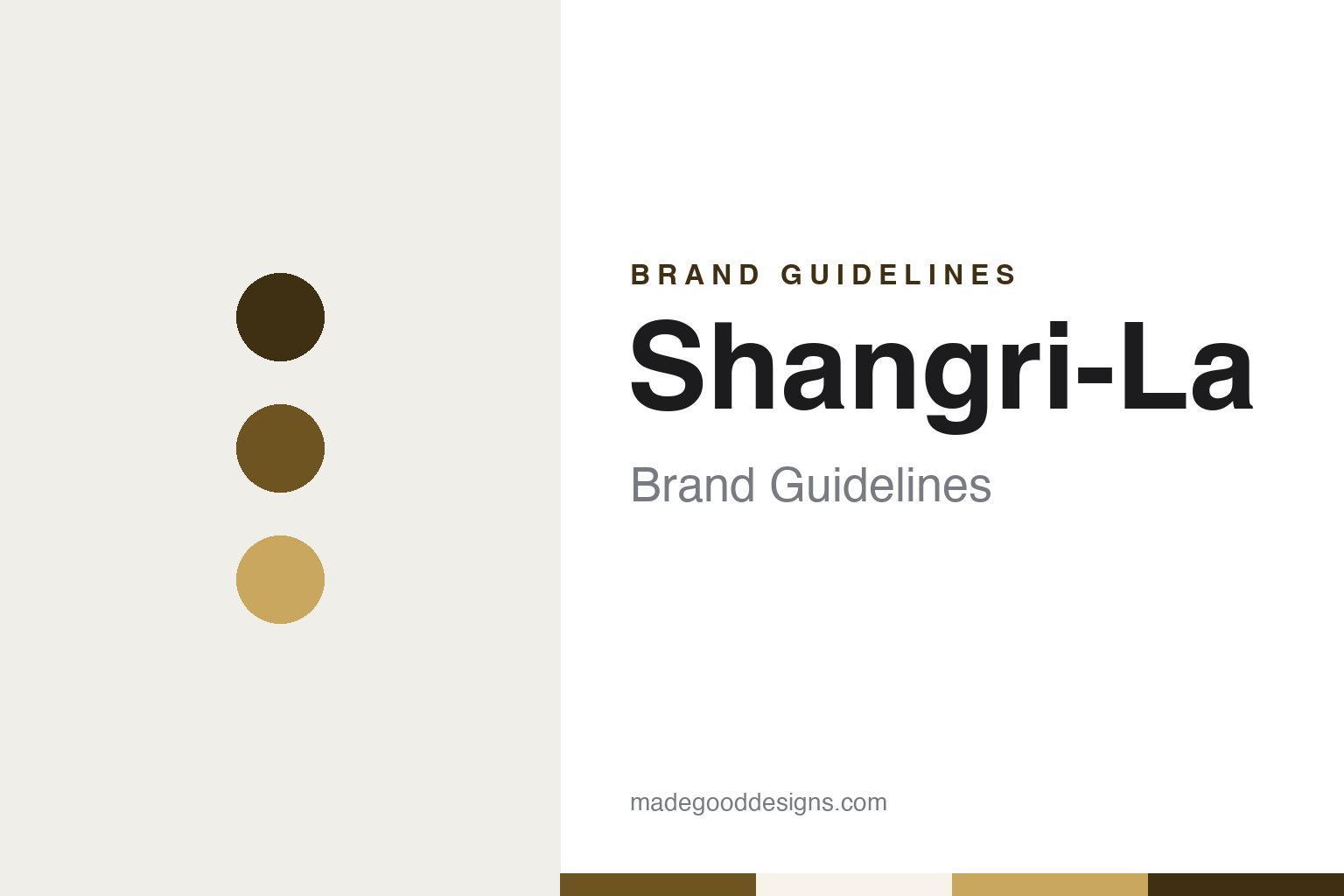
Two constants: a lacquer bronze, soft gold and silk cream palette and a refined display serif register. Abstract homage — not a Shangri-La asset or mark; no logo or signage is reproduced.
Orange Grove Road, 1971
A businessman, a novel and a hotel off Orchard Road.
Shangri-La began with a single hotel in Singapore. English Wikipedia records that the Shangri-La Hotel Singapore opened on 23 April 1971 on Orange Grove Road, just off Orchard Road, and that it was the first property of what became Shangri-La Hotels and Resorts. The group was founded that year by the Malaysian businessman Robert Kuok. Nikkei Asia, profiling Kuok in June 2018, described him as the founder of the Shangri-La Hotel chain and the hospitality arm as one part of a wider business empire built across Asia.
The name came from fiction. Shangri-La is the hidden, contented valley in James Hilton’s 1933 novel Lost Horizon, and Wikipedia says the hotel group took its name from that imaginary place. The Chinese name of the group, 香格里拉, renders the same word.
The first hotel was not run by the founder’s own company at the outset. Wikipedia says the Singapore hotel was managed by Westin Hotels & Resorts until Shangri-La International Hotel Management was founded in 1979; management of the Singapore hotel was taken back from Westin in 1984, and it was 1991 before Shangri-La assumed control of the rest of its hotels. Robert Kuok himself is listed as both chairman and chief executive of the group from 1984 to 1993.
The Singapore property grew in stages. Wikipedia dates its Tower Wing, the main wing with most of the restaurants, to 1971; the Garden Wing, set within the landscaped grounds and fitted with balconies, to 1978; and the Valley Wing to 1985. The Garden Wing closed for renovation in 2011 and reopened on 31 May 2012. The Tower Wing houses the hotel’s Horizon Club rooms and its Horizon Premier Suite, along with its deluxe and executive rooms, Wikipedia says. Wikipedia describes the grounds around the Garden Wing as landscaped gardens.
Colour
A Hong Kong head office, a listed parent and a family name.
As the group expanded beyond Singapore its centre of gravity moved to Hong Kong. English Wikipedia gives the head office as Kerry Centre in Quarry Bay, on Hong Kong Island. The listed company at the top of the structure is Shangri-La Asia Limited, incorporated in Bermuda and primarily listed on the Stock Exchange of Hong Kong, with a secondary listing in Singapore. Shangri-La Asia has owned Shangri-La International Hotel Management, the operating company, since 1997, Wikipedia says. Separate listed companies hold hotels in Malaysia and Thailand.
The leadership has stayed close to the founding family. Wikipedia’s list of former chairmen runs from Robert Kuok (1984–1993) through Pho Ba Quan and Richard Liu to Beau Kuok Khoon-chen, who chaired the group from 1997 to 2000 and again from 2013 to 2017; Edward Kuok Khoon-loong held the chair from 2003 to 2008 and Kuok Khoon-ean from 2008 to 2013. Among the chief executives, Wikipedia lists Paul Bush from 1994 to 1997 and Lim Beng Chee from 2017 to 2022. The same page records Kuok Hui-kwong as group chairman since January 2017 and as group chief executive since August 2025.
Shangri-La is the group’s main brand, and Wikipedia lists the group’s other brands for different market segments as Traders Hotels, Kerry Hotels and Hotel Jen. The group has hotels in Asia, Europe, the Middle East, North America, Oceania and Africa; Wikipedia names Shangri-La London and Shangri-La Toronto among its notable properties.
The first hotel has also lent the brand a name in international politics. CNA explained in May 2024 that the annual Asia security summit run by the International Institute for Strategic Studies began in 2002 as a small meeting of defence ministers at the Shangri-La hotel in Singapore, and that the forum was later named after the hotel. Wikipedia records that the hotel hosted the meeting between Xi Jinping and Ma Ying-jeou in 2015, and that a “special event area” was declared around the hotel and Capella Singapore in June 2018 ahead of the Trump–Kim summit.
Typography
Design and documentation.
Hotel identities tend to live in many places at once. A crest or wordmark appears on the façade, the lobby signage, the key card and the doorman’s cap, and each of those surfaces asks something different of the mark: legibility from across a street, quiet presence on a pillow card, crisp reproduction when it is embroidered in thread or pressed into a wax seal. A hotel group can keep a simplified version of the mark alongside the full lockup, so that a monogram or single initial can stand in where the complete name will not fit.
Uniforms carry a large share of the visual language. Colour, cut, buttons and badges signal role as much as brand, and they often repeat the palette of the interiors. Liveried cars, shuttle buses and boats extend the same tones onto the street, where a consistent paint colour can become part of how guests recognise the property from a distance.
Room collateral is where the system is read up close: stationery, menus, door hangers, toiletry labels and in-room guides. Typography and spacing matter more here than anywhere else, because guests handle these pieces and keep some of them as souvenirs.
Aa
A refined display serif — the register of a lobby sign and a room card. (Specimen set in Cormorant Garamond, a serif STAND-IN; NOT the Shangri-La logo.)
Shangri-La
A borrowed word, a Chinese name and a hotel that named a summit.
The Shangri-La identity starts with a word that already existed. The name comes from a literary source, and the group has used it for its main brand since the first hotel opened in 1971. The same word is written in Chinese characters as 香格里拉 for the group’s Chinese name, so the brand works in two scripts at once.
The portfolio is organised around that main name. Traders Hotels, Kerry Hotels and Hotel Jen each carry their own name rather than a Shangri-La suffix. The Kerry name is shared by a hotel brand and the Kerry Centre in Quarry Bay, where Wikipedia places the head office.
The first hotel has become part of the brand story in its own right. Its wings from 1971, 1978 and 1985, its gardens off Orchard Road and its role as host of the Shangri-La Dialogue since 2002 are recorded by Wikipedia, and the CNA explainer of 2024 ties the summit’s name to the hotel.
For a design guide, Shangri-La shows how a single borrowed word from a 1930s novel, written in both Latin letters and Chinese characters, can carry a hotel group from one Singapore site to a Hong Kong head office and a family of separately named brands. Compare it with Mandarin Oriental, another hotel group run from Hong Kong, and Four Seasons. For this guide we use lacquer bronze, soft gold and silk cream with a serif, an unofficial interpretation; no product or logo is reproduced.
Explore & save
Keep Shangri-La’s identity on hand — save it to a board in the Made Good inspiration library.
Shangri-La identity set
Pin the Shangri-La lacquer bronze, soft gold and silk cream palette and the refined display serif register to your own board.