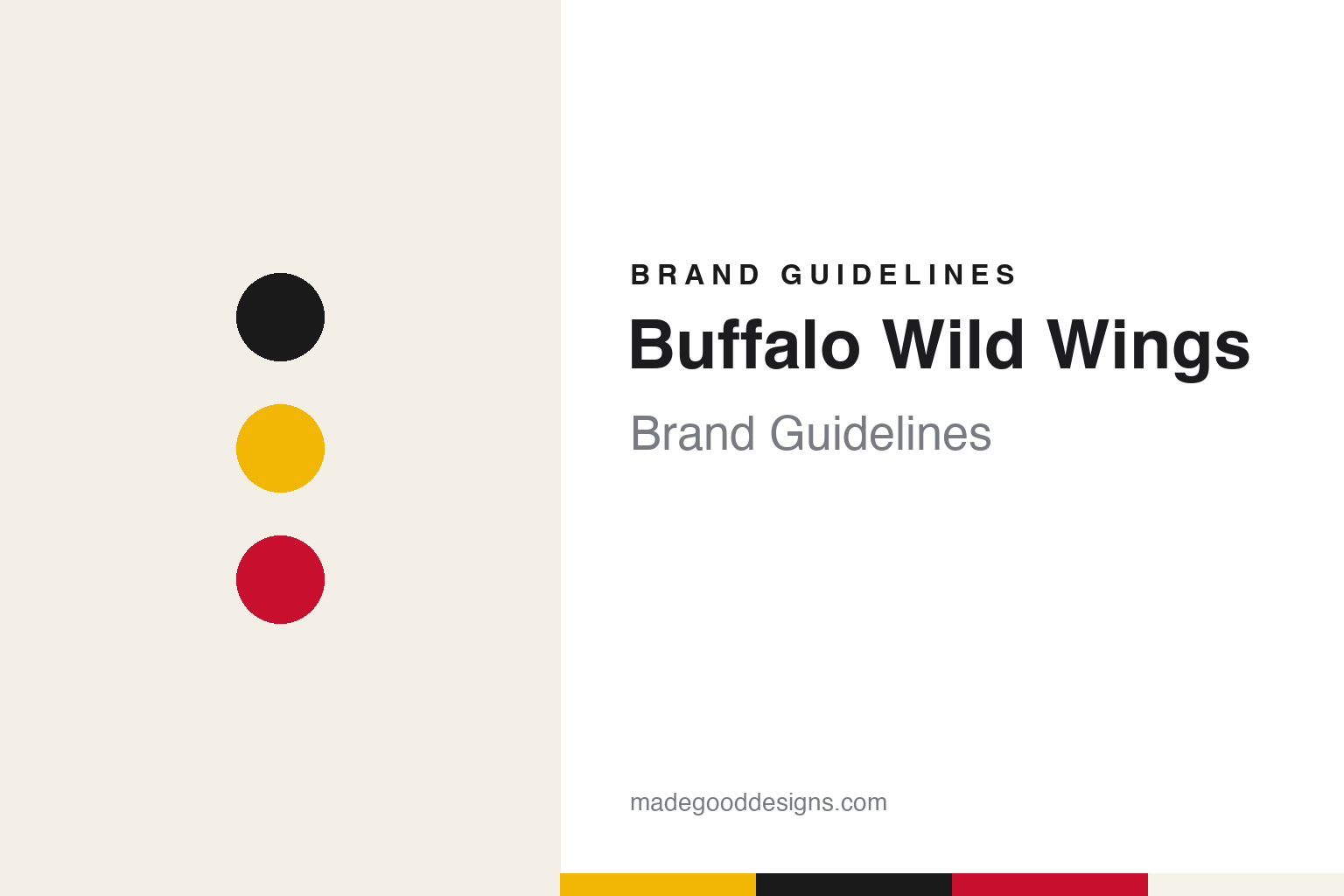
Buffalo Wild Wings Brand Guidelines
The Columbus wing bar that dropped the Weck.
Aa
Two constants: a wing gold, scoreboard black and sauce red palette and a condensed scoreboard sans register. Abstract homage — not a Buffalo Wild Wings product or mark; no logo, sign or packaging is reproduced.
Wings & Weck
Two friends, a skating competition and a storefront near campus.
Buffalo Wild Wings began in 1982 in Columbus, Ohio, under a longer name: Buffalo Wild Wings & Weck. The International Directory of Company Histories says the founders, Jim Disbrow and Scott Lowery, were longtime friends; Disbrow had moved to Cincinnati as a boy to live with Lowery’s parents, figure-skating coaches who became his legal guardians, and he later lived in Buffalo, New York, where he had come to know the city’s spicy chicken wings. The same history dates the idea to 1981, when Disbrow was judging a figure-skating competition at Kent State University and the pair went looking for Buffalo-style wings in town without finding any. English Wikipedia tells the same story of the Kent State meeting.
They chose Columbus because it was home to Ohio State University and its large student population, and in 1982 they opened in an empty storeroom space near the campus. In a 2025 report, News 4 Buffalo (WIVB) quoted Lowery, from a 2021 interview, recalling that the space had previously held another chicken-wing restaurant that had closed a few months earlier. The station also reported that Lowery had told the Dayton Daily News that both men had lived in Buffalo for a time.
The second half of the name pointed to the menu. “Weck” referred to kimmelweck, a roll topped with caraway seeds and coarse salt that is used for the beef-on-weck sandwich of western New York, and the company history says the first menu paired barbecued wings in a dozen sauces with beef sandwiches on kimmelweck buns. Customers soon shortened the long name to “bw-3”, the company history says, and Tasting Table wrote in 2025 that the nickname BW-3 still circulates. Within six months a third partner, Mark Lutz, had joined the business, and over the following decade new locations opened in Ohio, Indiana and Steamboat Springs, Colorado, where the partners liked to ski.
The business began to franchise in the early 1990s with help from Francorp, a Chicago law firm; the company history dates the plan to 1991 and Wikipedia dates the start of franchising to 1992. Franchisees were required to use the company’s bottled wing sauces, which the company history says were made at the time by Wilsey, Inc., of Atlanta. Headquarters were set up in Cincinnati, and after the company hired Sally Smith as chief financial officer in late 1994 it moved them to the Minneapolis–Saint Paul area, where she wished to stay. Smith became president and chief executive in August 1996, Wikipedia says, with Disbrow as chairman.
Colour
A sports-bar room, a shorter name and a new parent company.
The dining room became a large part of the brand. The International Directory of Company Histories describes a sports-bar motif aimed at a college-age crowd: wall-mounted televisions tuned to sporting events, computerised interactive sports trivia games and memorabilia displays, with a bar at the back of each restaurant. It also records a piece of in-store theatre — when a guest ordered the sauce then called “Better-Be-Ready-Blazin’”, a staff member in a fireman’s outfit delivered it to the sound of a siren.
In 1995, Wikipedia says, the company designed a new free-standing prototype with a clear separation between the bar and the dining areas, a shift in strategy from a college sports bar toward casual dining. The name was settled a few years later. After its first national advertising campaign used both “BW3” and “Buffalo Wild Wings” in different markets, Wikipedia says, the company decided in 1998 to standardise on Buffalo Wild Wings throughout the system and upgraded the packaging of its retail sauces. Tasting Table reported in 2025 that 1998 was the year the name became official on advertisements, bottled sauces and franchised restaurants. Lowery, quoted by News 4 Buffalo, said the shorter name came from the creative teams the partners had hired, and suggested it may have been chosen to fit better on a marquee.
By 2000 the locations were being called Buffalo Wild Wings Grill & Bar, Wikipedia and Tasting Table both say, and the chain had reached its namesake city, Buffalo, New York. In late 2001, Wikipedia says, the company signed Frito-Lay to make branded potato chips for the retail market. The company went public on the NASDAQ exchange on 21 November 2003, Wikipedia says, and later took a majority stake in the Rusty Taco chain in 2014, renaming it R Taco.
The ownership changed in 2018. Arby’s Restaurant Group announced plans to buy Buffalo Wild Wings in November 2017, and on 5 February 2018, Nation’s Restaurant News and Food Business News both reported, it completed the acquisition and renamed itself Inspire Brands. Food Business News named Arby’s chief executive Paul Brown and Neal K. Aronson, founder of Roark Capital Group, as Inspire’s founders, and described Roark as a majority owner. Nation’s Restaurant News reported that Inspire would be based in Atlanta and keep a support centre in Minneapolis, where Buffalo Wild Wings had been headquartered. Inspire Brands has owned Buffalo Wild Wings since 2018; Wikipedia gives the parent’s base as Sandy Springs, Georgia, a suburb of Atlanta.
Typography
Design and documentation.
Grill rooms, steakhouses, burger counters and roadside family restaurants have long carried their names on the building itself as much as on a menu. A sign on a pole beside the road, lettering along a roofline, a painted wall or a neon tube above the door can all serve as the first piece of a restaurant’s identity that a passing driver sees, before anyone has stepped inside or opened a menu.
Inside, the same name is repeated in smaller forms: on printed menus and table cards, on paper placemats, cups and carry-out bags, on staff uniforms and caps, and in the fabric and colour of booths, counters and stools. Some of these chains have redrawn their buildings and dining rooms several times as owners changed, while others have kept an older storefront or interior in use for decades.
Each guide separates what independent, dated sources record from what the company says about itself — the founding story, the owners over time, the buildings and the advertising — and attributes each claim to its source, so that a reader can see where every fact comes from.
Aa
A condensed scoreboard sans — the register of a sports-bar menu and a game-day screen. (Specimen set in Oswald, a sans-serif STAND-IN; NOT the Buffalo Wild Wings logo.)
Buffalo Wild Wings
A long name, a nickname and a room built around screens.
The Buffalo Wild Wings name has been shaped as much by its customers as by its owners. It opened in 1982 as a five-word name with an ampersand, and the people who ate there turned it into an initialism — “bw-3” in the company history, BW3 or BW-3 elsewhere — long before the company formally shortened it. News 4 Buffalo and Tasting Table both reported in 2025 on the nickname “B-Dubs”, which grew from the same initials. The name the company standardised in 1998 drops “& Weck” and keeps “Buffalo”, the city whose wings the founders set out to serve in Columbus.
The “Weck” half of the name has a small afterlife of its own. News 4 Buffalo reported that beef on weck was briefly offered again in 2017, during the chain’s 35th anniversary, and then left the menu. The company history describes the restaurants through their interiors — televisions on the walls, trivia games, memorabilia and a bar — and Wikipedia says the 1995 prototype divided the bar from the dining area.
Ownership has moved from three partners to public shareholders to a multi-brand restaurant company. Since February 2018 the name has sat inside Inspire Brands, alongside Arby’s, whose parent company bought it.
For a design guide, Buffalo Wild Wings shows how a restaurant name can be trimmed in stages — by customers first, then by the company — while keeping the one word that tells guests where its signature dish comes from. Compare it with Arby’s, its sister brand under Inspire Brands, and Red Robin, another American burger-and-bar chain in this group. For this guide we use wing gold, scoreboard black and sauce red with a sans, an unofficial interpretation; no product or logo is reproduced.
Explore & save
Keep Buffalo Wild Wings’s identity on hand — save it to a board in the Made Good inspiration library.
Buffalo Wild Wings identity set
Pin the Buffalo Wild Wings wing gold, scoreboard black and sauce red palette and the condensed scoreboard sans register to your own board.
