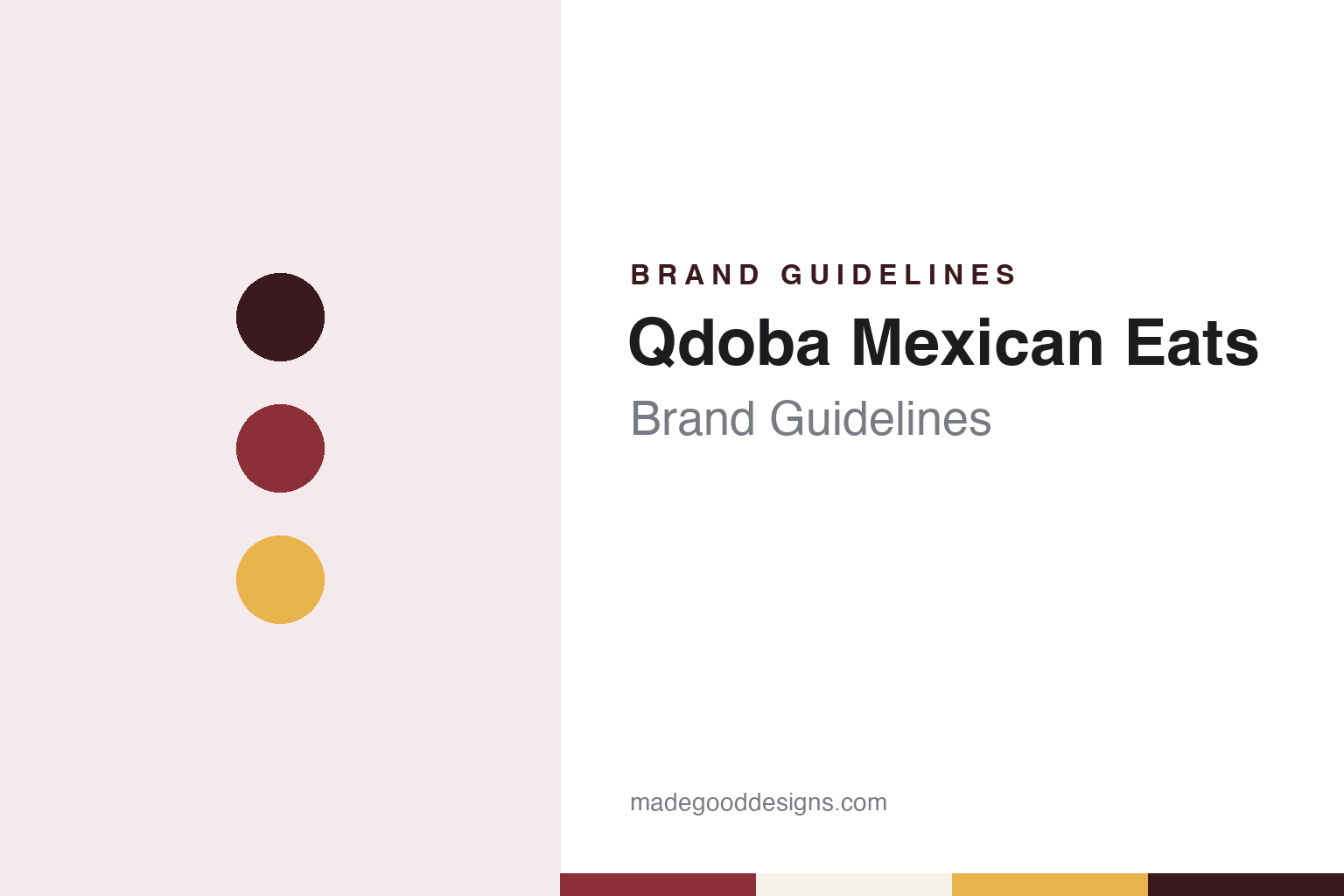
Qdoba Mexican Eats Brand Guidelines
The Denver burrito chain that changed its name three times.
Aa
Two constants: a chile red, queso gold and tortilla cream palette and a condensed signage sans register. Abstract homage — not a Qdoba product or mark; no Q, logo or sign is reproduced.
Zuma to Qdoba
A Denver corner, two lawsuits and a name from an agency.
Qdoba started life with a different name on a Denver corner. English Wikipedia says Anthony Miller, a Colorado native, and his partner Robert Hauser opened Zuma Fresh Mexican Grill in 1995 at Grant Street and Sixth Avenue in Denver. Denver’s FOX31, in a May 2023 report on restaurant chains that began in Colorado, confirmed the 1995 opening under the Zuma name and said diners could still eat at the original restaurant at Grant Street and 6th Avenue. Food Republic, writing in February 2026, said the site at Sixth Avenue and Grant Street in downtown Denver was still operating as a Qdoba restaurant in January of that year.
The founders met in New York, Wikipedia says, where Miller was an investment banker with Merrill Lynch and Hauser, a graduate of the Culinary Institute of America, had worked at the restaurant Le Cirque. Hauser developed much of the original menu. The name Zuma was made up, Wikipedia adds, though it also belonged to a friend’s cat.
The name did not last. In 1997 the company became Z-Teca Mexican Grill, because of a lawsuit from a Boston restaurant that also used the name Zuma and because of confusion with ZuZu Handmade Mexican Grill, a similar-sounding chain then operating around Denver, Wikipedia says. The same year Z-Teca began to offer franchises to take the chain beyond Colorado. In early 1998 Western Capital and other investors put money into the company in exchange for a large stake, and Gary Beisler was hired as president and chief operating officer while Miller stayed on as chief executive.
Z-Teca ran into trouble of its own. Wikipedia says Z’Tejas Southwestern Grill in Arizona and Azteca in Washington state claimed the name was too close to theirs and infringed their trade names. The answer was a word with no prior meaning: the name Qdoba was created in 1999 by the advertising agency Heckler Associates, and the chain became Qdoba Mexican Grill, with Beisler replacing Miller as chief executive. FOX31 and Food Republic give the same sequence of names: Zuma in 1995, Z-Teca in 1997 and Qdoba Mexican Grill in 1999.
Colour
Jack in the Box, Apollo and Butterfly Equity.
The chain spent its middle years inside a burger company. Wikipedia says Jack in the Box bought Qdoba, then based in Wheat Ridge, Colorado, from ACI Capital, Western Growth Capital and other private investors in early 2003. The first Canadian restaurant opened in Brandon, Manitoba, on 3 December 2012. Nation’s Restaurant News reported in October 2015 that a brand overhaul had begun in 2013, when Jack in the Box closed underperforming Qdoba restaurants and hired Tim Casey as brand president to bring Qdoba out from under the shadow of competitors such as Chipotle. Wikipedia says the headquarters moved from Wheat Ridge to nearby Lakewood in 2014 and was folded into Jack in the Box’s main offices in California from January 2017.
Private equity followed. In December 2017 a consortium of funds led by Apollo Global Management announced it would buy the chain, and the sale was completed in March 2018, Wikipedia says; Keith Guilbault, the brand president, became chief executive in May 2018. In June 2019 Qdoba moved out of the building it had shared with Jack in the Box in Kearny Mesa to the Amp&rsand building in San Diego’s Mission Valley. Its first location in Puerto Rico opened in Guaynabo on 6 June 2022.
Restaurant Dive reported on 9 August 2022 that Butterfly Equity, a Los Angeles private-equity firm focused on food, would acquire Qdoba from Apollo and merge it with Modern Restaurant Concepts, the group behind the fast-casual brands Lemonade and Modern Market Eatery. Wikipedia dates the completion of the deal to October 2022 and says that in January 2023 the former Applebee’s president John Cywinski became chief executive of Modern Restaurant Concepts. Butterfly Equity has owned Qdoba since 2022. Restaurant Business, reporting in August 2025 on a new continuation fund led by Apollo’s secondaries business, described Butterfly as the chain’s private-equity owner and Qdoba as a San Diego-based chain.
One court case touched both Qdoba and Panera. In 2006, Wikipedia says, a Massachusetts Superior Court judge rejected Panera’s attempt to block a Qdoba Mexican Grill at the White City Shopping Center in Shrewsbury under a lease clause reserving sandwich sales to Panera, ruling that a sandwich is not commonly understood to include burritos, tacos and quesadillas.
Typography
Design and documentation.
A sit-down or entertainment restaurant brand is carried less by one product than by a whole room. Its name appears first on a roadside sign, a roof line or a canopy over the door, then again on the menu, the server’s apron, the glassware and the receipt. Each of those surfaces asks something different of a logo: a pole sign has to work from a moving car at night, a laminated menu has to hold a long list of item names in a readable order, and a mark printed on a cup or a game card has to survive being very small.
The interior is part of the identity too. Booths, counters, buffet sneeze guards, carpet patterns, lighting and the colour of the walls all set a register before anyone reads a word, and a chain that renovates its dining rooms is changing its brand as surely as one that redraws its logo. Arcades and bars inside a restaurant add screens, prize counters and their own signage to that mix.
Each guide that follows records who founded the brand, who has owned it since, and how its name, sign and rooms have been documented over time, separating independent reporting from what the company says about itself.
Aa
A condensed signage sans — the register of a menu board and a storefront fascia. (Specimen set in Barlow Condensed, a sans-serif STAND-IN; NOT the Qdoba logo.)
Qdoba
From “Mexican Grill” to “Mexican Eats.”
The latest change to the name came in October 2015. Nation’s Restaurant News reported on 27 October 2015 that Qdoba Mexican Grill had become Qdoba Mexican Eats, hoping to stand out further in the crowded fast-casual Mexican market, and that the new name was the latest step in an effort to reinvent the brand. The chain relaunched its website with the new name, put staff in new uniforms and began using a new logo based on a simple “Q” across its social media channels.
The rollout was gradual. A Qdoba spokeswoman, Megan Prejzner, told Nation’s Restaurant News that new prototype restaurants carrying the new name were being built in new and existing markets, and that the “Qdoba Mexican Eats” name would go up on signage at “a small set of existing locations” being remodelled to the new prototype design. For a transition period the former name would remain on most of the chain while the company evaluated the design elements it would use going forward. The magazine noted that the chain had unveiled an “in your face” prototype design in tests earlier that year.
Restaurant Business, reporting the change on 28 October 2015, said the company described the move as taking the chain in a “bold, new direction” and called the name change one part of a larger brand recasting. Qdoba executives had said a month earlier that a “magnetic” customer persona they called “the Quentessa” was serving as a muse for the redesign, which would touch every aspect of the guest experience, from the restaurant atmosphere to menu items and uniforms. An updated logo was revealed at the same time. Writing in 2026, Food Republic said the switch to “Mexican Eats” distanced Qdoba from competitors such as Chipotle whose company names also ended in “Mexican Grill.”
For a design guide, Qdoba shows how a chain that lost two names to trade-name disputes ended up with a coined word that belongs to no one else, then reduced it to a single letter for its mark. Compare it with Chipotle, the Denver chain it has long been measured against, and Panera Bread, its opponent in the 2006 sandwich case. For this guide we use chile red, queso gold and tortilla cream with a sans, an unofficial interpretation; no product or logo is reproduced.
Explore & save
Keep Qdoba Mexican Eats’s identity on hand — save it to a board in the Made Good inspiration library.
Qdoba identity set
Pin the Qdoba chile red, queso gold and tortilla cream palette and the condensed signage sans register to your own board.