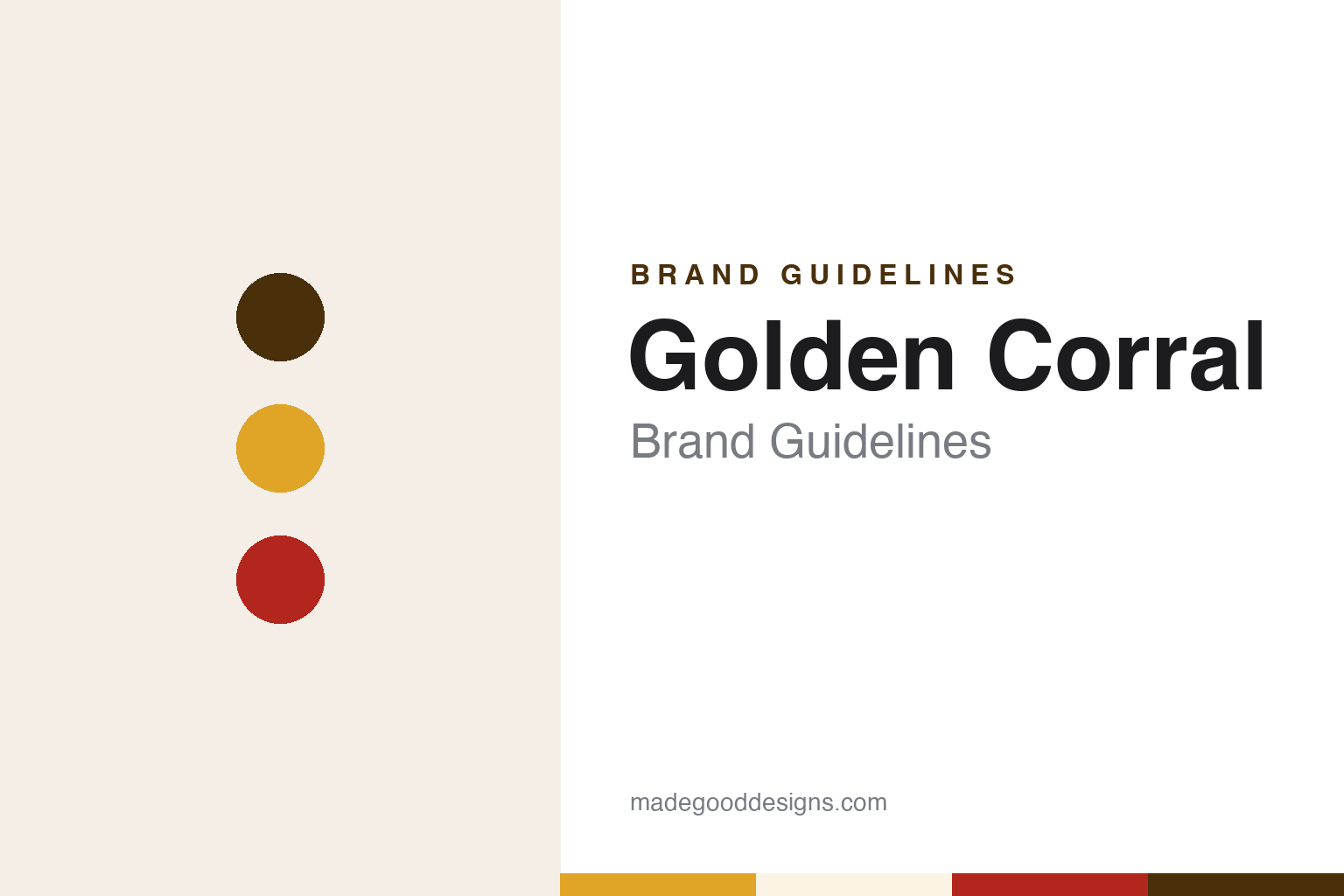
Golden Corral Brand Guidelines
The Fayetteville steak house that became a buffet.
Aa
Two constants: a corral gold, saddle brown and steak-house red palette and a western slab serif register. Abstract homage — not a Golden Corral product or mark; no sign or logo is reproduced.
Family Steak House
A western motif, cut steaks and a numbered order.
Golden Corral began with two would-be franchisees who could not get a franchise. The International Directory of Company Histories, in its entry on the company, says James H. Maynard and William Carl were unable to convince Ponderosa, Bonanza, Western Sizzlin’ or the other steak-house chains of the day that they were financially worthy, so they mapped out plans for a steak house of their own in a North Carolina library and raised money by selling shares to friends from school and college. English Wikipedia dates the idea to 1971 and the incorporation to 1972.
The Golden Corral Family Steak House opened in Fayetteville, North Carolina, on 3 January 1973, Wikipedia records. The company’s home base was Raleigh, where it has stayed. The name and the setting matched the steak-house fashion of the time: the Directory describes a western motif, an emphasis on meat and potatoes, and a way of serving in which customers raised their hands when waitresses, called “steerettes,” called out their order numbers. The same history says each restaurant cut its own steaks from fresh beef, and that the company concentrated on small towns where it faced little direct competition.
Instead of franchising, the young company let many restaurant managers become partners in the units they ran, and grew through sale-and-leaseback deals, bank loans and its own cash. In 1982 it bought restaurants from Sirloin Stockade, a Kansas-based competitor, and turned a large share of them into Golden Corrals, either owned outright or run under the Golden Corral banner through a leasing agreement with Investors Management Corporation, the Raleigh company the Directory names as Golden Corral’s parent. Carl left the company in 1984 but stayed on as a director, and Theodore M. Fowler, who had joined as an area supervisor in 1977, became president in 1982 and chief executive in 1989.
The old steak-house format came under strain in the 1980s. The Directory describes how the company added salad bars and then lengthened them, giving up dining seats and, in some places, parking spaces to make room, and how it closed restaurants that were losing money.
Colour
Metro Market, Strata and Gateway.
Golden Corral’s answer was a new building. After a series of strategy sessions in 1988 the company commissioned market research on every aspect of eating out, and, according to the Directory, hired the architect Jerry Cook to design a prototype based on what it learned. The first Metro Market restaurant, in Lawton, Oklahoma, was light, airy and large, in contrast with the dark, wagon-wheeled decor of the older steak houses, and it replaced the salad bar with a U-shaped buffet court that took up a large share of the floor.
The Metro Market design, also called GC-10, began opening in 1991. Its centrepiece was the Golden Choice Buffet, where customers entering a cafeteria-style line could still order a steak but could also help themselves from a long run of hot dishes, vegetables, salads and desserts. Next to it sat the Brass Bell Bakery, named for a brass bell that rang every quarter of an hour to announce bread, rolls and pastries coming out of the oven. Wikipedia notes that the new restaurants also moved the company away from its small-town base into metropolitan areas, with many of the early ones in Texas, Oklahoma, New Mexico and North Carolina. The Directory quotes Fowler calling the result a “steak, buffet, bakery concept.”
Franchising began in earnest in 1992, and the Directory records a restaurant in Juárez, Mexico, in 1993 and a franchise agreement with Frisch’s Restaurants in 1997. In the mid-2000s, Wikipedia says, the company remodelled its restaurants to a design called Strata, which brought more of the food preparation into view of guests, and in late 2018 it rolled out the Gateway design, meant to give the interior and exterior a more contemporary appearance, with new dining-room layouts, food bars and kitchen areas. In every format guests serve themselves, including made-to-order items such as waffles, omelettes and grilled steaks.
The brand reached Puerto Rico on 25 October 2020, when a restaurant opened in Canóvanas, Wikipedia records. The company also sponsors Camp Corral, a summer camp programme for children of wounded, disabled or fallen service members.
Typography
Design and documentation.
A sit-down or entertainment restaurant brand is carried less by one product than by a whole room. Its name appears first on a roadside sign, a roof line or a canopy over the door, then again on the menu, the server’s apron, the glassware and the receipt. Each of those surfaces asks something different of a logo: a pole sign has to work from a moving car at night, a laminated menu has to hold a long list of item names in a readable order, and a mark printed on a cup or a game card has to survive being very small.
The interior is part of the identity too. Booths, counters, buffet sneeze guards, carpet patterns, lighting and the colour of the walls all set a register before anyone reads a word, and a chain that renovates its dining rooms is changing its brand as surely as one that redraws its logo. Arcades and bars inside a restaurant add screens, prize counters and their own signage to that mix.
Each guide that follows records who founded the brand, who has owned it since, and how its name, sign and rooms have been documented over time, separating independent reporting from what the company says about itself.
Aa
A western slab serif — the register of a roadside sign and a steak-house menu. (Specimen set in Alfa Slab One, a slab-serif STAND-IN; NOT the Golden Corral logo.)
Golden Corral
A ranch name carried into a buffet hall.
The Golden Corral name matches the western motif that the Directory describes in the early restaurants. The company kept the name after the menu moved away from it: by the time of the Metro Market design, the Directory says, the restaurant hardly seemed a steak house to many, yet the corral stayed in the name.
Since then the company has documented its changes largely through its buildings. Each redesign — Metro Market in 1991, Strata in the mid-2000s and Gateway in 2018 — changed what a guest sees on arrival: first a large, bright room around a buffet court, then cooking moved into view, then a more contemporary exterior and new layouts. The bakery bell added a sound to the format, rung at fixed intervals through the day.
The name has also needed protecting online. Wikipedia records that in January 2002 the National Arbitration Forum ordered the domain goldencorralrest.com transferred to the company.
For a design guide, Golden Corral shows how a chain can keep a period name while rebuilding its rooms around a new way of eating, and how restaurant architecture can mark a change of format. Compare it with Friendly’s, another American family-dining name, and Chick-fil-A, a restaurant brand that also grew from the American South. For this guide we use corral gold, saddle brown and steak-house red with a slab serif, an unofficial interpretation; no product or logo is reproduced.
Explore & save
Keep Golden Corral’s identity on hand — save it to a board in the Made Good inspiration library.
Golden Corral identity set
Pin the Golden Corral corral gold, saddle brown and steak-house red palette and the western slab serif register to your own board.