Tonka Brand Guidelines
Pressed-steel trucks named for a Minnesota lake.
Aa
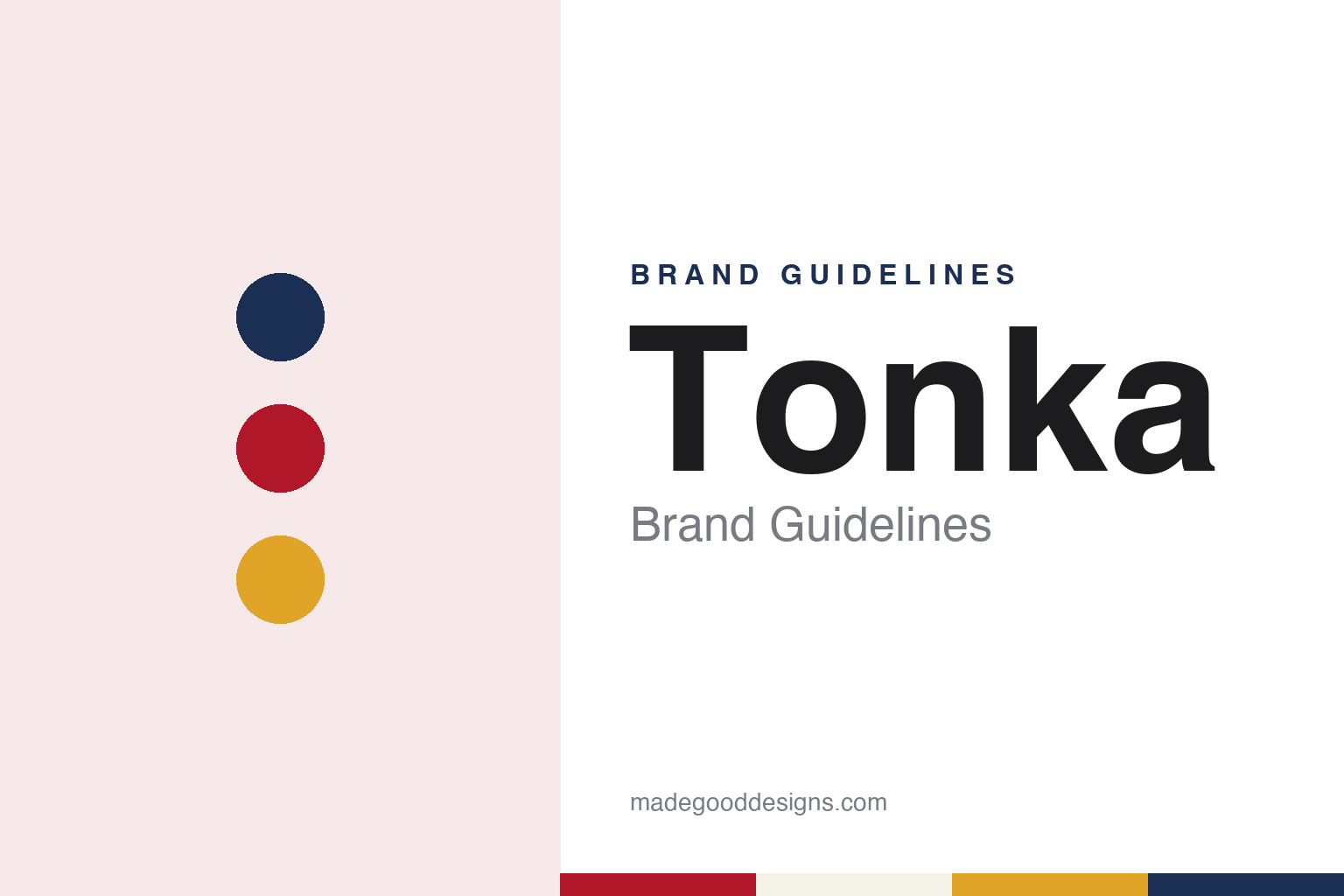
Two constants: a logo red, lake blue and gold palette and a heavy stencil sans register. Abstract homage — not a Tonka product or mark; no truck, oval or logo is reproduced.
Mound Metalcraft
Garden tools, a schoolhouse and a toy steam shovel.
Tonka began in Mound, Minnesota, near Lake Minnetonka, as Mound Metalcraft, a maker of garden tools. English Wikipedia dates the company to 1946 and names its founders as Lynn Everett Baker, Avery F. Crounse and Alvin F. Tesch, who set up in an old schoolhouse. The Strong National Museum of Play, in a National Toy Hall of Fame entry published in August 2021, describes three Minnesotans who founded the company just after World War II in the basement of a local schoolhouse, intending to manufacture garden tools.
The toys came with the building. Wikipedia says the schoolhouse’s previous occupant, the Streater Company, had made and patented several toys, including toy trucks, and that E. C. Streater, who was not interested in the toy business, approached Mound Metalcraft, whose three founders thought the toys might make a good sideline to their other products. The Strong dates the turn to 1947, when it says the company acquired a competing business and inherited a toy steam shovel in the process. Using pressed steel, the company designed a digger and a working “crane and clam”, The Strong says, and the founders then abandoned garden equipment to concentrate on toys. Wikipedia credits Alvin Tesch with modifying the toy designs and says metal toys soon became the main business.
The name and the mark were drawn in Minnesota as well. Wikipedia says the logo was created by Erling Eklof, based on a sketch by Donald B. Olson, a University of Minnesota drafting student who later became the company’s chief industrial engineer, and that it used the Dakota word tanka, meaning “great” or “big”. The Strong says the company took the name Tonka from nearby Lake Minnetonka. In November 1955, Wikipedia says, Mound Metalcraft changed its corporate name to Tonka Toys Incorporated, so the business took on the name its toys already carried.
Colour
Steel trucks, Minneapolis and Hasbro.
The range grew vehicle by vehicle. The Strong lists semis, wreckers, dump trucks, fire trucks and forklifts, and dates pick-up trucks to 1955, a Jeep to 1962 and the bright yellow Mighty Dump Truck to 1965. It also says Tonka kept its toys in step with changes in real construction and transport vehicles. Wikipedia records a move beyond toys in 1964, when Tonka bought the Mell Manufacturing Company of Chicago and began making barbecue grills, later sold under the Tonka Firebowl label, and a move of headquarters from Mound to Minneapolis in 1968.
By the 1980s Tonka’s range went well beyond trucks. Wikipedia lists dolls, the Gobots and Rock Lords lines, and the Pound Puppies toy line, which Tonka originally made. In 1987 Tonka agreed to buy Kenner Parker, including the British toy company Palitoy, a deal reported by the Chicago Tribune on 5 September 1987; Wikipedia says the debt taken on to pay for it eventually left Tonka looking for a buyer of its own.
Hasbro acquired Tonka in 1991, a date given both by Wikipedia, citing The New York Times of 1 February 1991, and by The Strong. Wikipedia says the headquarters then left Minnesota and manufacturing moved to Hasbro facilities in Pawtucket, Rhode Island. Hasbro has owned Tonka since 1991 and has licensed the name to other toy companies. Wikipedia says a licence with Funrise Toys began in 1998 with trucks fitted with electronic lights and sounds, and later grew to cover the whole brand. In June 2019 The Toy Book reported that Basic Fun!, a Florida-based toymaker that already licensed classic Hasbro names such as Lite-Brite and Tinkertoy, had an agreement in principle with Hasbro to license Tonka, with plans for steel trucks, die-cast vehicles and plastic lights-and-sounds vehicles. Wikipedia dates the transfer of the licence from Funrise to Basic Fun! to July 2019, and says Maisto International acquired rights to use the Tonka name on a line of 1:64 scale die-cast vehicles.
Typography
Design and documentation.
A toy brand often reaches its buyer through the package before the toy itself is ever touched. A window box lets a child see the figure, doll or vehicle through a clear panel while the printed board around it carries the name, the artwork and the age guidance, so the logo has to read clearly across a crowded shelf and still leave room for the product to show.
Blister cards work in a similar way on a smaller scale: a printed backing card, a moulded plastic bubble and a hang hole at the top. The card is usually designed to be seen hanging on a peg, which pushes the name and character art towards the upper half and keeps the logo bold enough to survive at a distance.
Die-cast and other small vehicle lines tend to rely on compact logos that can be printed on a box end, a card or even the base of the toy. Character mascots add another layer, standing in for the brand in advertising and on packs, so that a face or figure becomes as recognisable as the lettering beside it.
Aa
A heavy stencil sans — the register of a truck door and a toy-box lid. (Specimen set in Archivo Black, a sans-serif STAND-IN; NOT the Tonka logo.)
Tonka
An oval, a lake and a word on its own.
Tonka’s visual identity can be traced step by step through its logo. Wikipedia says that from 1947 to 1957 the mark was an oval showing the Tonka Toys name in red above blue ocean waves with seagulls overhead, a nod to Lake Minnetonka. From 1958 to 1961 the seagulls went and the colours changed to white, grey and red; in 1963 the colours became red and gold; and in 1978 the oval was removed, leaving the Tonka name on its own on the toys.
The trucks carry the other half of the identity. The Strong’s account of the brand centres on pressed steel and on construction vehicles such as the Mighty Dump Truck, and Basic Fun! today sells Tonka Steel Classics that it says are “made TONKA TOUGH” from cold-rolled steel, alongside plastic Lights and Sounds trucks. In 2002, Wikipedia says, Ford showed a Mighty F-350 concept truck developed with Tonka. The National Toy Hall of Fame at The Strong in Rochester, New York, inducted Tonka trucks in 2001. Retail Dive reported on 3 July 2024 that Basic Fun had filed for Chapter 11 bankruptcy in Delaware and planned to keep operating while it restructured.
For a design guide, Tonka shows how a small metalworking business turned a lake, a word and a steel truck into a name that passed from Minnesota to Rhode Island and on to licensees, while its logo moved from a waves-and-gulls oval to a word alone. Compare it with Lite-Brite and Tinkertoy, two other classic toy names that Basic Fun! has licensed from Hasbro. For this guide we use logo red, lake blue and gold with a heavy sans, an unofficial interpretation; no product or logo is reproduced.
Explore & save
Keep Tonka’s identity on hand — save it to a board in the Made Good inspiration library.
Tonka identity set
Pin the Tonka logo red, lake blue and gold palette and the heavy stencil sans register to your own board.