Carter’s Brand Guidelines
A Needham knitting business that grew into a family of kidswear labels.
Aa
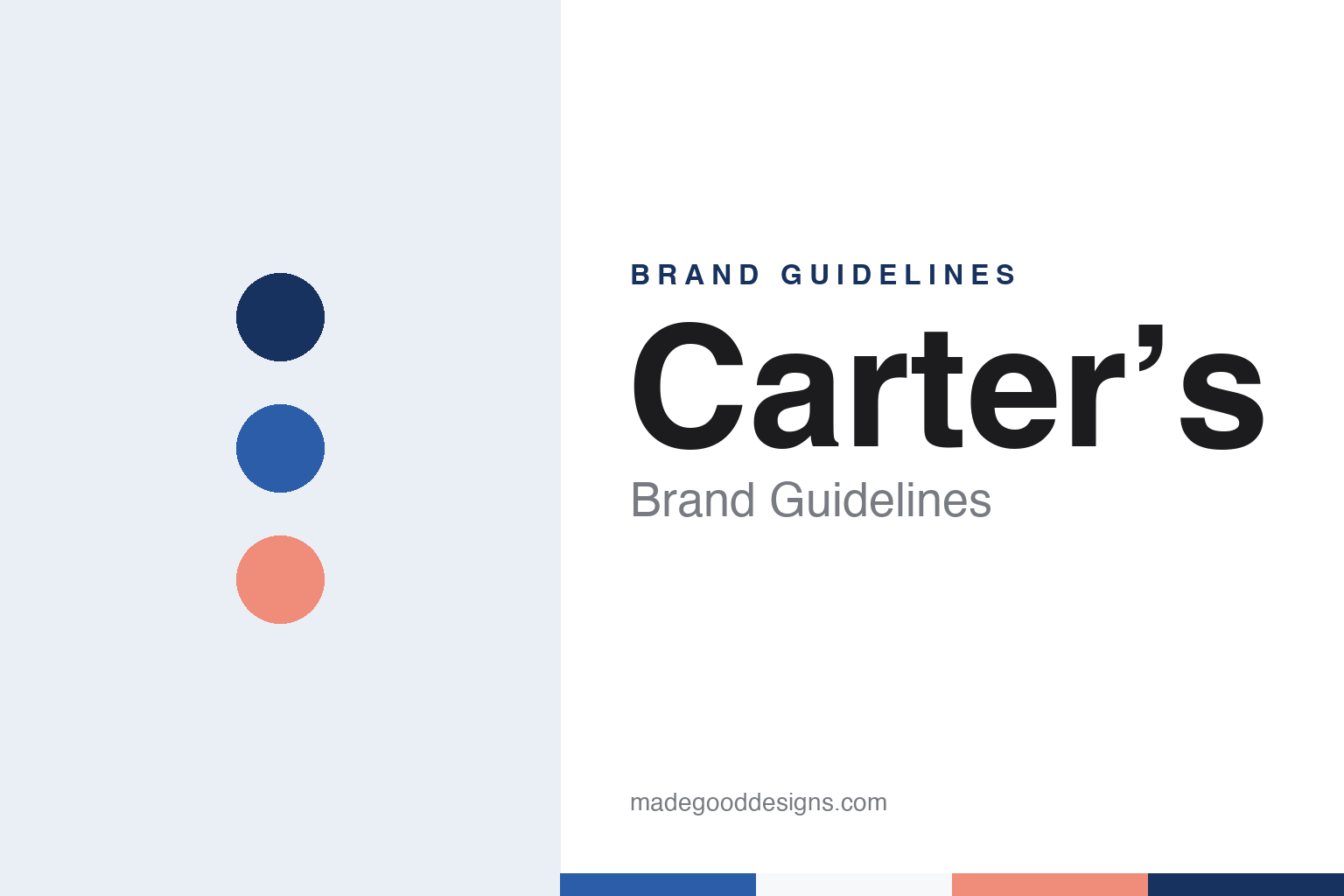
Two constants: a layette blue, soft coral and bodysuit white palette and a rounded label sans register. Abstract homage — not a Carter’s product or mark; no garment, label or logo is reproduced.
Needham Heights
Knitting frames in the kitchen, a mill by the lake.
Carter’s traces its history to William Carter, a knitter from the market town of Alfreton in Derbyshire, England. The Needham History Center & Museum, in a walking-tour account of the company archived in 2018, says Carter spent his childhood partly at the village school and partly helping his grandfather, who made hand-knitting looms, and that he went to work as a knitter while still a boy. As the industrialisation of English textiles put hand-knitters out of work, he left for the United States. The museum’s account puts his move to Needham, Massachusetts, in 1854; English Wikipedia gives the date of his arrival in America as 28 January 1857.
In Needham, the museum says, Carter set up a workshop making knitted goods for adults and children — sweaters, underwear and mittens among them. In its earliest days the business was run from his home in Needham Heights, with knitting frames in the kitchen and the sewing staff working in the parlour. He went into partnership with two old friends, Mark and John Lee, and the Carter and Lee Mill on Highland Avenue was built in 1865, the year Wikipedia gives for the founding of the William Carter Company and the date the company uses: its corporate brands page, archived in 2021, describes Carter’s clothing as providing solutions for real life “since 1865”.
Carter later bought out the Lee brothers and enlarged the mill, and as demand grew he built a second mill on the north shore of Rosemary Lake, known as Mill #2. The museum says the company went on to own manufacturing plants in Massachusetts and the American South, and Wikipedia says that by the early 1960s the William Carter Company was manufacturing at mills in Massachusetts and the South. During Needham’s anniversary celebrations in 1961, the museum notes, the company’s mills were celebrated on a parade float.
The business stayed in the family for well over a century. Wikipedia records that Carter’s son, William Henry Carter, served in the U.S. House of Representatives from 1915 to 1919 before being elected president of the William Carter Company in 1918. The English knitters who came to work in Needham Heights brought cricket with them, and the museum’s archive includes a 1904 photograph of the Albion Cricket Club, Eastern Massachusetts champions that year, with William Henry Carter standing among the players.
Colour
A family sale, a move south and a portfolio of labels.
According to both Wikipedia and the Needham History Center & Museum, the Carter family sold the business in 1990; the museum says it went to a corporation based in Georgia and that the company remained in Needham until that sale. Today Carter’s, Inc. is headquartered in Atlanta. Wikipedia, citing reports in the Atlanta Business Chronicle from October and December 2012, says the company announced that year that it would move its head office from Midtown Atlanta to Phipps Tower in Buckhead, consolidating out-of-state jobs into the new building.
The brand family widened in 2005. The Business Journal of Milwaukee reported on 10 May 2005 that the children’s apparel maker OshKosh B’gosh, of Oshkosh, Wisconsin, had agreed to be acquired by Carter’s through its subsidiary The William Carter Co., and quoted Carter’s chairman and chief executive Fred Rowan as saying Carter’s would continue to market OshKosh B’gosh as a separate and distinct brand. The company’s brands page says OshKosh B’gosh, which it dates to 1895, joined the Carter’s family in 2005. Carter’s has owned the brand since then, and Wikipedia notes that the company sells through its own Carter’s and OshKosh B’gosh stores as well as department stores and other retailers.
In February 2017 Carter’s acquired Skip Hop, a New York company making products for babies and young children, which Wikipedia says the private equity firm Fireman Capital Partners had taken a majority stake in during November 2013. The Washington Post, writing in July 2019, described Carter’s as the owner of the OshKosh B’gosh and Skip Hop brands, and the company’s own brands page says Skip Hop joined the Carter’s family in 2017.
Alongside the brands it sells in its own stores, Carter’s runs a set of labels made for individual retailers. Wikipedia says that in the early 2000s Carter’s agreed with Target to create the Just One You line, sold exclusively in Target stores, and later created exclusive lines for Walmart and Amazon; each has its own design team and pricing specific to the retailer. The company’s brands page dates Just One You to 2001, Child of Mine for Walmart to 2003 and Simple Joys for Amazon to 2017. Vox reported in July 2017 that Amazon had introduced Simple Joys by Carter’s that spring as a line of baby and children’s clothing sold in multi-piece bundles. One more Target label, Genuine Kids, came with OshKosh: the company says OshKosh B’gosh established it in 2003, before the acquisition.
Typography
Design and documentation.
Children’s clothing brands share a particular problem of identity: the people who choose the clothes are rarely the people who wear them. A name and a mark have to speak to parents and grandparents in a shop or on a printed page, while the garment itself has to stay simple enough to be worn, washed and handed down.
Much of that work is done by small, practical pieces of print. A hang-tag is often the first thing a shopper reads, and some children’s labels have used it as more than a price ticket, turning it into a guide to which pieces belong together. Size labels add another layer, because children’s clothing is sized by age, height or a numbered scale, and a brand’s choice of system becomes part of how families recognise it.
Catalogues and their covers have long been another stage for the look of a label, with photography, layout and typography setting a mood before any garment is seen in person. Each guide here separates what independent sources record about a brand — who started it, who owns it now and how its look has changed — from what the company says about itself.
Aa
A rounded label sans — the register of a sewn-in tag and a hang card. (Specimen set in Nunito, a sans-serif STAND-IN; NOT the Carter’s logo.)
Carter’s
A surname that works as an endorsement.
The Carter’s identity is built on a surname. The William Carter Company carried its founder’s name from the Needham mill onwards, and the possessive form the company uses today, Carter’s, is the thread that ties together a business which has changed owners, headquarters and product range since the 1860s, moving from knitted sweaters and mittens for adults and children to clothing for babies and young children.
A notable feature of the brand system is the way the name travels onto other labels. Wikipedia says that the logo of each retailer-exclusive brand notes that it is “made by Carter’s”, with one exception: Genuine Kids, the Target label that predates the OshKosh acquisition, carries the line “from OshKosh” instead. The result is a two-level identity. Each exclusive line has its own name, its own design team and its own place in a single retailer’s stores, while a small endorsement line ties it back to the parent; on Amazon the endorsement is part of the full name, Simple Joys by Carter’s, as Vox reported in 2017.
OshKosh B’gosh sits differently. When Carter’s agreed to buy it in 2005, its chairman said it would be marketed as a separate and distinct brand, and the company still presents Carter’s and OshKosh B’gosh side by side, each with its own story and founding date rather than one absorbed into the other. Skip Hop, which makes bags, bath toys and other products rather than clothing, keeps its own name and its own tagline, “Must-Haves Made Better”, which the company’s brands page quotes.
For a design guide, Carter’s shows how a single family name, set on a mill in Needham more than a century and a half ago, can be stretched across a company’s own stores, several retailer-exclusive labels and acquired brands without being repainted each time: the name either leads or quietly endorses. Compare it with OshKosh B’gosh, the Wisconsin overall maker Carter’s has owned since 2005, and Skip Hop, the New York baby-gear brand it has owned since 2017. For this guide we use layette blue, soft coral and bodysuit white with a rounded sans, an unofficial interpretation; no product or logo is reproduced.
Explore & save
Keep Carter’s’s identity on hand — save it to a board in the Made Good inspiration library.
Carter’s identity set
Pin the Carter’s layette blue, soft coral and bodysuit white palette and the rounded label sans register to your own board.