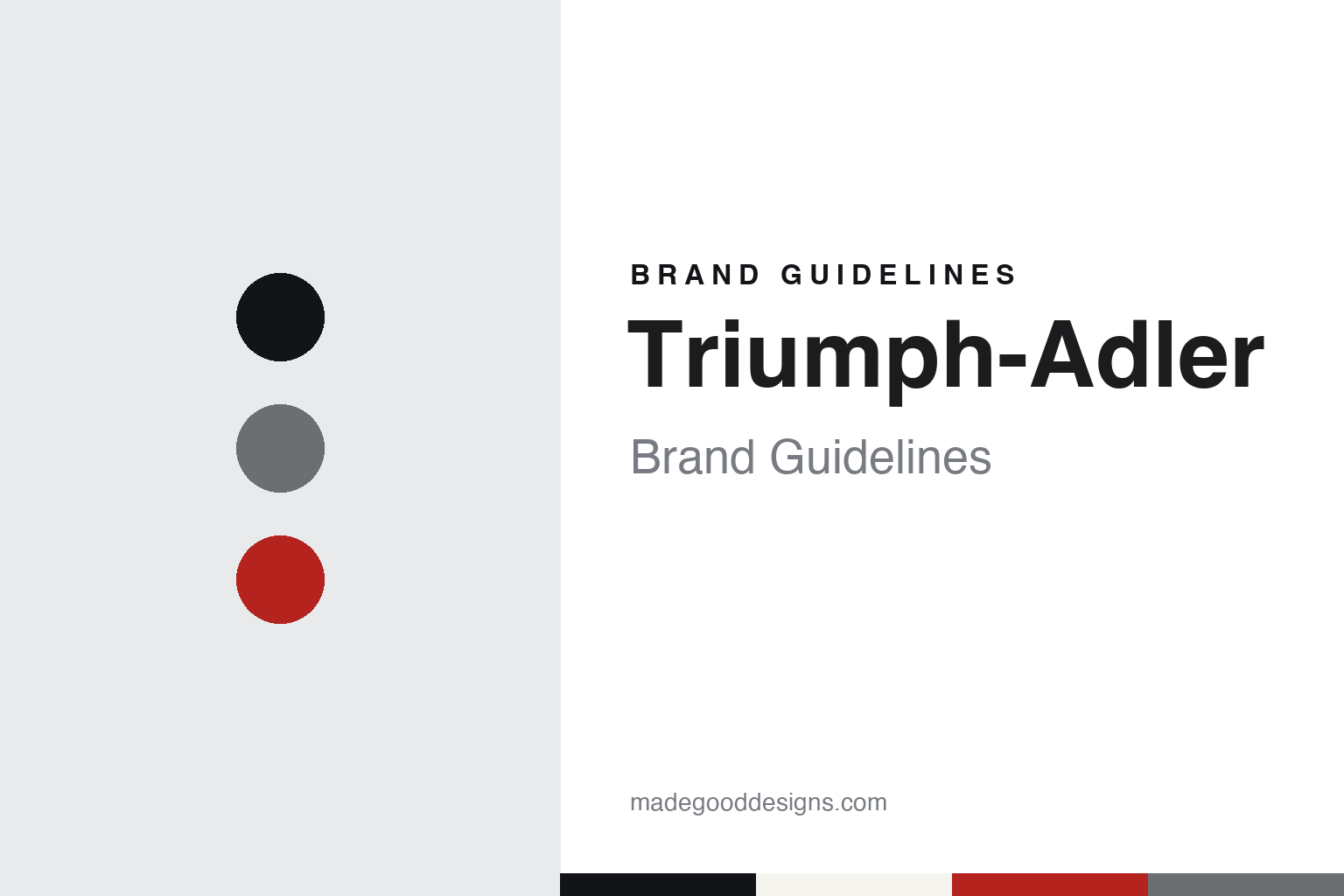
Triumph-Adler Brand Guidelines
Two German typewriter makers under one name.
Aa
Two constants: a Triumph-Adler black, grey and ribbon red palette and an office sans register. Abstract homage — not a Triumph-Adler product or mark; no machine, logo or nameplate is reproduced.
Triumph and Adler
A Nuremberg bicycle works and a Frankfurt factory.
Triumph-Adler joins two German companies that each began with bicycles. The older name in the pair is Adler. German Wikipedia says Heinrich Kleyer founded the business in Frankfurt am Main in 1880 as Heinrich Kleyer GmbH, making bicycles; by 1895–96 it had become the joint-stock company Adlerwerke vorm. H. Kleyer AG, and in 1898 it began making typewriters in a seven-storey factory building on Weilburger Straße. Adler also built cars and motorcycles, and German Wikipedia records that during the Second World War the company produced armaments, used forced labourers and prisoners of war, and had the Katzbach concentration camp set up on its works site.
The other half is Triumph. English and German Wikipedia both say Siegfried Bettmann founded Deutsche Triumph Fahrradwerke AG in Nuremberg in 1896 as a subsidiary of the Triumph Cycle Company of Coventry, and that until 1909 it made bicycles, and for a short time motorcycles. In 1909 it moved into typewriters. German Wikipedia’s article on the Nuremberg works says Bettmann took over the manufacturing rights to the Norica typewriter of Schreibmaschinenwerke Kührt & Riegelmann, a business whose assets were being sold off in bankruptcy, and that the designer Paul Grützmann improved the machine before it went on sale as the Triumph, a four-row typebar typewriter.
The company was renamed Triumph Werke Nürnberg AG in 1911 and, two years later, was separated from its English parent, which is why the Nuremberg Triumph and the British Triumph names went separate ways. Through the first half of the twentieth century, both encyclopedias say, it made typewriters alongside bicycles, motorcycles and even cars.
Colour
Grundig, Litton, Volkswagen and Olivetti.
The two names were brought together by Max Grundig. In 1957, according to German Wikipedia, he bought the share capital of the Triumph works and a holding in the Adlerwerke; in 1958 he merged both, together with the dictation-machine business of his Grundig tape-recorder works, the Stenorette, into Triumph-Adler-Büromaschinen-Vertriebs-GmbH. From then on the company made and sold only office machines, and German Wikipedia says its office typewriters were fitted with control keys and a socket for the Stenorette so that the two worked as one system.
Ownership then changed several times. Both encyclopedias say Grundig sold Triumph-Adler to the American group Litton Industries in 1968, as Grundig turned towards colour television, and that Volkswagen took a majority in 1979 and the remaining shares in 1980. Under Volkswagen the company bought a majority of the Pertec Computer Corporation of the United States in 1980, and built computers under the Alphatronic name. In 1985 it was renamed TA Triumph-Adler AG, and the initials TA became part of its identity.
In 1986 the Italian office-machine maker Olivetti, a direct competitor, bought the majority from Volkswagen. Both encyclopedias say production and development in Germany were largely wound down afterwards and the factories sold, including the historic Frankfurt Adlerwerke site in 1993; German Wikipedia adds that the Adlerwerke company itself was later sold to an investor and has traded since 1999 as Adler Real Estate, a residential property business. In 1994 a group of shareholders bought TA from Olivetti and turned it into a holding company with office, games and leisure, construction-technology and healthcare divisions.
Typography
Typewriters as brands.
The seven brands in this group are all typewriter names: Olivetti, Smith-Corona, Underwood, Hermes, Imperial, Facit and Triumph-Adler. Typewriter brands in general sit at many different points in their histories, from names that moved on to computers and office equipment to marques that closed their factories long ago and now live on mainly through collectors, archives and old advertising.
A typewriter brand’s identity is usually carried less by a single machine than by a nameplate, a decal, a case and the advertising around it, because the company behind the name may have merged, changed hands, moved production or stopped making typewriters altogether. That makes the questions behind each name worth asking plainly: who started it, who owns the name now, where its machines were made, and when typewriter production ended.
Each guide separates what independent sources record from what the company says about itself — its founding story, its owners over time, where its machines were made and how its marks have changed — and marks plainly what rests only on the company’s own word.
Aa
An office sans for a name built on typewriters and copiers. (Specimen set in Archivo, a sans STAND-IN; NOT the Triumph-Adler logo.)
TA Triumph-Adler
From typewriters to document services under Kyocera.
The typewriters left the company before Kyocera arrived. German Wikipedia says that in October 2003 Bandermann GmbH of Kaarst, until then TA’s main distributor of typewriters, bought the typewriter, desk and pocket calculator and laser-toner product lines from TA and carried on making and selling them. In the same year TA began a partnership with the Japanese copier and printer maker Kyocera Mita, now Kyocera Document Solutions, selling Kyocera machines under the TA name; English Wikipedia says Kyocera took a 25 per cent stake as part of that arrangement.
Kyocera then took control. German Wikipedia dates its majority to 10 December 2008 and its purchase of the remaining shares to 13 October 2010; English Wikipedia gives early 2009 for the majority. In spring 2011 the AG became TA Triumph-Adler GmbH, wholly owned by Kyocera Document Solutions. Kyocera has owned all of Triumph-Adler since 2010, and German Wikipedia describes the Nuremberg company as having turned from an office-equipment maker into a provider of managed document services. Its group includes the dealer-channel brand UTAX, which TA bought in 1999.
So the Triumph-Adler name on a typewriter today points to a machine made under the earlier owners, while the company that carries the name sells document services. That split matters for anyone using the brand as a reference: the Triumph and Adler nameplates and the later TA initials on typewriters belong to the machines, while the current company’s identity belongs to a copier and printer business inside a Japanese group.
For a design guide, Triumph-Adler shows how a merged name can outlast the products that made it familiar. Compare Olivetti, its owner from 1986 to 1994, and Imperial, another typewriter name. For this guide we use platen black, carriage grey and a ribbon red with a sans, an unofficial interpretation; no product or logo is reproduced.
Explore & save
Keep Triumph-Adler’s identity on hand — save it to a board in the Made Good inspiration library.
Triumph-Adler identity set
Pin the Triumph-Adler black, grey and ribbon red palette and the office sans register to your own board.