ZF Brand Guidelines
A gear works by a lake, two letters and a signet turned blue.
Aa
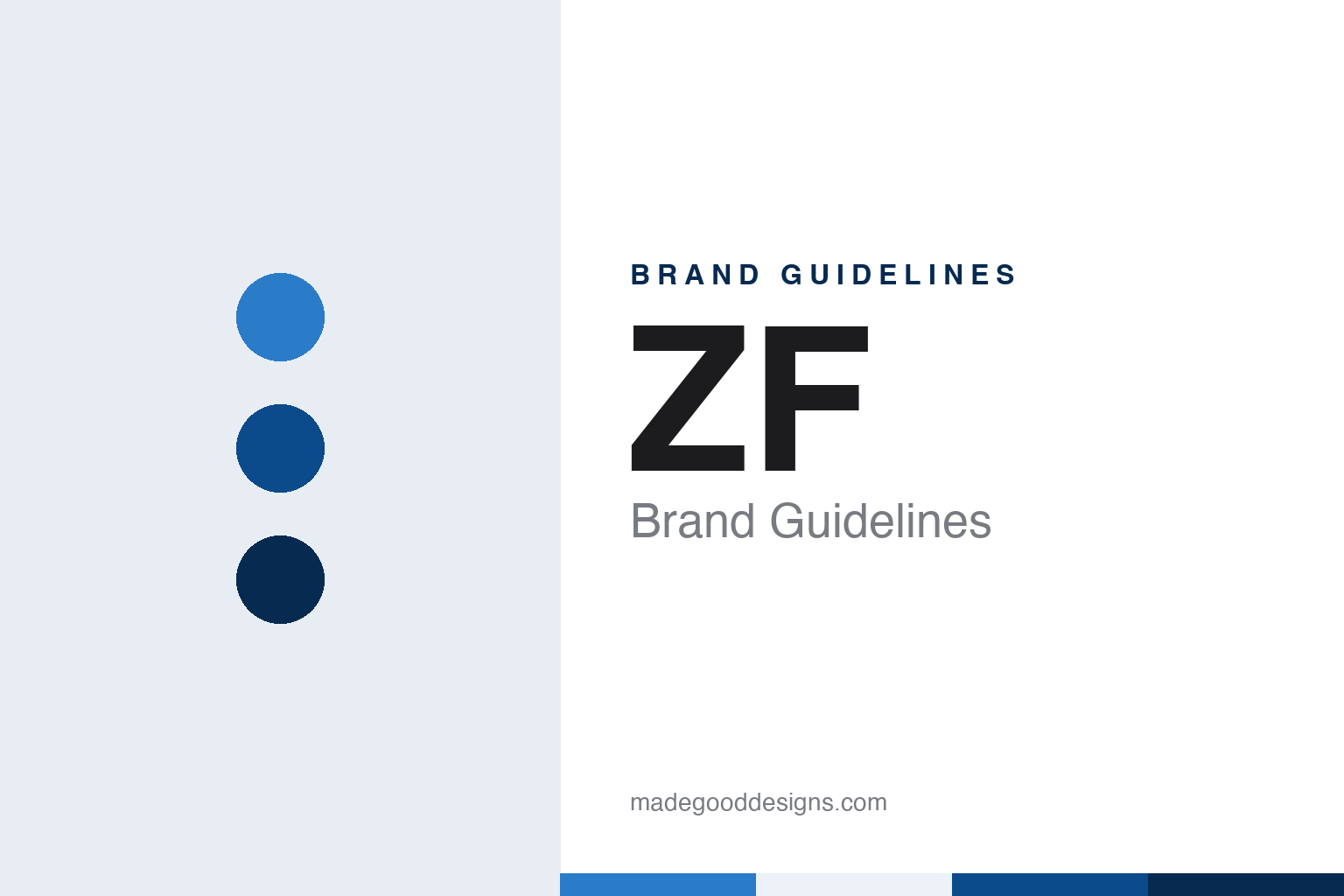
Two constants: a signet blue, lake and deep blue palette and an engineered sans register. Abstract homage — not a ZF asset or mark; no logo, icon or wordmark is reproduced.
A gear works
Friedrichshafen, 1915.
The letters ZF stand for Zahnradfabrik, German for gear factory, and the company that carries them was born inside the airship business on the shore of Lake Constance. In a long history published in April 2015, the Schwäbische Zeitung described the gear works as the last offshoot of Luftschiffbau Zeppelin GmbH, after a string of earlier spin-offs that included an engine company later known as Maybach and a department that became Dornier. The newspaper called the gear works a German-Swiss joint venture with a modest aim at the start: to make better gears.
The idea came from an engineer. The Schwäbische Zeitung says Alfred Graf von Soden-Fraunhofen, whom Count Zeppelin had brought into the airship company’s test department in 1910, came across a new way of cutting gear wheels in 1914. It had been developed by the Swiss engineer Max Maag. Talks went well enough that in the spring of 1915 the airship company sent staff to Zurich to learn to run the new Maag machines, and on 20 August 1915, the paper says, the airship company and Maag signed the partnership agreement that created the Zahnradfabrik Friedrichshafen GmbH, with Soden-Fraunhofen as managing director.
German Wikipedia names the two founding partners as Luftschiffbau Zeppelin, represented by Alfred Colsman, and the Max Maag Zahnräderfabrik, and lists Theodor Winz as a second managing director beside Soden. The trade magazine eurotransport, writing on the company’s centenary in September 2015, gave the date of entry in the commercial register as 9 September 1915, and quoted the founding purpose as the development, testing and manufacture of gears and transmissions for aircraft, motor cars and motor boats.
Cars were in the paperwork from the beginning. German Wikipedia says vehicle transmissions were written into the founding deed to widen the business, and the Schwäbische Zeitung says Soden-Fraunhofen filed a patent for an automobile transmission in the founding year. In June 1916, the paper adds, the young company moved into a wooden hall in the Löwental district of Friedrichshafen that local people nicknamed the “Zackenbude”, roughly the shed of teeth, after the toothed wheels made inside it.
Colour
Zahnradfabrik becomes ZF.
The company changed its legal form early. Both German Wikipedia and the Schwäbische Zeitung date the conversion of the GmbH into a stock corporation to 1921, and the newspaper says the shareholders stayed the same: the airship company and the Maag gear and machine works in Zurich. German Wikipedia says the company then traded as Zahnradfabrik Friedrichshafen AG until 1991. Through those decades the long name lived on the transmissions themselves, and the Schwäbische Zeitung lists the Soden gearbox of 1921 and the Aphon transmission of 1929 among the products that carried it into German car and lorry factories.
Ownership settled into its present shape in 1950. The Schwäbische Zeitung says the Zeppelin Foundation, administered by the City of Friedrichshafen since 1947, became the majority shareholder in 1950. The same article calls ZF the “Zeppelin’sche Stiftungsunternehmen”, the Zeppelin foundation company. German Wikipedia lists two shareholders today: the Zeppelin Foundation, administered by the city, and the Dr. Jürgen und Irmgard Ulderup Stiftung of Lemförde. The town that gave the company its name has, through that foundation, been its majority owner since 1950.
The short name became the official one in the early 1990s. German Wikipedia says the company has been called ZF Friedrichshafen AG since the start of 1992, and that at the same moment the colour of its signet changed from black to blue. It gives two reasons for the change: a stronger international outlook, and a business whose field of activity had moved on from the gear works of the founding years. The two letters had long been used as a shorthand; from 1992 they were the name on the door.
The pairing of letters and place works in both directions. ZF says what the company once made, in the initials of a German word for gears, and Friedrichshafen says where it comes from. English Wikipedia glosses the old name as Friedrichshafen gear factory and notes that the company is widely known as ZF Group.
Typography
Gears, a name and its letters.
Corporate identity where the end user rarely looks
Component makers and drug companies share an odd identity problem: the people who use their work most often never see the parent name. A brake module, a sensor or a seat frame arrives inside somebody else’s car, and a medicine reaches a patient under a product name, in packaging shaped by regulators as much as by designers. The corporate mark has to work instead for engineers, buyers, investors, recruits and the towns that host the factories.
That audience shapes the names. Mergers in both sectors often produce a blended word built from the two predecessors, or a coined term with Latin or Greek roots chosen because it carries no prior meaning in any market and can be registered worldwide. Other houses keep a founder’s surname or an old place name long after the business has outgrown it.
The visible identity tends to live in plant and laboratory signage, on gatehouses, lorry livery, safety notices and campus wayfinding. Those settings favour plain wordmarks, a single corporate colour and lettering that stays legible from a distance and in a photocopied procedure sheet. Restraint here is a working requirement rather than a style choice.
Aa
An engineered sans — after a name cut down to two letters. (Specimen set in Archivo, a sans STAND-IN; NOT the ZF logo or any ZF typeface.)
ZF
Two letters over many names.
The blue signet now sits above names that ZF has bought. In 2001, the Schwäbische Zeitung says, ZF took over Mannesmann Sachs AG, the former Fichtel & Sachs, and in 1984 it had bought into the Lemförder group, which brought chassis components into the business. English Wikipedia lists LEMFÖRDER, SACHS, TRW and BOGE beside ZF as the company’s aftermarket brands, so the older names live on as product marks under the group name.
The TRW name arrived in 2015. Heavy Duty Trucking reported on 15 May 2015 that ZF had completed its acquisition of TRW Automotive, that TRW would become a new division called Active and Passive Safety Technology, and that the combined company would operate under the name ZF Friedrichshafen AG. The magazine said the merger agreement had been signed in September 2014. German Wikipedia dates the announcement to 15 September 2014 and the closing to mid-May 2015.
WABCO followed. German Wikipedia says ZF announced the purchase of the commercial-vehicle supplier at the end of March 2019 and completed it on 29 May 2020, integrating WABCO as a division of its own. Truck & Bus Builder reported on 1 June 2020 that ZF had completed the acquisition late the previous month after receiving all regulatory approvals, the Chinese clearance arriving in mid-May. English Wikipedia names the new unit the Commercial Vehicle Control Systems division.
The headquarters stayed by the lake. German Wikipedia says the ZF Forum opened in November 2016 as the group’s new head office in Friedrichshafen, with a company museum open to the public on its ground floor. The airship company that founded the gear works is long gone from its centre; the town, through its foundation, is still the owner.
For a design guide, ZF shows how a long German compound name can shrink to two letters and a colour without losing the place it came from. Compare Denso, the Japanese parts maker whose name is also a compound, and Aisin, a Japanese automotive supplier. For this guide we use signet blue, lake and deep blue with a sans, an unofficial interpretation; no product or logo is reproduced.
Explore & save
Keep ZF’s identity on hand — save it to a board in the Made Good inspiration library.
ZF identity set
Pin the ZF signet blue, lake and deep blue palette and the engineered sans register to your own board.