Ryder Cup Brand Guidelines
A small gold cup with a golfer on the lid, carried back and forth across the Atlantic.
Aa
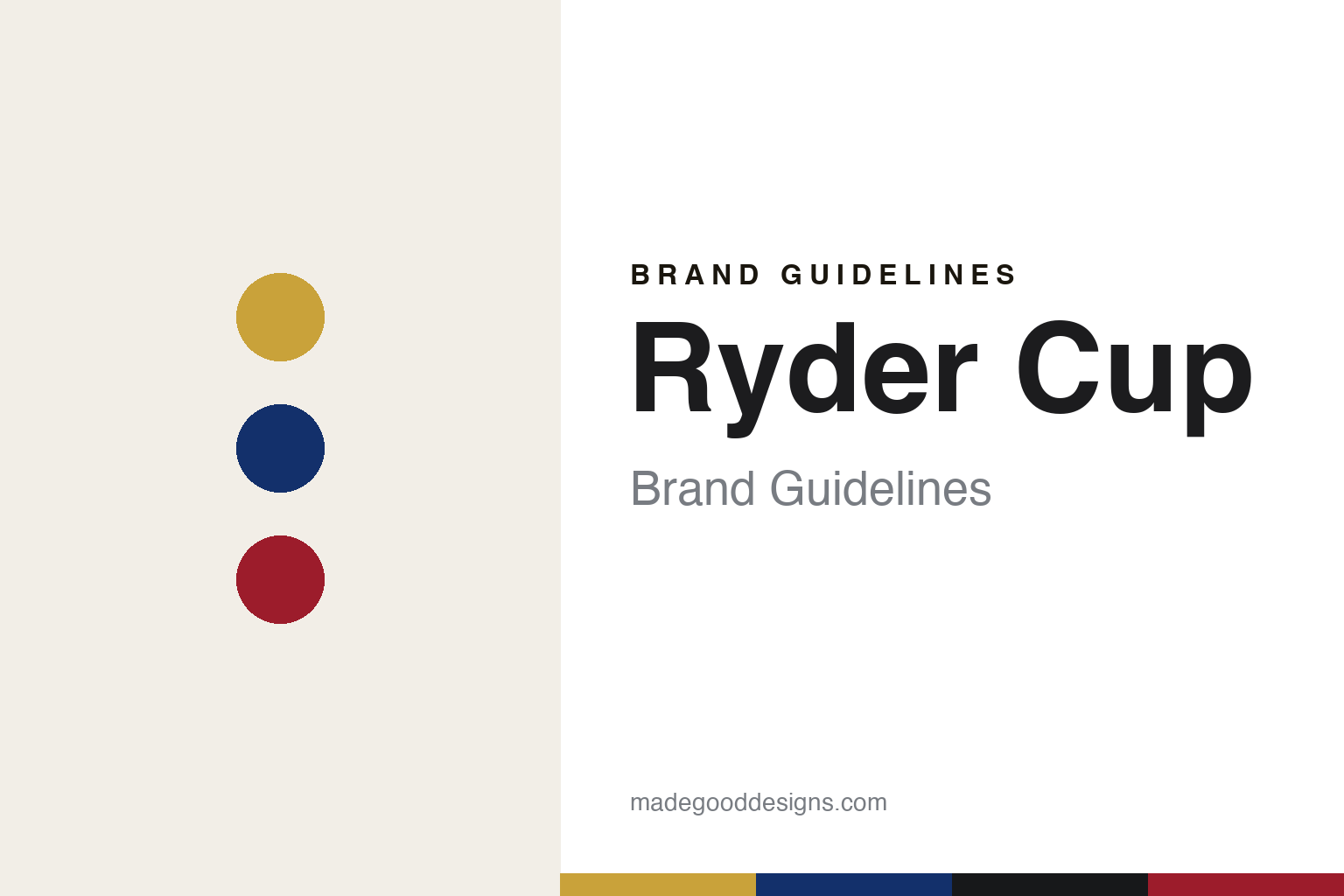
Two constants: a gold, navy and red palette and an engraver’s serif register. Abstract homage — not the Ryder Cup trophy, logo or any team mark; no logo is reproduced.
Worcester
A seed merchant, a magazine and a match that waited a year.
The Ryder Cup is named after the man who gave the trophy. English Wikipedia describes Samuel Ryder as an English businessman, and Today’s Golfer, in a history of the trophy updated in September 2025, calls him an English seed merchant. The competition grew out of earlier informal matches between British and American professionals. Wikipedia says that on 27 September 1920 the magazine Golf Illustrated wrote to the PGA of America suggesting that a team of American professionals be sent to play in the 1921 Open Championship, an idea credited to James D. Harnett of the magazine, and that a match between the two sides was played at Gleneagles in 1921.
A second match was played at Wentworth in 1926, before that year’s Open. Wikipedia says it was widely reported as being for the “Ryder Cup,” but that Golf Illustrated wrote in June 1926 that Ryder had decided to withhold the cup for a year, after the general strike in May made it uncertain how many Americans would travel. Today’s Golfer says a match of sorts took place in 1926 but that the first Ryder Cup was officially played a year later.
That first official match was organised on a formal footing. Wikipedia says a Ryder Cup Deed of Trust was drawn up setting out the rules, and that each PGA ran its own selection process. The match was played in 1927 at Worcester Country Club in Worcester, Massachusetts, between the United States, captained by Walter Hagen, and Great Britain, captained by Ted Ray. National Club Golfer, in a piece dated 12 September 2023, also places the first presentation of the trophy at Worcester in 1927.
The British side widened over time. Wikipedia says that although the original Deed of Trust referred to a team “representing Great Britain,” players from Jersey, Guernsey and Northern Ireland later took part, and the British PGA created a united division for players from the island of Ireland in the early 1950s. From 1979, players from all of Europe became eligible, following a discussion in 1977 between Jack Nicklaus and Edward Stanley, 18th Earl of Derby, then president of the British PGA. The event is held every two years, with the venue alternating between Europe and the United States, and Wikipedia says it is jointly administered by the PGA of America and Ryder Cup Europe, a joint venture of the European Tour and the professional golfers’ associations of Great Britain and Ireland and of Europe.
Colour
Nine-carat gold, a detachable lid and a golfer on top.
The trophy is the brand’s centre. Today’s Golfer says the original cup was commissioned by Samuel Ryder and made in Sheffield by Mappin & Webb in 1926, with the cost shared between Ryder, Golf Illustrated and the Royal and Ancient Golf Club of St Andrews. The magazine describes it as a nine-carat gold chalice standing 17 inches tall without its base, set on a wooden base with the results of each match engraved around gold bands. National Club Golfer gives the same maker and height.
The figure on the lid is the detail people ask about. Today’s Golfer says the gilded golfer on top of the detachable lid is not Samuel Ryder but is modelled to resemble Abe Mitchell, a professional who became Ryder’s friend and golf instructor. National Club Golfer said in September 2023 that the figure is Mitchell, and that Ryder employed him as a personal professional at the Verulam club in St Albans after Mitchell had decided against a move to America in 1925. Today’s Golfer adds that Mitchell missed the first official match through illness and played for Great Britain in 1929, 1931 and 1933.
Who keeps the cup is part of its story. Today’s Golfer says that when the United States won in 1927 no provision had been made to house the trophy, so the American players shared it, drawing lots to decide the order, with Leo Diegel taking it to begin with. Ownership of the original now rests with the Professional Golfers’ Association of Great Britain and Ireland, which keeps it at its headquarters at The Belfry. The PGA of America owns an exact replica used for the trophy ceremony, another version is kept for promotional use, and players and captains of the winning team receive scaled-down replicas.
Because the cup is small and gold, its silhouette is easy to recognise at any size: a two-handled bowl, a lid, and a single standing golfer at the top. That outline, and the plain words “Ryder Cup,” do the work that a commissioned emblem does for other events.
Typography
Trophies, venues and traditions.
A sporting event is an unusual kind of brand. It has no product on a shelf and often no single owner of the kind a company has; instead it is held together by a name, a date on the calendar and a set of objects and rituals that recur each time it is staged.
Trophies frequently become the mark itself. A cup, a figure or a plate is drawn, simplified and printed on tickets, broadcasts and merchandise, so that the object handed to the winner also works as the event’s signature. Host venues do similar work: a clubhouse, a finish line, a grandstand or a stretch of road is photographed so often that its outline turns into shorthand for the whole occasion.
Traditions add another layer. A jacket, a garland, a particular flower, a colour worn on the day or a song sung before the start can be as recognisable as any wordmark, and organisers tend to protect them carefully. Finally, sponsor naming sits alongside all of this. Presenting partners, official suppliers and naming rights put commercial marks next to the event’s own, and the way an organiser balances or limits them is itself a design decision worth studying.
Aa
A high-contrast engraver’s serif — the register of a trophy inscription and an honours board. (Specimen set in Cormorant Garamond, a serif STAND-IN; NOT the Ryder Cup trophy, logo or any team mark.)
Ryder Cup
A cup, two continents and a name that stays.
For a designer, the Ryder Cup shows how a trophy can carry an event’s identity across generations of organisers. The match has changed its teams, formats and governing bodies several times. The British side became Great Britain and Ireland and then Europe, and the event is now run jointly by the PGA of America and Ryder Cup Europe, yet the name of the donor and the shape of his cup have stayed fixed since the 1920s.
The figure on the lid gives the trophy a human scale. A single golfer, modelled according to Today’s Golfer and National Club Golfer on Ryder’s friend and teacher Abe Mitchell, stands where many trophies would place an abstract finial. It turns the cup into a portrait of the game rather than a generic piece of silverware, and it gives illustrators and broadcasters a recognisable outline to work from.
The way the cup is held reinforces the story. The original sits with the British PGA at The Belfry, an exact replica is used at the ceremony, and smaller replicas go to the winning players. The arrangement keeps a single historic object at the centre while letting the image of the cup travel to every venue, every two years, on both sides of the Atlantic. The engraved results on the base turn the trophy into a register of its own history, written in the object itself.
For a design guide, the Ryder Cup shows a donor’s name and a gold cup working as an identity for an event that moves between continents. Compare the PGA Tour, the American professional circuit, and the Masters Tournament, another golf event built around a single object, its green jacket. For this guide we use gold, navy and red with a serif, an unofficial interpretation; no product or logo is reproduced.
Explore & save
Keep Ryder Cup’s identity on hand — save it to a board in the Made Good inspiration library.
Ryder Cup identity set
Pin the Ryder Cup-inspired gold, navy and red palette and the engraver’s serif register to your own board.