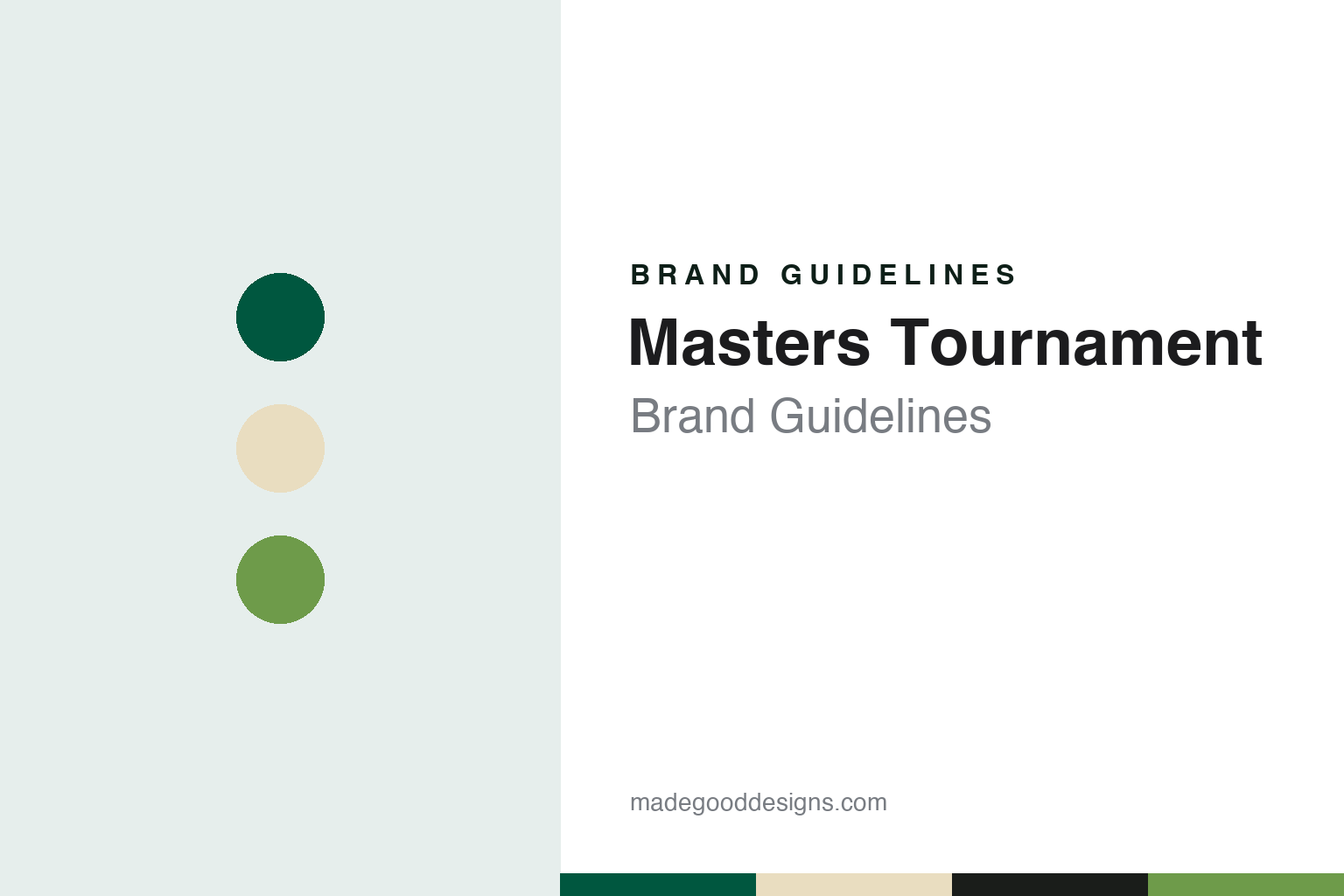
Masters Tournament Brand Guidelines
A map of the country with a flagstick in Georgia, in use since 1934.
Aa
Two constants: a deep green palette on white and a bookish serif register. Abstract homage — not the Augusta National map-and-flag emblem or any Masters mark; no logo is reproduced.
Augusta
A retired amateur, a banker and a former nursery in Georgia.
The Masters was built around a club. English Wikipedia says the idea for Augusta National came from Bobby Jones, the amateur champion who wanted to build a golf course after retiring from competition, and that he sought advice from Clifford Roberts, an investment banker who later became the club’s chairman. The two found a piece of land in Augusta, Georgia, that had been an indigo plantation in the early nineteenth century and then a plant nursery. Jones hired the course architect Alister MacKenzie to co-design the course; Wikipedia says work began in 1931 and the course formally opened in 1933. The Berckmans family, Belgian nurserymen, had owned the land from 1858 to 1910, and the club’s hospitality venue Berckmans Place is named after Louis Mathieu Berckmans.
The tournament came next. Wikipedia says Jones and Roberts first tried to bring the U.S. Open to Augusta for 1934 and were turned down, partly because of the Georgia summer heat, so Roberts told the PGA of his plan for a new spring event late in 1933. The first edition began on 22 March 1934 under the name Augusta National Invitation Tournament. Roberts borrowed chairs for spectators from local funeral homes, Wikipedia adds, and the field was at first made up largely of Jones’s associates.
The name arrived early and was made official later. Wikipedia says the present name, Masters Tournament, was officially adopted in 1939 but had been in informal use since the first edition, with newspapers sometimes calling it the “Masters Open.” Unlike the other men’s majors, which move between venues, the Masters is played every year at Augusta National, in the first full week of April. That fixed setting gives the event a single place, a single date and a single host, and the tournament’s visual identity is drawn almost entirely from the club.
Traditions have accumulated around that setting. Wikipedia says the Champions Dinner, officially the “Masters Club,” was first held in 1952, hosted by the defending champion Ben Hogan, and takes place on the Tuesday evening before the first round. The Par 3 Contest on the Wednesday was introduced in 1960 on a nine-hole course built in 1958. Since 1963, in most years, the tournament has opened with an honorary tee shot by one or more older players. Pimento cheese sandwiches have been sold as a concession since the 1940s, and spectators are called “patrons.”
Colour
A crude outline of the country, a flagstick and a jacket in Augusta green.
The emblem is a map. The New Republic reported on 8 April 2016 that Augusta National’s spokesman Steve Ethun had said there is no documented history of the logo’s origins, but that the mark appears at least as far back as a 1934 poster advertising the first invitation tournament. The poster’s logo is plainly the continental United States, the magazine said, with the proportions squeezed and the Great Lakes filled in. It noted that the northern border was bowed in 1934, close to a Lambert projection, while the current version has a straight border more like a Mercator map, and that Florida hangs straight down where it once kept a slight angle. The magazine added that the club draws a more accurate map on the buttons of the green jacket.
GOLF magazine’s Sean Zak, writing on 4 April 2023, described the logo as an elemental outline of the United States with a flagstick pegged near Georgia, and said it sat atop the very first invitations sent to players for the 1934 event. In the early years, he wrote, patches sewn onto members’ jackets carried the letters “A.N.G.C.” in a bubbly type above the outline. He reported that Clifford Roberts told the author Frank Christian the logo looked like “an ancient drawing.” Zak listed the places the mark now appears: planted in flowers on the roundabout at the club entrance, on the chairman’s wooden podium, on commemorative cups and on the gold buttons of the jacket. He also reported that the club has sent cease-and-desist letters to apparel companies and golf courses over similar marks, and that the cleanest version of the emblem has no words at all, while merchandise sold to the public adds the word MASTERS.
The jacket is the second mark. Wikipedia says a green jacket has been formally awarded to the champion since the 1949 Masters, and informally to earlier champions, in a shade identified as Pantone 342C, known as “Augusta Green.” The green sport coat is the official attire of Augusta National members on the club grounds, and each Masters winner becomes an honorary member. Wikipedia says the jacket is presented in Butler Cabin in a televised ceremony and then again outside near the 18th green, traditionally by the previous year’s winner, and that the champion must return it to the club after a year, where it is kept with other champions’ jackets.
The setting is kept free of outside branding. The New Republic wrote in 2016 that brand names and advertisements are not welcome on the premises, even on the menu, where drinks appear as “domestic beer” or “cola” rather than under their makers’ names.
Typography
Trophies, venues and traditions.
A sporting event is an unusual kind of brand. It has no product on a shelf and often no single owner of the kind a company has; instead it is held together by a name, a date on the calendar and a set of objects and rituals that recur each time it is staged.
Trophies frequently become the mark itself. A cup, a figure or a plate is drawn, simplified and printed on tickets, broadcasts and merchandise, so that the object handed to the winner also works as the event’s signature. Host venues do similar work: a clubhouse, a finish line, a grandstand or a stretch of road is photographed so often that its outline turns into shorthand for the whole occasion.
Traditions add another layer. A jacket, a garland, a particular flower, a colour worn on the day or a song sung before the start can be as recognisable as any wordmark, and organisers tend to protect them carefully. Finally, sponsor naming sits alongside all of this. Presenting partners, official suppliers and naming rights put commercial marks next to the event’s own, and the way an organiser balances or limits them is itself a design decision worth studying.
Aa
A calm, bookish serif — the register of an invitation card and a scoreboard name. (Specimen set in Libre Caslon Text, a serif STAND-IN; NOT the Augusta National emblem or any Masters mark.)
Masters Tournament
One place, one colour, very few logos.
For a designer, the Masters is an exercise in restraint. Its identity rests on three things that the club controls directly: a map-and-flag emblem, a colour and a set of rituals that happen on the same ground every April. The emblem is not refined. Both The New Republic in 2016 and GOLF magazine in 2023 dwelt on its rough geography, and both reported that its origin is undocumented. Yet the mark has changed only in small ways since the 1934 poster, a bowed border straightened and Florida turned downward, and it now appears everywhere from a flowerbed at the gate to the buttons of a jacket.
The colour works the same way. Augusta green is the colour of the members’ coats, so when the champion receives a jacket, the identity of the event and the identity of the club become the same object. The presentation in Butler Cabin and again by the 18th green turns a piece of clothing into the event’s prize, with the jacket returned to the club after the champion’s year.
The absence of other brands is part of the design. The New Republic noted that brand names are kept off the premises and even off the menu, and GOLF described how the club guards its emblem through cease-and-desist letters while selling the word MASTERS on merchandise only on site. A wordless map for members and a worded one for visitors is a small, deliberate distinction that tells the two audiences apart.
For a design guide, the Masters Tournament shows a club emblem, a single colour and a jacket working as one identity. Compare the PGA Tour, whose swinging-golfer silhouette serves a season of events, and Wimbledon, another private club whose colours define its championship. For this guide we use Augusta green, fairway and sand with a serif, an unofficial interpretation; no product or logo is reproduced.
Explore & save
Keep Masters Tournament’s identity on hand — save it to a board in the Made Good inspiration library.
Masters Tournament identity set
Pin the Masters-inspired Augusta green, fairway and sand palette and the bookish serif register to your own board.