Wimbledon Brand Guidelines
A croquet club that added lawn tennis, then dressed it in purple, green and white.
Aa
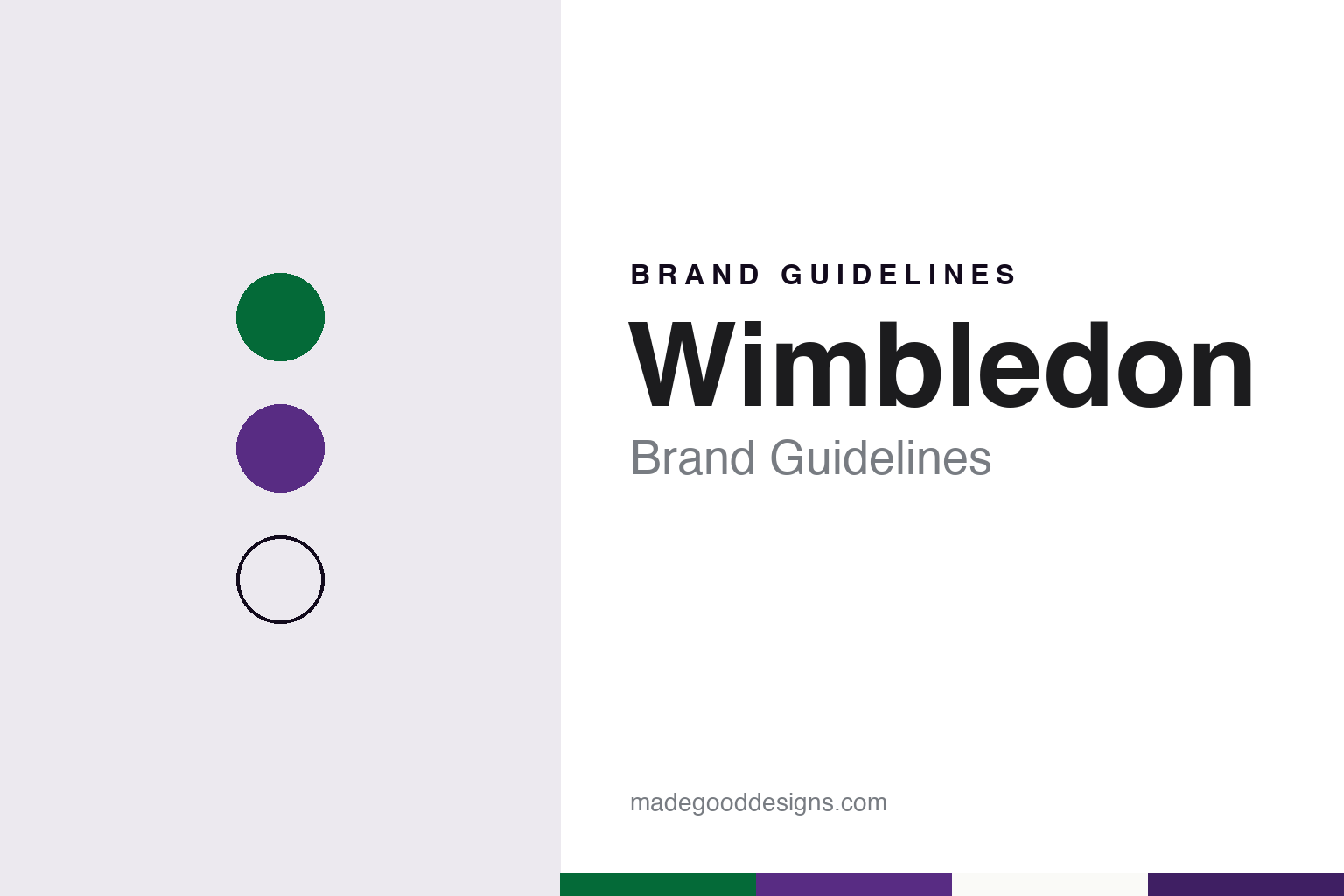
Two constants: a green, purple and white palette and a bookish serif register. Abstract homage — not the Wimbledon crossed-rackets logo, colour mark or any trade mark; no logo is reproduced.
Worple Road
A croquet lawn, a new game and a championship in 1877.
Wimbledon began as a croquet club. English Wikipedia says the All England Lawn Tennis and Croquet Club was founded on 23 July 1868 as “The All England Croquet Club,” with its ground at Nursery Road off Worple Road, Wimbledon. In 1876 the club added lawn tennis, the outdoor game devised a year or so earlier by Major Walter Clopton Wingfield and originally called Sphairistikè.
The tournament followed within a year. Wikipedia says that in spring 1877 the club renamed itself “The All England Croquet and Lawn Tennis Club” and marked the change by staging a Lawn Tennis Championship, which started on 9 July 1877 with a single event, the Gentlemen’s Singles. The Ladies’ Singles and the Gentlemen’s Doubles followed in 1884. By 1882 the club was playing almost nothing but lawn tennis and dropped “croquet” from its title; Wikipedia says the word was restored in 1899 for sentimental reasons.
The name of the event is as much a brand as the club’s. The trade mark firm Keltie wrote in June 2026 that the club’s earliest registered UK marks are for THE CHAMPIONSHIP and THE WIMBLEDON, both filed in 1884 for goods in Class 28, and that the club has sought protection for its names almost since the tournament began. The event is still formally The Championships; Wimbledon is the place.
The address changed after the First World War. Wikipedia says the grounds sat on meadowland between Worple Road and the railway line from 1877 until 1921, and that the club moved in 1922 to its present site on Church Road. The principal court there, Centre Court, opened that year. Its name was carried over from Worple Road, where the main court had stood in the middle of the others, even though it no longer described the court’s position until new courts were added on the north side of the ground in 1980.
Wikipedia says the Championships are organised by the club in collaboration with the Lawn Tennis Association. A retractable roof was built over Centre Court in time for the 2009 Championships, and a new No. 1 Court opened in 1997 as part of a long-term plan unveiled in 1993.
Colour
Dark green and purple, a crossed-rackets mark and a colour registration.
The colours date from before the move to Church Road. IPWatchdog reported in July 2022 that the club has used a dark green and purple colourway since 1909, and Keltie described the same scheme as in use since the early twentieth century. Both pieces say the colours went unregistered as a colour mark for decades, so the club relied on the law of passing off to stop others using them.
That changed in 2016. Keltie says the club secured a UK colour mark that year, described in the registration as a stripe of green, Pantone 349 C, beside purple, Pantone 268 C, in equal proportions, with the green on the left when shown vertically. The mark covers tennis books, stationery and diaries, a narrowed list of tennis clothing, and some broadcasting and entertainment services. Keltie says the evidence included a survey of people at the grounds, written statements and pictorial material going back many years, some of it from the Wimbledon Museum. IPWatchdog and Keltie both say the application was prompted partly by unofficial ticket resale sites that used the colours to suggest a link with the tournament.
The logo is the crossed rackets. IPWatchdog lists the word mark “Wimbledon” and the crossed-rackets logo among the club’s registered trade marks, and Keltie says many of the club’s recent registrations feature that logo. The club also holds figurative marks showing the men’s and women’s trophies.
Players wear white. Wikipedia says the all-white rule was formalised in 1963, when a written dress code was enforced, and that white with small colour accents is allowed so long as the accents are not an identifiable commercial logo other than the outfitter’s own. The Deseret News reported in July 2023 that white does not include off-white or cream, and that trim wider than about a centimetre around a sleeve or neckline must be changed. In November 2022 the club added an exception allowing women and girls to wear dark-coloured undershorts; the paper quoted chief executive Sally Bolton saying the change was meant to relieve “a potential source of anxiety.” Wikipedia gives the 2023 wording as “solid, mid/dark-coloured undershorts,” no longer than the player’s shorts or skirt.
The colours appear on everything else. Wikipedia says chair umpires, line judges and ball boys and girls wore green until 2005, and that from 2006 officials and ball crews were dressed in navy and cream uniforms by the American designer Ralph Lauren.
Typography
Clubs, colours and white.
A league or event identity has to work at sizes a single club badge rarely meets. The same emblem may sit on a sleeve patch, a corner flag, a ticket, a mobile app icon and a screen graphic in the corner of a live broadcast, often within the same afternoon. That pushes designers toward simple silhouettes, a limited set of colours and a wordmark that stays readable when it is shrunk to a few pixels or stretched across a stand.
Title sponsorship adds a second layer. When a company buys naming rights, its name is set beside or inside the competition mark, and the lock-up has to change when the contract ends. Organisers often keep a core symbol stable and treat the sponsor line as a replaceable module, so that kits, signage and graphics can be updated without redrawing the whole system.
Trophy imagery is a third resource. A cup, plate or shield is a recognisable shape, and some identities borrow its outline for the emblem itself. Broadcast graphics then extend the system with score bugs, line-up cards and motion templates, which is where a custom typeface or a strict grid tends to show its value.
Aa
A bookish serif — the register of a scoreboard name and a printed programme. (Specimen set in Libre Caslon Text, a serif STAND-IN; NOT the Wimbledon logo or wordmark.)
Wimbledon
Few logos on court, and partners measured in decades.
Wimbledon keeps branding off the court. Wikipedia says advertising at the Championships is minimal and low-key, limited to official suppliers, and Keltie wrote in June 2026 that on-court advertising is “limited and discreet,” with players allowed to show only their clothing manufacturer’s logo. The commercial partners that do appear tend to stay for a long time.
The ball supplier has been there since the Edwardian era. Wikipedia and Keltie both say Slazenger has supplied the tournament’s balls since 1902, and Keltie says Slazenger remains the Official Ball partner. Rolex has been Official Timekeeper since 1978 and IBM the official information technology partner since 1990, according to Keltie. Wikipedia says the club had a sponsorship deal with Robinsons fruit squash from 1935 to 2021.
Keltie notes that some partners also make co-branded goods, citing Polo Ralph Lauren x Wimbledon sunglasses sold in the Wimbledon shop, and that the club runs the Wimbledon Lawn Tennis Museum and offers tours of the grounds. The museum supplied part of the evidence for the 2016 colour mark.
The club’s visual rules are short. Dark green and purple frame the event; the competitors wear white; the crossed rackets and the word Wimbledon carry the identity on goods and signs; and partner branding is confined to a few long-running suppliers. The grass courts, the white clothing and the two club colours make a three-colour system in use since 1909.
For a design guide, Wimbledon shows how a colour pair used for more than a century can be turned into a registered trade mark with exact Pantone references. Compare Robinsons, whose squash sat beside the courts for decades, and the Premier League, which also built its identity around purple. For this guide we use club green, club purple and tennis white with a bookish serif, an unofficial interpretation; no product or logo is reproduced.
Explore & save
Keep Wimbledon’s identity on hand — save it to a board in the Made Good inspiration library.
Wimbledon identity set
Pin the Wimbledon green, purple and white palette and the bookish serif register to your own board.