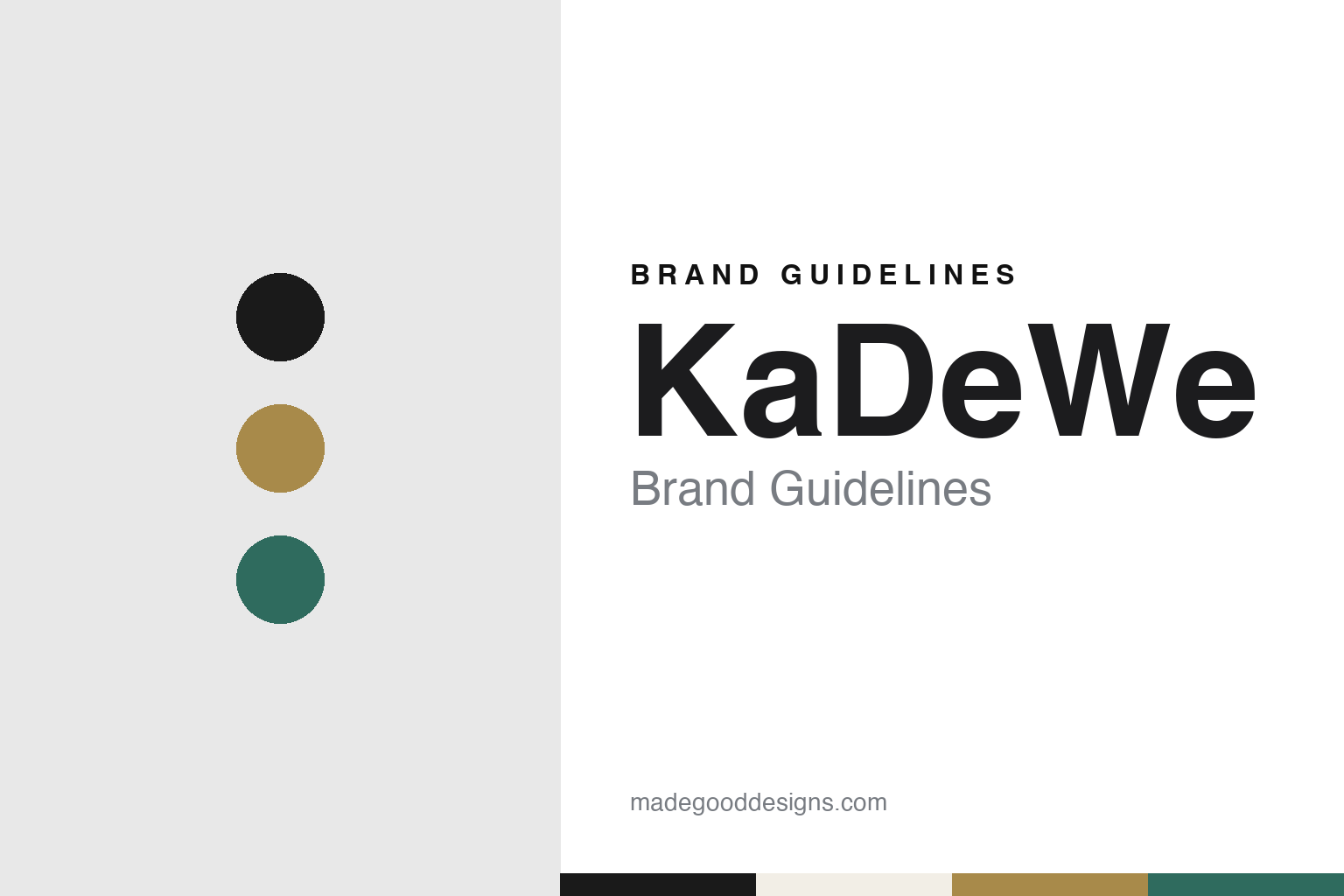
KaDeWe Brand Guidelines
A department store of the west, known by four syllables since 1907.
Aa
Two constants: a black, brass and green palette and a bold grotesque register. Abstract homage — not a KaDeWe product or mark; no logo, bag or packaging is reproduced.
The department store of the west
A Berlin retailer, an architect and a name built for abbreviation.
KaDeWe is short for Kaufhaus des Westens, “department store of the west”, and the short form has been part of the brand from the beginning. English Wikipedia says that the Berlin businessman Adolf Jandorf, who by 1905 ran six stores under his company A. Jandorf & Co., began planning a new store that year for a wealthier clientele in the west of the city. It says the word Kaufhaus was chosen to set the store apart from ordinary shops and warehouses, and that the abbreviation KaDeWe was used from the start, modelled, according to a commemorative publication of 1932, on the abbreviated company names then fashionable in the United States.
The store opened in 1907, the year given by The Local Germany in January 2024 and by a German Press Agency report published by FashionUnited in June 2024. Wikipedia dates the opening to 27 March 1907 and says the building was designed by the architect Emil Schaudt. It stands on Tauentzienstrasse, between Wittenbergplatz and Breitscheidplatz, in what The Local described as the commercial heart of the former West Berlin.
Ownership moved on in June 1927, Wikipedia says, when the store passed to Hermann Tietz OHG, which planned to modernise and enlarge it. In the post-war years the building was reconstructed: Wikipedia says the first two floors reopened in 1950 and that all seven floors were complete by 1956. FashionUnited’s 2024 report described the store as a symbol of consumption and purchasing power in that period, and Wikipedia says it became emblematic of the prosperity of West Berlin.
The building kept growing. Wikipedia records an extension between 1976 and 1978, and the addition of a further floor and restaurant by 1996, including a winter garden that looks out over Wittenbergplatz. In 1994, it says, the KarstadtQuelle corporation acquired the Hertie group and with it KaDeWe, and most floors were renovated between 2004 and 2007 ahead of the store’s centenary.
Colour
The KaDeWe Group, Rem Koolhaas and Central Group.
In 2015, English Wikipedia says, the KaDeWe Group was formed, bringing together KaDeWe in Berlin, Alsterhaus in Hamburg and Oberpollinger in Munich under joint ownership of Thailand’s Central Group and the Austrian property group Signa. The same year, a long renovation of the Berlin store began.
WWD reported on 1 October 2021 that the building work had been overseen by the Dutch architect Rem Koolhaas and his firm OMA. Under Koolhaas’s plans, it said, the store was to be divided roughly into four areas, each with its own sculptural staircase, and the renovated fashion and beauty floors opened that autumn after six years of work. The report singled out a new spiral escalator, and quoted the group’s chief executive, André Maeder, describing the homewares, toys and gourmet food departments of the three stores as part of what made each one distinct. Wikipedia says the sixth and seventh floors are devoted to food, with the sixth-floor food hall and the seventh-floor winter garden restaurant.
Ownership then changed in 2024. The Local reported on 29 January 2024 that the KaDeWe Group had filed for insolvency, citing rising rents. FashionUnited, carrying a German Press Agency report on 14 June 2024, said a contract had been signed to transfer the business operations of KaDeWe, Oberpollinger and Alsterhaus to Central Group, which had already taken over the KaDeWe building in Berlin in April. Wikipedia says Central bought the building on 12 April 2024 and acquired all of the KaDeWe Group later that year. Central Group, the Bangkok-based retailer controlled by the Chirathivat family, has owned KaDeWe since 2024, and FashionUnited noted that its other department store interests include La Rinascente in Italy, Selfridges in Britain and Globus in Switzerland.
The store also has a place in popular culture. Wikipedia says the six-part German television series KaDeWe: Our Time Is Now, made in 2021, is set in and around the store, with characters based in part on the Jandorf family.
Typography
Design and documentation.
A department store is one of the few retail formats where the building itself carries the brand. Many flagships occupy purpose-built premises on major city streets, and their facades, corner towers, clocks and glass domes are designed to be recognised from a distance and photographed from the pavement. Inside, atriums, galleries and grand staircases give the name a physical setting that a logo alone cannot supply, and the building often appears in advertising, on postcards and on the store’s own merchandise.
The shopping bag is the identity that leaves the building. A strong bag uses a single colour, a wordmark or a simple pattern that reads clearly at street level, and stores tend to keep the same scheme for years so that the bag becomes a familiar sight in other parts of the city. Gift boxes, tissue and ribbon usually follow the same palette.
Window displays add a seasonal layer. Many department stores dress their street windows to a theme each season, and the year-end windows are often unveiled at a public event that draws crowds. Spring fashion launches, sale periods, illuminated facades and in-store decorations follow a yearly calendar, so the identity changes on a schedule while the name and the building stay the same.
Aa
A bold, compact grotesque with a direct Berlin feel — the register of an abbreviation set large on a facade. (Specimen set in Libre Franklin, a sans STAND-IN; NOT the KaDeWe logo.)
KaDeWe
An abbreviation, a building on Tauentzienstrasse and a set of staircases.
The KaDeWe identity is built on an abbreviation. Kaufhaus des Westens is a description, “department store of the west”, and from 1907 the store used the short form KaDeWe, with its mix of capital and lower-case letters. The four syllables are easy to say and easy to set in type, and they carry both the type of business and its place in the city.
The second element is the building on Tauentzienstrasse. Emil Schaudt’s store, reconstructed between 1950 and 1956, extended in the 1970s and 1990s and renovated for its centenary, has stayed at the same address throughout, between Wittenbergplatz and Breitscheidplatz. The winter garden on the top floor turns the view over Wittenbergplatz into part of the visit.
The third element is the interior. The renovation led by Rem Koolhaas and OMA from 2015 organised the store into four areas around sculptural staircases and added a spiral escalator, so that movement through the building becomes part of how the store presents itself. The food floors, described by Wikipedia as occupying the sixth and seventh levels, give the store a second identity alongside fashion and beauty.
The fourth is a stable name through changes of owner. Jandorf, Hermann Tietz, KarstadtQuelle, the joint venture of Central Group and Signa, and Central Group alone since 2024 have all kept the abbreviation and the building.
For a design guide, KaDeWe shows how a short, coined abbreviation can become the whole of a store’s name and outlast every change of ownership. Compare it with Selfridges, in which Central Group also holds an interest, and with Galeries Lafayette in Paris. For this guide we use wordmark black, brass and winter-garden green with a bold grotesque, an unofficial interpretation; no product or logo is reproduced.
Explore & save
Keep KaDeWe’s identity on hand — save it to a board in the Made Good inspiration library.
KaDeWe identity set
Pin the KaDeWe black, brass and winter-garden green palette and the bold grotesque register to your own board.