Vivendi Brand Guidelines
A water company, a coined name and a group that split in four.
Aa
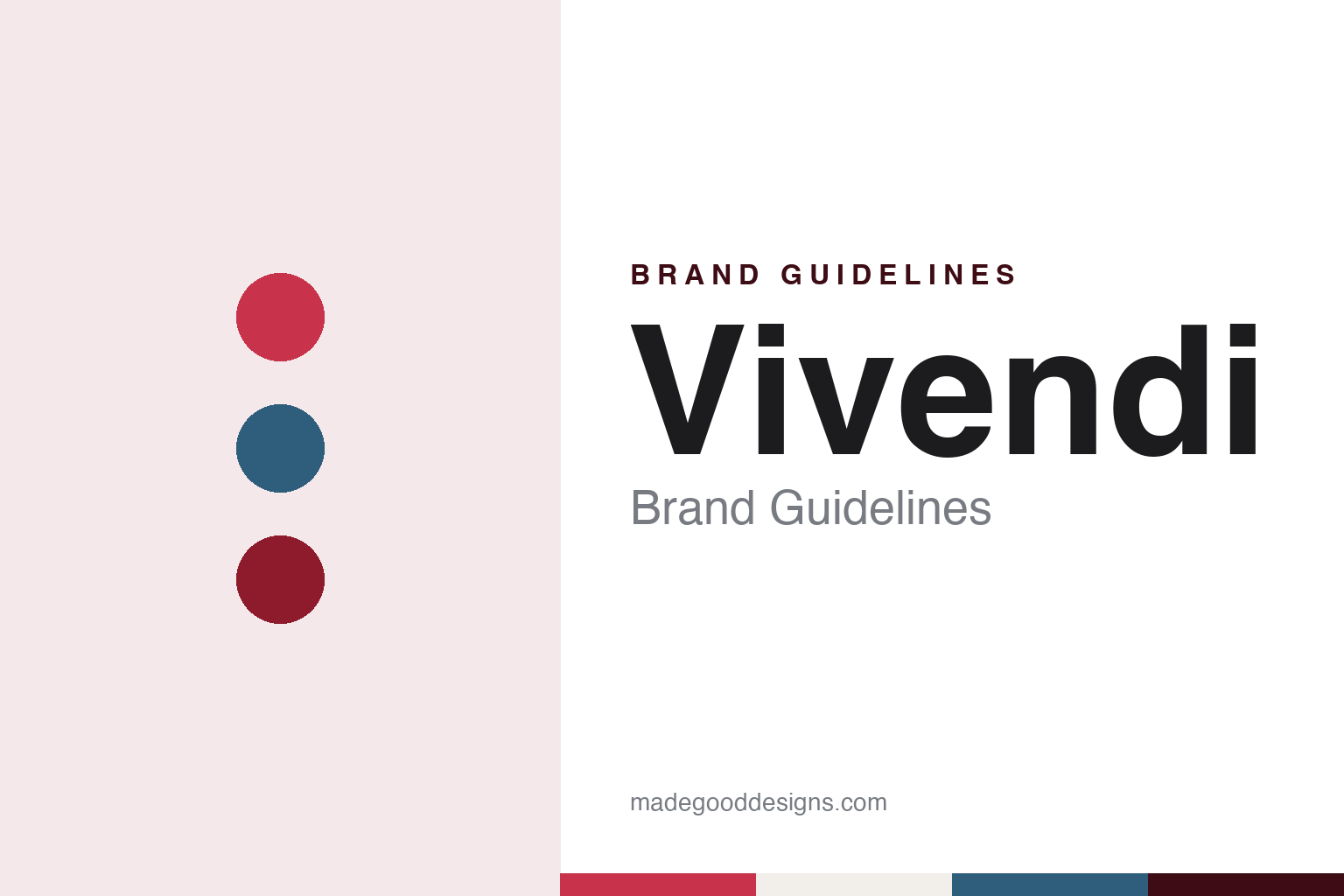
Two constants: a signal, water and claret palette and a lowercase geometric sans register. Abstract homage — not a Vivendi asset or mark; no logo, icon or wordmark is reproduced.
A water company
Paris, 1853.
Vivendi is a name from the late 1990s, but the company that carries it began as a water supplier in the France of Napoleon III. The International Directory of Company Histories, in its 2002 entry on Vivendi Universal, says Compagnie Générale des Eaux was authorised by imperial decree on 14 December 1853, with backing from investors in Paris, London and Lyon. Its list of founders, the directory says, included members of the Rothschild family and the Duc de Morny, the emperor’s half-brother. English Wikipedia gives the same date for the decree.
The early business was municipal water. The directory describes a long agreement with Lyon to supply water for homes and industry, a contract with Nantes in 1854 and, after the suburbs of the capital were annexed to the city in 1860, a 50-year contract to supply Paris and its suburbs. From the 1860s, it says, the company installed water supply and drainage in Nice and the surrounding area, and later supplied towns along the coasts of Brittany and Normandy. English Wikipedia adds concessions abroad, in Venice from 1880, Istanbul from 1882 and Porto from 1883.
For more than a century the name on the door described the work: a general company of waters. That changed in the second half of the twentieth century. The directory says the engineer Guy Dejouany joined the company in 1950 and became its president and director general in 1976, and that he took it into urban cleaning, waste, electrical contracting, house building and construction. English Wikipedia says the company helped to found the pay-television channel Canal+ in 1983, and that Jean-Marie Messier succeeded Dejouany on 27 June 1996.
Under Messier the group moved further into telephones and media. By the late 1990s a name that spoke of water sat above businesses in waste, energy, transport, building, telecommunications, television and publishing. The directory sums up the next step in one line of its timeline: in 1998 the company changed its name to Vivendi.
Colour
A name for life.
English Wikipedia dates the decision precisely. On 27 March 1998, it says, days after agreeing to take full control of the French media and advertising group Havas, Compagnie Générale des Eaux announced that it was changing its name to Vivendi. The International Directory of Company Histories says the new name was chosen to suggest life and vitality. The word is Latin in form, and it carries none of the old name’s water, place or trade.
The water business itself soon moved under a separate label. English Wikipedia says the group formed Vivendi Environnement in 1999 to gather its water, waste, energy-services and transport divisions, that the new company was floated in Paris in 2000, and that it was renamed Veolia Environnement in 2003. The name of the original water company had, in effect, been handed on twice: once to the media group and once, in a new coinage, to the environmental services business.
The next rename came quickly. The directory records that in 2000, after merging with Canal+ and the Canadian group Seagram, the company took the name Vivendi Universal S.A. English Wikipedia dates the merger to 11 December 2000 and says that on the same day Havas became Vivendi Universal Publishing. Seagram brought the film studio and record company that carried the Universal name, and the group joined that name to its own.
The longer name lasted a little more than five years. English Wikipedia says that on 20 April 2006 the company announced that its shareholders had approved a change of name back to Vivendi; French Wikipedia gives the same date. By then the Universal film business had been sold, and the name went back to the single word coined in 1998. Wikipedia describes the company’s name as stylised in all lowercase.
Vivendi’s name history is a sequence of dated changes: a descriptive name in 1853, a coined word in 1998, a compound in 2000 and the coined word again in 2006.
Typography
Parent names, labels and mastheads.
Group identities in beauty and media work on two levels at once. On the shelf or the newsstand, a reader meets a lipstick, a fragrance, a newspaper or a television channel, each with its own name, typeface and colours. Behind those labels and mastheads sits a parent name that appears in smaller type: on the back of a carton, in the legal line under an advertisement, in the corner of a website footer or on a stock-market listing. The parent identity has a different job. It speaks to investors, employees, regulators and partners rather than to the shopper or the reader, so it tends to be quieter, more typographic and more stable than the brands it carries.
Those parent names also change more often than the labels below them. Groups merge, split into separately listed companies, sell divisions and take new names, and each change brings a new wordmark, a new set of corporate colours and, sometimes, a name chosen to sound neutral across many languages. A house colour can work in both directions: on packaging it can tie a range of products together, while on mastheads it can mark a title as part of a wider family. Reading a group identity well means looking at both layers and at the dates when each one changed.
Aa
A lowercase geometric sans — after a coined name written in small letters. (Specimen set in Manrope, a sans-serif STAND-IN; NOT the Vivendi logo or any Vivendi typeface.)
Vivendi
One name, four companies.
The latest change to the group came in 2024. The broadcasting trade publication IBC reported on 11 December 2024 that Vivendi’s shareholders had approved the break-up of the group at an extraordinary general meeting in Paris, where a two-thirds majority was required. Vivendi had announced a feasibility study into the split in December 2023, IBC said, and the plan was proposed by the group’s chairman, Yannick Bolloré. English Wikipedia adds that the supervisory board approved the project on 30 January 2024 and that the shareholder vote took place on 9 December 2024.
Three companies came out of the split. IBC reported that the broadcaster Canal+ would be listed on the London Stock Exchange while keeping its headquarters in Paris, that the advertising group Havas would be listed in Amsterdam, and that the publishing company Louis Hachette Group would trade on Euronext Growth in Paris. Trading in all three began, it said, on 16 December 2024. English Wikipedia says the name Louis Hachette Group for the publishing business was announced on 22 July 2024.
Each of the three names was already familiar before the split. Canal+ was the channel the water company had helped to found in 1983; Havas was the group whose purchase in 1998 coincided with the choice of the name Vivendi. The new publishing company took the name of the nineteenth-century Paris bookseller and publisher Louis Hachette. The parent name had sat above all three for years; after December 2024 each stood on its own listing.
Vivendi itself remained. English Wikipedia says the company, formally Vivendi SE, kept its listing on Euronext Paris and continued as an investment company, with its headquarters in Paris. It records that the Bolloré group was Vivendi’s main shareholder at the end of 2024, and that Vincent Bolloré was appointed to head the company’s supervisory board in June 2014. The record company Universal Music Group, which had come to the group with Seagram, had already been floated in Amsterdam in September 2021, Wikipedia says.
From water to media to a group of separate listings, the Vivendi name has outlasted the businesses it was chosen for. It began as a replacement for a descriptive name, gained a second word through a merger and lost it again, and now stands above an investment company rather than a set of operating brands.
For a design guide, Vivendi shows how a coined parent name can be passed between businesses, lengthened by a merger and shortened again, while the labels beneath it, such as Canal+ and Havas, keep their own marks. Compare Bertelsmann, a family media group with its own long name history, and Schibsted, a Norwegian publisher that also split in 2024. For this guide we use signal red, water blue and claret with a sans, an unofficial interpretation; no product or logo is reproduced.
Explore & save
Keep Vivendi’s identity on hand — save it to a board in the Made Good inspiration library.
Vivendi identity set
Pin the Vivendi signal, water and claret palette and the lowercase geometric sans register to your own board.