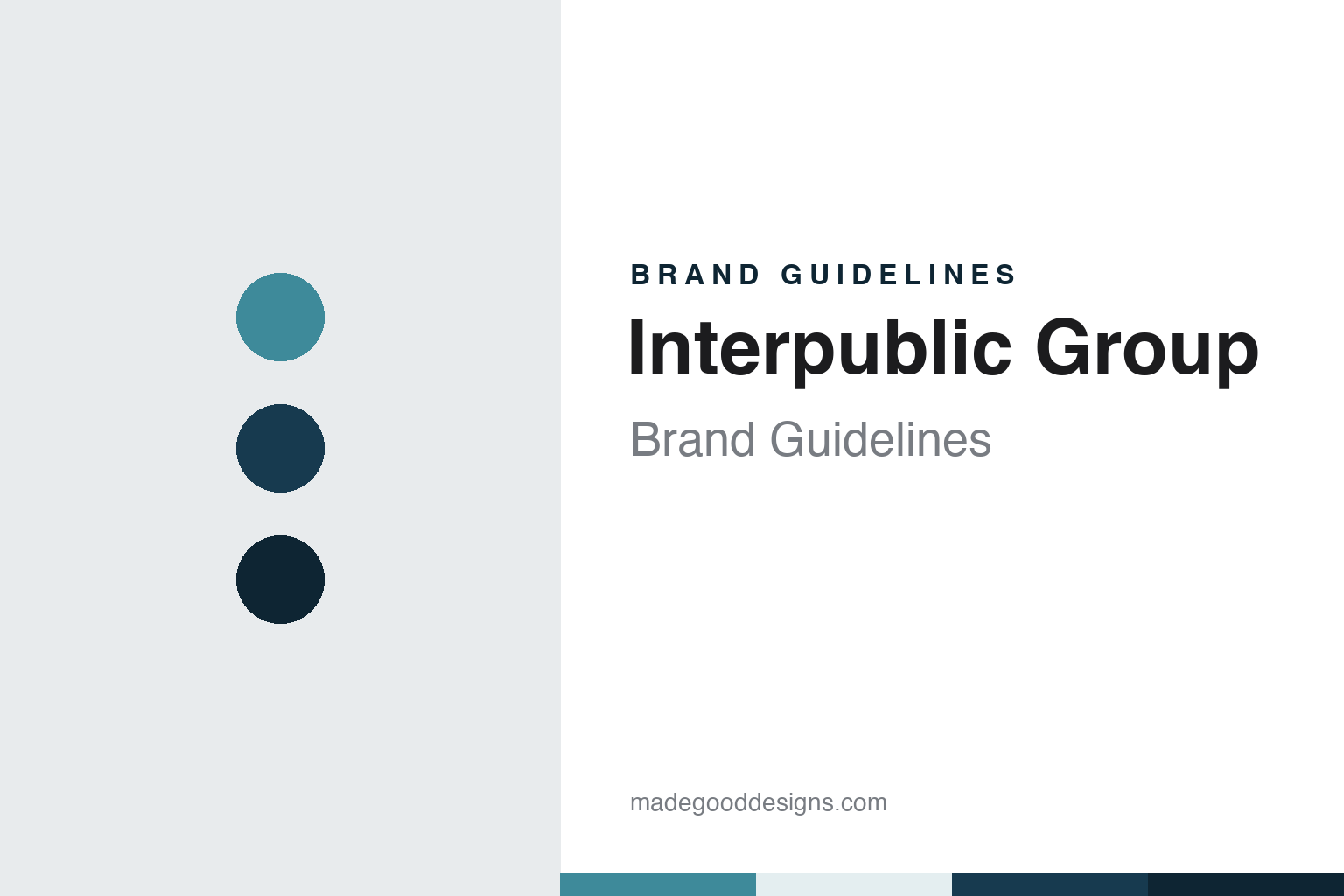
Interpublic Group Brand Guidelines
A parent company announced in 1960, renamed in 1964, acquired in 2025.
Aa
Two constants: a harbour, teal and deep-navy palette and a Humanist sans register. Abstract homage — not an Interpublic asset or mark; no logo, icon or wordmark is reproduced.
An agency becomes a parent
New York, 1961.
The Interpublic Group began as one agency deciding to become several. Its roots lie in McCann-Erickson, which Wikipedia says was formed in New York City on 2 October 1930, when the H.K. McCann Co., founded in 1911, merged with the Erickson Co., founded in 1902. The combined name kept both founders’ surnames, joined by a hyphen, and McCann-Erickson traded under it for the next three decades.
The parent company came out of a reorganisation. A MediaVillage history column published in January 2020, titled “The Birth of the Big 4 Holding Companies”, says that at the very end of December 1960, Marion Harper Jr., then president of McCann-Erickson, announced a reorganisation of his agency that created a new parent company. In January 1961, the column says, that parent, Interpublic Inc., began operations. Three years later, in January 1964, it was renamed the Interpublic Group of Companies, abbreviated IPG.
Wikipedia describes how the agency was divided. In 1960 McCann was restructured into four operating units, each reporting to the new holding company: McCann-Erickson Advertising for the United States, McCann-Erickson Corp. for international work, McCann-Marschalk and Communications Affiliates. McCann-Erickson became a subsidiary of the parent it had created, and the new parent was based, like the agency, in New York City.
Unlike McCann-Erickson, the new parent’s name contained no founder’s surname. Its 1964 form, “the Interpublic Group of Companies”, named the arrangement instead: a group, made of companies. The McCann name continued underneath it, on the agency that had started the whole structure.
Colour
A group of companies, each with its own name.
Under the Interpublic name, the agencies were reorganised and renamed many times, while the parent’s own name stayed fixed. Wikipedia says that in late 1973 McCann-Erickson combined its domestic and international branches into a single worldwide agency under IPG. In 1997 the McCann-Erickson World Group was formed from several IPG units, and in March 2004 it was renamed McCann Worldgroup. Wikipedia lists the agency itself as McCann, formerly McCann Erickson.
Other networks joined by acquisition. Wikipedia says IPG acquired Deutsch Inc. in December 2000 as an autonomous unit, and in 2001 bought True North Communications, the holding company for Foote, Cone & Belding. That agency was later merged with Draft Worldwide as Draftfcb, and in March 2014 it was renamed FCB, three capitals standing for the surnames Foote, Cone and Belding. In July 2008 IPG formed a media buying and planning unit called Mediabrands, later IPG Mediabrands, and in January 2016 the American agency Mullen and the worldwide network Lowe and Partners were renamed together as MullenLowe Group.
Wikipedia lists the specialist firms that sat alongside those networks, including Weber Shandwick in public relations, Golin, the branding agency FutureBrand, the experience agency Jack Morton Worldwide and the sports agency Octagon. Each carried its own name and identity, and the IPG initials appeared in the names of a few units, such as IPG Mediabrands and the IPG Media Lab.
Inside McCann Worldgroup, Wikipedia lists agencies whose names were joined to McCann’s with a double slash, among them Commonwealth//McCann in Detroit and Casanova//McCann, formerly Casanova Pendrill, a Hispanic-focused agency in Orange County, California. It also lists McCann Health, the production network Craft and the agency Avrett Free Ginsberg, stylised as AFG&. Another unit on the list was MCN FP7, the Middle Eastern Communication Network.
Leadership passed in January 2021, when Wikipedia says Philippe Krakowsky succeeded Michael I. Roth as chief executive.
Typography
A parent name and its networks.
Advertising-agency identities are built from unusual raw material. Many agency names began as the surnames of their founders, set side by side or shortened to a run of initials, and over time those initials can become a wordmark that few people read as names at all. Above the agency brands sit holding-company names, which tend to be shorter, more abstract and designed to work on annual reports, stock listings and conference stages rather than on client work.
Because an agency sells ideas rather than packaged goods, its brand surfaces are unusual too. The lobby and reception area act as a shop window for visiting clients and job candidates. House symbols, small objects or colours associated with a founder, can turn up on desks, award shelves and merchandise. Pitch decks, credentials documents and case-study reels carry the identity into rooms the agency does not own, so the type, colour and layout rules have to survive being projected, printed and shared as files.
For a designer, the useful lesson is how a business-to-business identity balances heritage, signalled by founders’ names and dates, against the need to look current to the next client in the room.
Aa
A humanist sans — after a parent name without a founder’s surname. (Specimen set in Work Sans, a sans STAND-IN; NOT the Interpublic logo or any Interpublic typeface.)
Interpublic Group
Into Omnicom.
The Interpublic name ended as a separate company in 2025. Wikipedia says the Wall Street Journal reported on 8 December 2024 that Omnicom and Interpublic were in advanced merger discussions, and that the combined firm would keep the Omnicom name and trade as OMC on the New York Stock Exchange, with Daryl Simm and Krakowsky as chief operating officers and co-presidents. MediaPost reported on 22 October 2025 that the European Commission was the remaining regulator yet to approve the deal and that a late-November closing was expected. On 26 November 2025, Omnicom said it had completed its acquisition of The Interpublic Group of Companies, Inc.
The networks were redistributed almost at once. Marketing-Interactive reported on 1 December 2025 that Omnicom would retire several long-established agency brands, including FCB and MullenLowe, both from Interpublic, along with Omnicom’s own DDB. FCB was being folded into BBDO, and MullenLowe and DDB rolled into TBWA. McCann, the agency from which Interpublic grew, became one of three global networks in the new creative structure, alongside BBDO and TBWA. The same report placed former Interpublic media agencies UM, Initiative and Acxiom in the consolidated Omnicom Media Group, and Golin and Weber Shandwick among Omnicom’s public relations firms. Krakowsky was listed as co-president and chief operating officer of Omnicom, alongside Daryl Simm. Social Samosa, on 2 December 2025, said DDB, FCB and MullenLowe were being phased out as independent global entities.
In 1961 McCann-Erickson created a parent company to hold it. In 2025 that parent was absorbed into Omnicom, and McCann continued as one of Omnicom’s three global creative networks.
For a design guide, the Interpublic Group shows how a parent name without a founder’s surname can stand above agencies that kept their own surnames and initials. Compare Omnicom, the holding company that acquired Interpublic in 2025, and BBDO, the network into which FCB was folded. For this guide we use harbour, teal and deep navy with a sans, an unofficial interpretation; no product or logo is reproduced.
Explore & save
Keep Interpublic Group’s identity on hand — save it to a board in the Made Good inspiration library.
Interpublic Group identity set
Pin the Interpublic Group harbour, teal and deep-navy palette and the Humanist sans register to your own board.