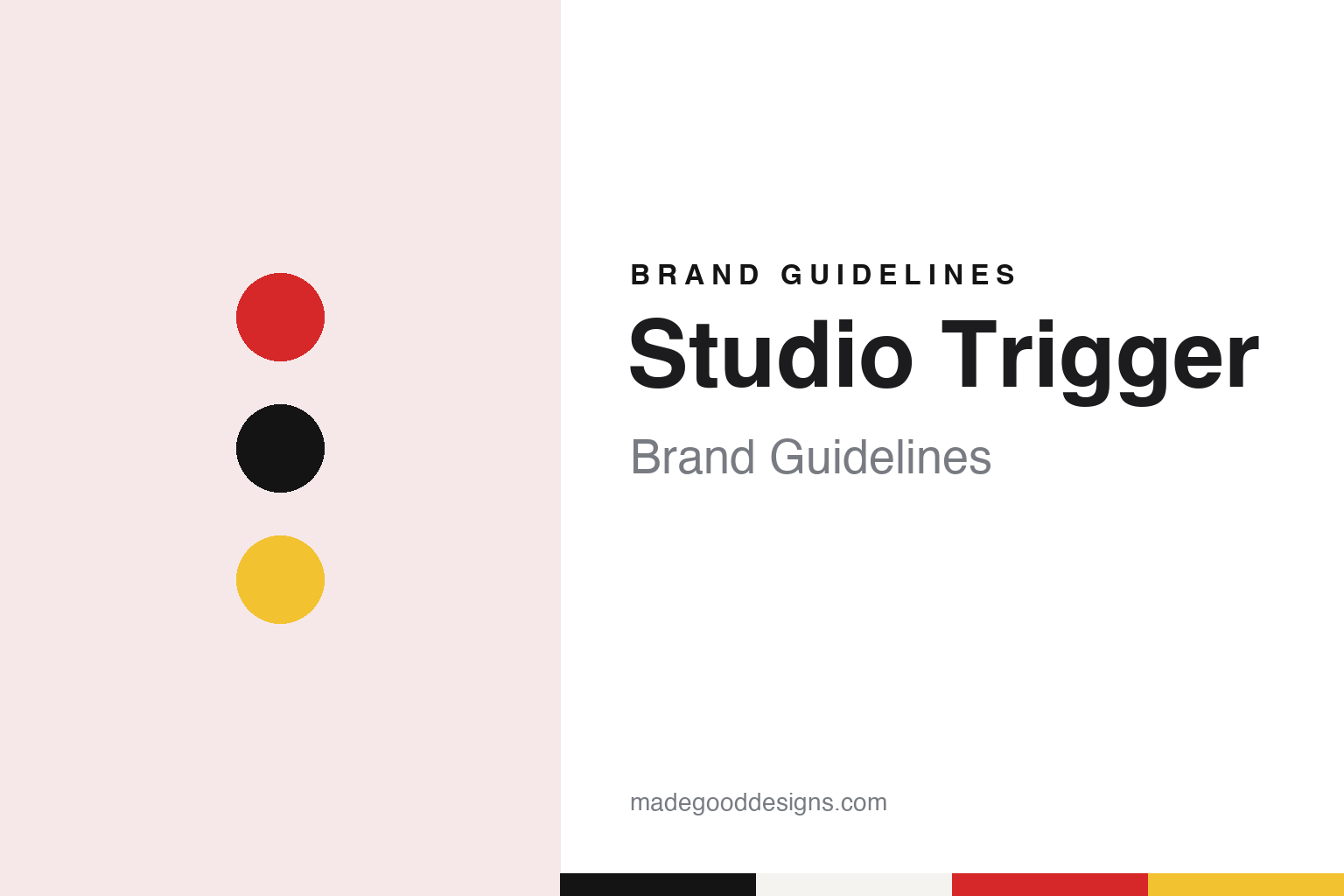
Studio Trigger Brand Guidelines
Capital letters, a muzzle and a spring.
Aa
Two constants: a signal red, ink black and flash yellow palette and a Condensed poster caps register. Abstract homage — not a Trigger asset or mark; no logo, mascot, character or wordmark is reproduced.
A studio that left Gainax
Two directors, a producer and the Gurren Lagann team, 2011.
Studio Trigger is the working name of Trigger, Inc., a Japanese animation company whose name, Wikipedia notes, is usually styled in capital letters as TRIGGER. Anime News Network reported on 23 August 2016 that the directors Hiroyuki Imaishi and Masahiko Otsuka founded the studio on 22 August 2011. A profile of the studio published by the Japan Media Arts Festival’s overseas promotion programme, run by Japan’s Agency for Cultural Affairs, names a third co-founder: it says Otsuka founded TRIGGER in 2011 together with Imaishi and the producer Kazuya Masumoto. Wikipedia says the studio name and its official website were made public in October 2011.
Both directors came from Gainax. In an interview with the Japan Media Arts programme, Otsuka said that at the time he belonged to a Gainax team that was separate from Hideaki Anno’s Evangelion crew and had been developing Gurren Lagann. The group wanted to try new ways of making animation and of talking with fans, and to find out how far it could go without the Gainax name. Otsuka recalled that when they told the company they wanted to leave and set up their own studio, Gainax wished them good luck and sent them off, and that TRIGGER was founded with the core members who had worked on Gurren Lagann.
The founders’ careers explain some of that mix. The same profile says Otsuka began in live-action film, joined Studio Ghibli as an assistant to the director on Pom Poko and Whisper of the Heart, and later moved to Gainax, where he worked on Neon Genesis Evangelion and directed Petite Princess Yucie. Anime Corner, reporting on 30 November 2023 from a press conference at Anime NYC, said Imaishi founded TRIGGER after Gurren Lagann at Gainax, and that the creative director Hiromi Wakabayashi, who appeared beside him, had also been at Gainax as a production designer on Gurren Lagann.
From the outset the studio worked inside a wider structure. Wikipedia says that in 2011 Trigger formed the joint holding company Ultra Super Pictures with the studios Sanzigen and Ordet, and that Trigger’s early output included animation for the game Project X Zone and a short film, Little Witch Academia, in 2013.
Colour
Original series, a director-led studio and a returned title.
Trigger’s early years were marked by original work rather than adaptations. Wikipedia dates Kill la Kill, the studio’s own television series, to a run from October 2013 to March 2014. At the Anime NYC press conference reported by Anime Corner in November 2023, Imaishi recalled that the series took a very long time in pre-production because everything about it was original and because, with the studio so new, he did not yet have a clear sense of what it could handle.
The studio also turned to its audience for funding. The Japan Media Arts profile says Trigger ran a Kickstarter campaign in July 2013 to make a sequel to the Little Witch Academia short, and that the project led to the feature Little Witch Academia: The Enchanted Parade in 2015. The profile ties this to a wider aim, which Otsuka traced to his Gainax years: to let the production team speak directly to fans. It mentions occasional TRIGGER NIGHT events at which directors, writers, producers and designers appear together.
Inside the studio, Otsuka described a method built around directors. In the Japan Media Arts interview he said TRIGGER entrusts each work to its director, greenlights a project once it can see what the director wants to achieve, and treats the director’s intention as more important than a shared house vision. He added that, because Imaishi is strong at action animation and many staff are drawn to it, the studio’s work leans towards action. He also said the studio wanted to keep the hand-drawn look that Japanese animation had developed, even as animation elsewhere moved towards 3D CGI. In the 2023 press conference, Wakabayashi said a partner’s title becomes a TRIGGER project when the partner is willing to let the studio make it its own.
Wikipedia lists later dated works including SSSS.Gridman (2018), the feature Promare (2019), BNA: Brand New Animal (2020), Cyberpunk: Edgerunners (2022) and Delicious in Dungeon (2024). Anime News Network reported on 8 November 2023, in an interview with Otsuka at Otakon 2023, that the studio had premiered Delicious in Dungeon at Anime Expo 2023 ahead of its January 2024 release on Netflix, announced screenings for the fifteenth anniversary of the Gurren Lagann films and shown a trailer for a New Panty & Stocking project. Otsuka said that, while still at Gainax, the team had hoped to make more Panty & Stocking with Garterbelt, but had given up because the rights stayed with Gainax, and that the studio had acquired them through what he called a fortunate turn of events. He also described the surprise at the studio when Tsuburaya made physical suits of the Gridman and Alexis Kerib designs.
Typography
Capital letters, three mascots and a fan audience.
A game studio’s identity usually reaches players before the game does. The company logo appears on a splash screen or a short animated ident in the seconds while software loads, then again on store pages, trailers, packaging and the credits. Because those seconds repeat every time someone opens a game, the ident tends to be short, legible on a phone or a television, and quiet enough that it does not compete with the title that follows. Animation studios use the same device in front of their films, often with a brief piece of motion or a sound cue that returns from release to release.
Much of the visible branding, though, belongs to the work rather than the company. Characters, mascots and title logos carry the recognition, and a studio name may sit underneath them in small type. Some companies let a recurring character stand in for the studio; others keep the studio mark plain so that each new game or film can look different. Ownership changes add another layer: when a studio is bought or becomes independent, the parent’s mark may appear beside its own or drop away. For designers, the practical point is that a studio identity is a set of placements — a splash screen, a store icon, a credit line, a website — and each needs a version of the mark that works at its size and in its moment.
Aa
Condensed poster caps — after the all-capital TRIGGER name. (Specimen set in Anton, a condensed sans STAND-IN; NOT the Trigger logo or any Trigger typeface.)
Studio Trigger
A name in capitals and a family of mascots.
Trigger’s identity starts with its name. Wikipedia gives the company as Trigger, Inc., written in Japanese as Torigā and stylised in capital letters. The Japan Media Arts profile and the studio’s 2023 interviews in Anime News Network and Anime Corner print the name the same way.
The studio also has characters that stand for the company itself. Anime News Network reported on 23 August 2016 that a short animation shown at the end of a Nico Nico marathon stream of Space Patrol Luluco featured Trigger’s mascots, named Trigger, Muzzle and Spring, with music by TeddyLoid, who had composed the ending theme of Luluco. Both the stream and the short marked the fifth anniversary of the studio’s founding.
The studio’s presence at fan events is part of the same system. The 2023 interviews took place at Otakon, Anime Expo and Anime NYC, and Anime News Network said Otsuka was accompanied in Baltimore by animators and by a staff member dedicated to the studio’s YouTube channel. The Japan Media Arts profile describes this direct line from the production team to the audience as something the founders set out to build when they left Gainax.
For a design guide, Studio Trigger shows how a short, all-capital name and a small family of named mascots can carry a studio across festival stages, streams and anniversary shorts. Compare Studio Ghibli, where Otsuka worked as an assistant to the director in the 1990s, and Aardman, another independent animation studio built around its founders. For this guide we use signal red, ink black and flash yellow with a sans, an unofficial interpretation; no product or logo is reproduced.
Explore & save
Keep Studio Trigger’s identity on hand — save it to a board in the Made Good inspiration library.
Studio Trigger identity set
Pin the Studio Trigger signal red, ink black and flash yellow palette and the Condensed poster caps register to your own board.