Bruce Mau Design Brand Guidelines
A founder’s name that outlasted the founder’s desk.
Aa
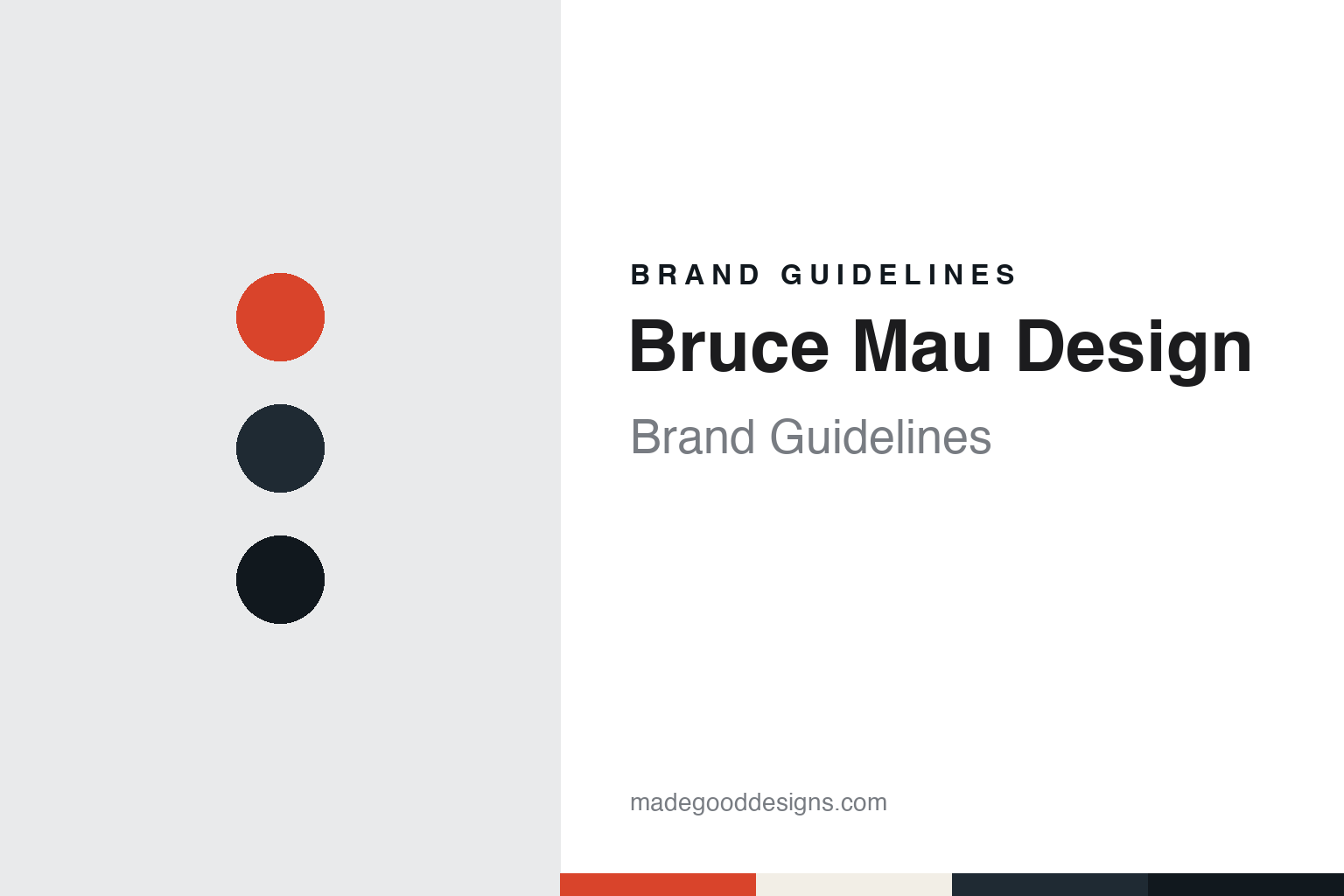
Two constants: a signal red, slate and ink palette and a Plain grotesque register. Abstract homage — not a Bruce Mau Design asset or mark; no logo, icon or wordmark is reproduced.
A book series, a studio and a name
Toronto, 1985.
Bruce Mau Design, usually shortened to BMD, is a design studio in Toronto that carries the full name of the designer who started it. On its own website the studio describes itself as a multidisciplinary brand and design studio, and says Bruce Mau founded it in Toronto in 1985. The Toronto site UrbanToronto used the same founding year when it interviewed the studio’s chief executive in October 2014, calling BMD a multidisciplinary design firm founded in 1985.
The studio grew out of books. The Globe and Mail profiled Mau on 15 April 2010 and set out the sequence. Mau was raised in Sudbury, Ontario, and left after high school to study at what was then the Ontario College of Art in Toronto. He left the college to work for a short time at Fifty Fingers, a Toronto design group, and then, the paper said, founded his own studio in 1985 to develop the Zone Books series. He remained Zone’s artistic director until 2004.
English Wikipedia fills in the route between those two points. It says that after Fifty Fingers, Mau spent a short spell at Pentagram in the UK, returned to Toronto as one of the founders of Public Good Design and Communications, and then left when the chance came to design Zone 1/2, a compendium about the contemporary city, setting up his own studio to do it.
Books stayed central to the studio’s name for years. The Globe noted that S,M,L,XL, Mau’s collaboration with the Dutch architect Rem Koolhaas on the work of Koolhaas’s Office for Metropolitan Architecture, was published in 1997. In 1998 Mau wrote the Incomplete Manifesto for Growth, a set of short statements about his creative method. The paper quoted two of its points, “Allow events to change you” and “Don’t clean your desk,” and said the text travelled widely around the world.
That manifesto is still part of how the studio presents itself. BMD’s website says its design practice continues to be guided by the design-thinking methods Mau set out in the Incomplete Manifesto for Growth, and it links to the text from its own about page. The studio’s name has stayed the founder’s name throughout, even after Mau himself moved on to other ventures, and the short form BMD appears on its website and in press coverage of its work.
Colour
An exhibition, a move to Chicago and a new chief executive.
In 2004 the studio’s founder put his name to an exhibition. CBC Arts reported on 4 October 2004 that Massive Change had opened that weekend at the Vancouver Art Gallery, which had commissioned it from the Toronto-based designer Bruce Mau. The show was about the future of design and what design makes possible, and it was split into themes Mau called economies, from urban, information and transportation to energy, materials, manufacturing, health and politics. One room was built from discarded objects, including VHS tapes, computer keyboards and dolls, and a wall near the exit asked visitors: “Now that we can do anything, what will we do?” The exhibition ran in Vancouver until 3 January 2005.
Massive Change was also a book and an educational programme. The Globe said in 2010 that Mau described the process of launching the Institute Without Boundaries, a Toronto postgraduate programme founded with George Brown College in 2003 to teach collaborative design strategy, and of creating Massive Change as life-changing experiences for him.
By then the studio worked from more than one city. The Globe profile of April 2010 said Mau, as chief creative officer, ran business and cultural design studios in Toronto and Chicago. A year later, in an interview with the curator Zoë Ryan published by Sixty Six magazine in March 2011, Mau was living outside Chicago and talking about a new venture, Bruce Mau Live. Asked whether he had left Bruce Mau Design, he said he would still do key projects, and named Hunter Tura as the studio’s chief executive. English Wikipedia says Mau left the company in 2010 and co-founded the Massive Change Network in Chicago with Bisi Williams.
Tura led BMD for the decade that followed. He told UrbanToronto in October 2014 that he had moved to Toronto to lead Bruce Mau Design in 2010, and that as president and chief executive a large part of his job was setting a clear vision for the organisation. He listed Sonos, Harvard and GE as long-time collaborators, said the studio was helping the developer DREAM roll out a new visual identity and urban branding in Hong Kong, Jersey City and Toronto, and pointed to marketing work for The Well, a Toronto development. He also said BMD had opened an office in Los Angeles in February 2014.
Mau’s later ventures carry his name as well. Wikipedia says he founded Bruce Mau Studio in 2020. BMD’s current website still presents the Toronto studio under the name he gave it in 1985, and describes Mau as a designer, educator and writer who continues to speak and write through new projects.
Typography
A founder’s name, kept as the studio’s name.
For an advertising or design agency, the name is the one piece of branding it has to live with on every pitch, credit and door plate. Canadian agencies have taken very different routes. Some keep the founder’s name. Bruce Mau Design was named after the designer who started it in Toronto in 1985, and it kept that name after Mau moved to Chicago and Hunter Tura took over as chief executive in 2010; the studio still uses it, usually shortened to BMD. Others turn the founder into something less literal. Zulu Alpha Kilo, which Zak Mroueh started in Toronto after leaving Taxi in 2007, takes its name from the NATO phonetic spelling of his name, and for a time its website introduced three fictional founders played by actors rather than the real one.
The rest of the identity tends to be built from what an agency shows rather than a logo alone: the work it puts on its site, the way it describes its offices, the projects it chooses to name, and how it carries one name across studios in Toronto and cities such as New York, Vancouver, Chicago and Los Angeles. When reading these identities, look at how much the name explains about the people behind it, how the agency’s own website and spaces are staged, and which client projects it puts forward as evidence of how it thinks.
Aa
A plain grotesque — after a studio that lets the work carry the voice. (Specimen set in Libre Franklin, a sans STAND-IN; NOT the Bruce Mau Design logo or any BMD typeface.)
Bruce Mau Design
Identity systems and named projects, as dated facts.
One BMD identity covered in detail by the design press is for the audio company Sonos. Creative Bloq reported on 29 January 2015 that Sonos’s move towards the mainstream had begun in 2011, and that part of that process was a new brand identity by Bruce Mau Design centred on the plain SONOS wordmark. With more competitors in wireless audio, the magazine said, BMD had returned to the identity and given it a refresh.
The 2015 system, as Creative Bloq described it, was built from a small kit of graphic tools meant to be mixed and remixed. The wordmark itself was left largely unchanged but could be repeated into an endless palindromic pattern. A simple colour gradient could be added in any colours. The third element was a sunburst made of tightly packed lines of different widths, which produced moiré patterns when viewed and appeared to pulse when scrolled up and down a screen, an effect the magazine compared to seeing sound waves leave a speaker. It said the system had already been used on a wrapped New York subway train and at an exhibition in Paris.
Other named projects appear in the studio’s own account and in the press. Tura’s 2014 interview listed the DREAM identity roll-out and The Well. English Wikipedia says BMD was involved in the redevelopment and redesign of Ontario’s ONroute highway service centres in the 2010s. On its about page, BMD lists among past clients and collaborators the Art Gallery of Ontario, the Seattle Public Library, the Walt Disney Concert Hall, the National Ballet of Canada, Harvard University and Sonos.
The studio describes its services in plain categories: brand identity, naming and voice; web design and motion; books and editorial design; signage, wayfinding and environmental graphics; packaging; and research and stakeholder engagement. The mix reflects where it began, with books and exhibitions, and where it has gone since, into identity systems that have to work on a subway car as well as on a screen.
For a design guide, Bruce Mau Design shows how a studio can keep its founder’s name as a fixed point while the founder, the offices and the kind of work around it change. Compare Blok Design and john st., two other Toronto agencies in this collection. For this guide we use signal red, slate and ink with a sans, an unofficial interpretation; no product or logo is reproduced.
Explore & save
Keep Bruce Mau Design’s identity on hand — save it to a board in the Made Good inspiration library.
Bruce Mau Design identity set
Pin the Bruce Mau Design signal red, slate and ink palette and the Plain grotesque register to your own board.