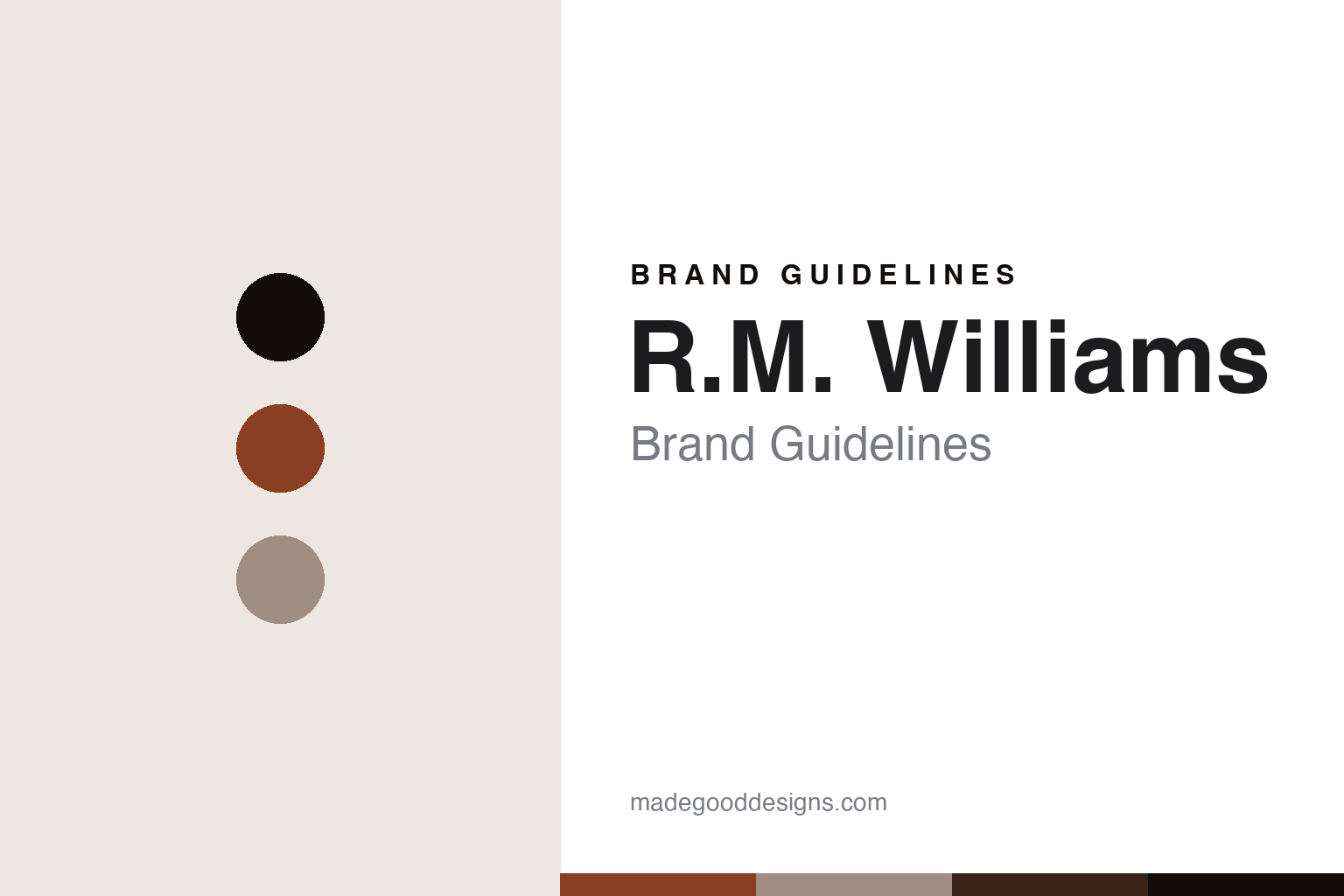
R.M. Williams Brand Guidelines
The one-piece Australian boot.
Aa
Two constants: a redgum-brown palette and an outback-sans register. Abstract homage — not an R.M. Williams boot, last or wordmark.
The one-piece Australian boot
R.M. Williams is the Australian bootmaker, since 1932, whose Craftsman boot pairs a one-piece leather upper with a Goodyear welt, made in Adelaide.
R.M. Williams is a lesson in how one construction idea becomes a national icon. From Adelaide, South Australia, it makes the Craftsman — an elastic-sided boot whose upper is cut from a single piece of leather, with no side seams, joined only at the heel, and attached to its sole with a Goodyear welt. Its answer, in a series about the corners of the trade, is the fresh country: Australia’s outback bootmaker, whose seamless upper is a genuine construction signature. A boot born of the stockman’s saddle.
Its identity is the one-piece Australian boot. R.M. Williams’s seamless upper, its Goodyear welt and its Australian making are the work it is known for. A construction idea, made an icon. A bootmaker that became a national symbol.
(Honest notes, so the story stays precise, and with cultural care. R.M. Williams was founded in 1932 by Reginald Murray Williams, who died in 2003, so we speak of the founder in the past tense; its boots are made in Salisbury, in Adelaide, South Australia. Its construction is worth stating exactly: the Craftsman’s upper is cut from a single piece of leather with no side seams — the founder’s innovation — and that upper is attached to the sole with a Goodyear welt, so both facts are true together and we do not say it is “not Goodyear.” Two honest points: its iconic leather boots and small leather goods are Australian-made, but a large share of its clothing and accessories is imported, so we scope the made-in-Australia claim to the boots; and its ownership has changed hands often, passing through the LVMH-affiliated investment firm L Catterton in the 2010s before being bought in 2020 by Tattarang, the Forrests’ Australian private company, which owns it now. With respect: the founder learned leather-working in part from an Aboriginal stockman known as “Dollar Mick,” which we credit plainly, and we use no Indigenous or outback imagery. Its designs and marks are its IP, described but never reproduced, and there is no official brand hex — these tones are an unofficial interpretation. This is design commentary and does not promote any product.)
Colour
R.M. Williams lives in a redgum-brown palette. Click a swatch to copy the hex.
R.M. Williams’s identity is Australian, rugged and iconic — a redgum brown, an ink, a calf tan, an umber, and a chalk. The palette leans redgum brown and tan: the register of a hard-wearing boot leather and the Australian bush. It signals durability and national heritage over fashion. The honest caveat: with no published brand hex, these values are an original, unofficial interpretation, not first-party colours, and we evoke the bush through leather tones only, not through any Indigenous or outback imagery.
The lesson is a redgum-brown palette signals a one-piece, made-in-Australia identity. R.M. Williams’s world is a seamless-upper, Goodyear-welted, Australian object. For designers, it is a reminder that a warm redgum brown and a soft tan can carry a brand built on a construction idea — the red-brown of Australian leather and the tan of the last. Because these tones can fail as small text, keep type dark and let the colour live in the accents, palette and band. The takeaways: own a construction idea; keep the boots Australian-made; be honest about ownership and imports; and treat any single hex as unofficial.
Typography
The register is an outback sans — plain, sturdy, grounded.
R.M. Williams’s identity carries a plain, sturdy, grounded spirit — a working national icon, not a fashion label. An outback sans captures the mood: solid, honest and unpretentious, the register of a boot born on the land. Set in a redgum-brown palette, the outback sans feels plain and sturdy — exactly the personality the brand carries. It is grounded rather than showy, mirroring a one-piece leather boot. (R.M. Williams’s real designs and marks are things we describe but do not reproduce, and the exact typeface is not ours to use.) Because it is not ours to use, the honest description is “an outback-sans spirit,” shown here in a stand-in. The type behaves like the brand: plain, sturdy and grounded.
Aa
An outback-sans spirit — plain and sturdy. (Specimen set in Manrope, an outback-sans STAND-IN; NOT the R.M. Williams wordmark, any Indigenous or outback imagery, or a boot design.)
Further afield
R.M. Williams stands for the one-piece construction idea.
R.M. Williams is a lesson in how one construction idea builds a national icon. A redgum-brown palette, an outback sans and a one-piece boot make one thing — a seamless-upper, Goodyear-welted Australian boot — the whole brand: Australian, rugged and iconic. The one-piece upper is the differentiator, and the Goodyear welt is the durability. The point is a genuinely distinctive object, made in Adelaide, whose seamless leather upper turned a stockman’s riding boot into a national symbol.
Put to work, the identity is a construction idea as design. A brand in this spirit would build its whole identity on one genuine innovation, keep the icon made at home, and be honest about ownership changes and about which products are actually local. It would credit the roots of its craft with respect. A brand learning from it would see that a single construction idea — a seamless one-piece upper — can carry a national identity, and that being precise, one-piece upper and a Goodyear welt together, boots Australian-made while much apparel is imported, and Tattarang-owned now after an overseas-investment era, is more trustworthy than a simpler myth. A brand learning from it would also handle a craft’s origins, and the Aboriginal stockman who helped teach it, with plain respect and no appropriated imagery. The lesson R.M. Williams teaches is that a construction idea plus honest heritage can hold an identity: the seamless upper gives it distinction, and the Australian making gives it meaning. The idea is the personality, and the one-piece boot is the proof.
For designers and brand-builders, R.M. Williams holds the fresh-country point in this round about the far corners of the trade: build on one real construction idea, and tell the heritage honestly and respectfully. The lessons: own the innovation; keep the icon local; disclose ownership and imports; credit the craft’s roots without appropriating imagery; and never reproduce a protected design. It is also a reminder to stay precise: R.M. Williams is an Australian bootmaker founded in 1932, its Craftsman boot pairing a one-piece leather upper with a Goodyear welt, made in Adelaide and owned by Tattarang — with the palette here an unofficial interpretation. R.M. Williams made the one-piece upper an icon — proof that a construction idea can be the difference.
Explore & save
Keep R.M. Williams’s identity on hand — save it to a board in the Made Good inspiration library.
R.M. Williams identity set
Pin the redgum-brown palette and the outback-sans register to your own board.