Bergs Potter Brand Guidelines
Danish design, Italian clay.
Aa
Two constants: a clay-rose palette and a design-sans register. Abstract homage — not a Bergs Potter product or mark.
Danish design, Italian clay
Bergs Potter is the Danish terracotta-pot brand of 1942, designed in Copenhagen and made in Italy from Tuscan clay.
Bergs Potter closes the round with a pot that crosses two countries — designed in Denmark, made in Italy. Bergs Potter makes design-led terracotta pots and planters, for plants indoors and out. Its answer to how a maker becomes a name is a split of roles: pair a Danish design sensibility with Italian terracotta craft, and make an everyday flowerpot desirable. A pot, Danish in design, Italian in clay.
Its identity is Danish design, Italian clay. Bergs Potter’s design-led terracotta, its Copenhagen roots and its Italian making are the work it is known for. A pot, made in Italy. Danish design, Italian clay.
(Honest notes, so the story stays precise. Bergs Potter — at bergspotter.com — makes design-led premium terracotta pots and planters, fired at high temperatures and made to develop a natural patina. It was founded in 1942 in Copenhagen, in the Nørrebro district, by Victor Berg, who inherited a ceramics shop; we cite 1942 as the founding year. On where it is made — the point of this round — Bergs Potter is a Danish brand, but its pots are made in Italy, from premium Galestro clay from Tuscany, so it is a name-isn’t-origin case: Danish in design, Italian in clay. On ownership, present-day ownership is not stated, so we do not claim it is family-owned; we credit founder Victor Berg and leave the current structure open. The description “hand-thrown” we present as reported, since the site emphasises high-firing and premium clay rather than the word handmade. Its name and marks, and the pot shapes, are IP, described but never reproduced; the Tuscan terracotta craft is referenced respectfully, and there is no official brand hex; these tones are an unofficial interpretation. This is design commentary and does not promote any product.)
Colour
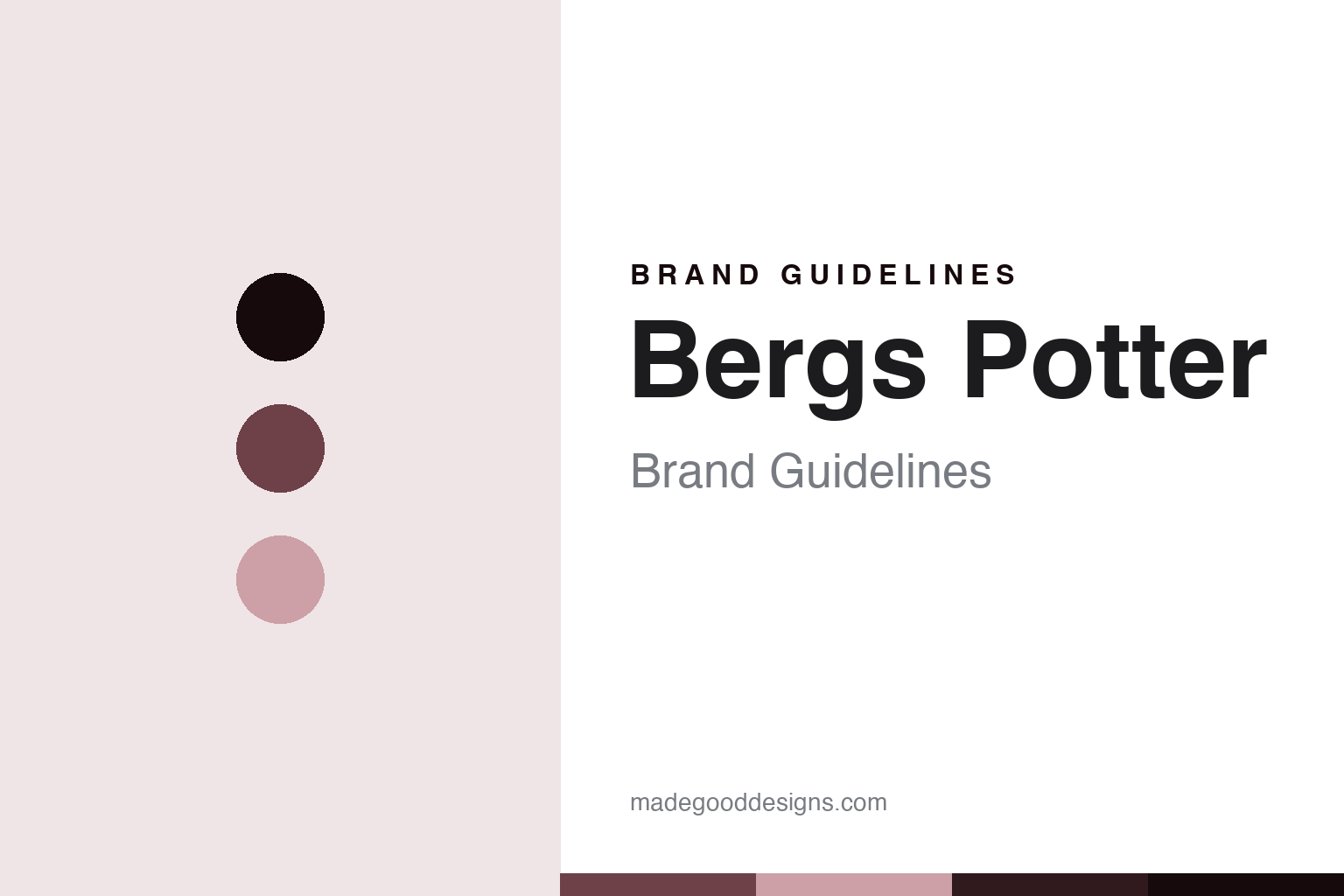
Bergs Potter lives in a clay-rose palette. Click a swatch to copy the hex.
Bergs Potter’s identity is design-led, made and warm — a clay rose, an ink, a blush, a deep clay, and a paper. The palette leans clay rose and blush: a warm, design-forward register for a terracotta that ages to a patina. It signals a design-led pot brand. The honest caveat: with no published brand hex, these values are an original, unofficial interpretation, not first-party colours.
The lesson is a clay-rose palette signals a design-led, Danish-Italian identity. Bergs Potter’s world is a design-led, warm object. For designers, it is a reminder that a soft clay rose and a warm blush can carry a pot brand — the tone of terracotta and its patina. Because these tones can fail as small text, keep type dark and let the colour live in the accents, palette and band. The takeaways: split design and make honestly; choose the right clay; let it patina; and treat any single hex as unofficial.
Typography
The register is a design sans — modern, warm, made.
Bergs Potter’s identity carries a modern, warm, made spirit — a design-led brand, not a mass potter. A design sans captures the mood: contemporary, considered and Scandinavian, the register of a pot chosen as much for looks as for planting. Set in a clay-rose palette, the design sans feels modern and warm — exactly the personality Bergs Potter carries. It is a design-and-make split rather than a logo, mirroring a considered terracotta pot. (Bergs Potter’s real wordmark, and the pot shapes, are things we describe but do not reproduce, and the exact typeface is not ours to use.) Because it is not ours to use, the honest description is “a design-sans spirit,” shown here in a stand-in. The type behaves like the pot: modern, warm and made.
Aa
A design-sans spirit — modern and made. (Specimen set in Mulish, a design-sans STAND-IN; NOT the Bergs Potter logo or a pot.)
The garden tool makers
Danish design, Italian clay — Bergs Potter closes the round.
Bergs Potter closes the round on a two-country pot — designed in Denmark, made in Italy. A clay-rose palette, a design sans and a patina make one thing — Danish design, Italian clay — the whole identity: design-led, made and warm. The Danish design is the differentiator, and the Italian terracotta is the meaning. The point is a Copenhagen brand that pairs Danish design with Tuscan clay to make an everyday flowerpot desirable.
Put to work, the identity is a design-and-make split, told straight, as design. A maker in this spirit would design in one country and make in another, and say so — Danish design, Italian clay. A reader in this spirit would keep the name distinct from the origin: Bergs Potter is Danish, but its pots are made in Italy from Tuscan clay, so the brand and the clay sit in different countries. Bergs Potter closes the round’s pots side with Whichford, and its where-made thread at the name-isn’t-origin end with Gardena and Guillouard — the counterpoint to the proudly-made-at-home Whichford. Across four rounds, twenty-eight garden-tool and garden-ware makers — from a Swiss secateur to a solo Montana forge and a Danish-Italian flowerpot — answer the vein’s question: in a garden tool, who makes it, and where? The honest editorial moves are to state the Danish-brand, Italian-made split, to cite 1942, and to leave present ownership open. The lesson Bergs Potter teaches is that a design-and-make split can hold an identity when it is told honestly: the Danish design gives it substance, and the Italian clay keeps it credible. Danish design, Italian clay is the personality, and the terracotta pot is the proof.
For designers and brand-builders, Bergs Potter closes the garden tool makers, from Denmark: split design and make — and tell it honestly. The lessons: pair a design country with a craft country; choose the right material; keep the name distinct from the origin; leave an unknown ownership open; and never reproduce a logo. It is also a reminder to stay precise: Bergs Potter is the Danish terracotta-pot brand of 1942, designed in Copenhagen and made in Italy from Tuscan clay — with the palette here an unofficial interpretation. Bergs Potter made Danish-design-Italian-clay the identity — proof that a pot, honestly told, can be the difference.
Explore & save
Keep Bergs Potter’s identity on hand — save it to a board in the Made Good inspiration library.
Bergs Potter identity set
Pin the clay-rose palette and the design-sans register to your own board.