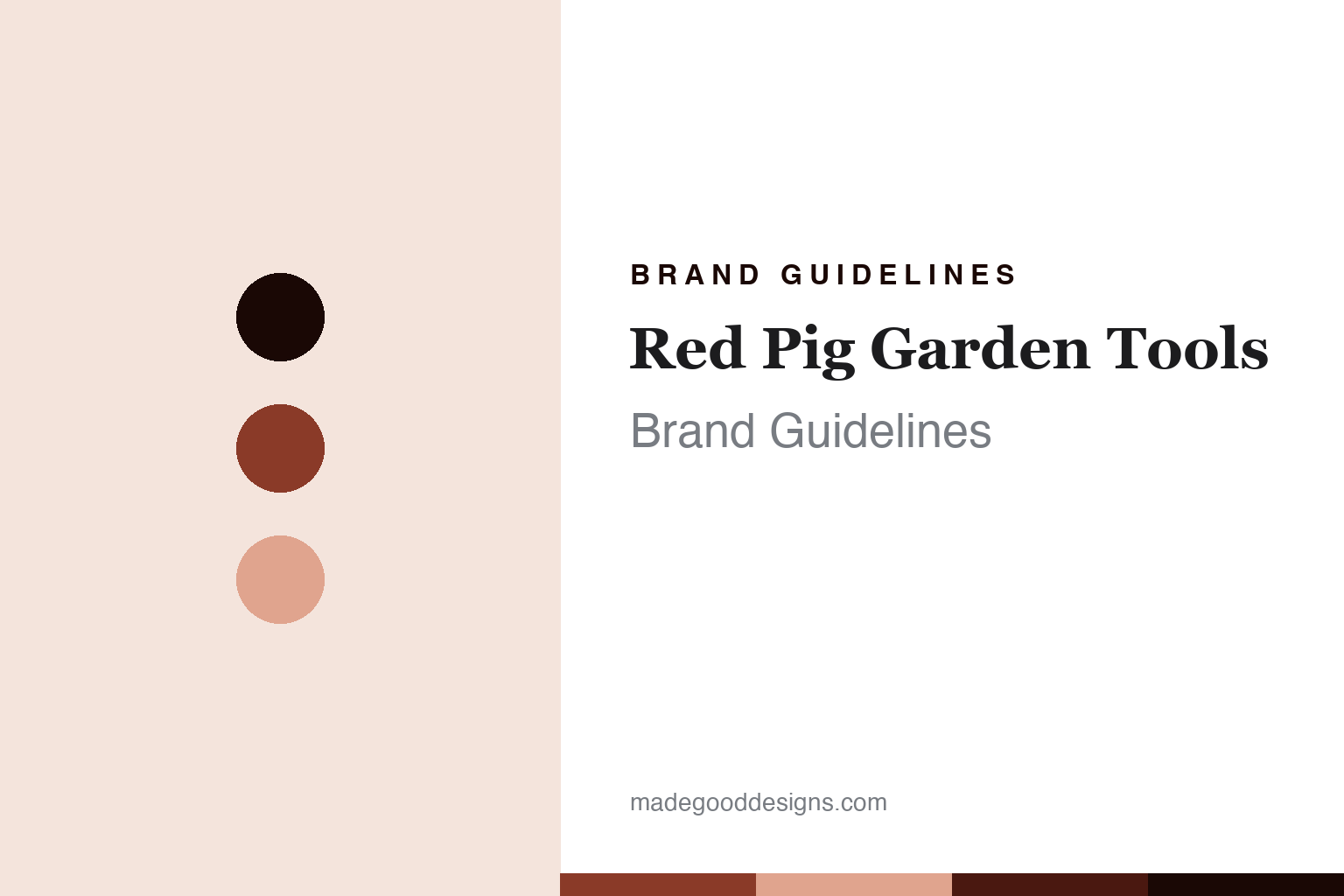
Red Pig Garden Tools Brand Guidelines
Forged by one blacksmith.
Aa
Two constants: a forge-red palette and a forge-serif register. Abstract homage — not a Red Pig product or mark.
Forged by one blacksmith
Red Pig Garden Tools is the Oregon blacksmith hand-forging some seventy garden tools, made in the USA, run by one smith.
Red Pig Garden Tools opens the round at the smallest scale of all — one blacksmith at an anvil. Red Pig makes hand-forged digging and cultivating garden tools: trowels, weeders, cultivators, hoes and long-handled tools, some seventy designs in all. Its answer to how a maker becomes a name is the forge itself: hand-forge each tool from steel, fire and anvil, in Oregon, one at a time. A garden tool, forged by hand.
Its identity is forged by one blacksmith. Red Pig’s hand-forged “Originals,” its US making and its single-smith scale are the work it is known for. A tool, made in the USA. Forged by one blacksmith.
(Honest notes, so the story stays precise. Red Pig Garden Tools — at redpigtools.com — hand-forges around seventy of its own “Red Pig Originals”: trowels in graduated sizes, the Cape Cod weeder, cultivators, hoes, root tools and more. It carries the mark “Since 1989,” founded by Bob and Rita Denman; a detail to get right is that it originated in Orange, California, in the late 1980s and moved to Boring, Oregon, in 2004 — so it is a California-born, now-Oregon maker, not an Oregon-founded one. On where it is made — a theme of this round — its own tools are genuinely hand-forged in Oregon, with US-sourced handles and rivets; a caveat, though, is that it also resells imported Japanese lines to fill gaps, so this piece features only the US-forged Originals and does not blur the two. On ownership, it is a single-blacksmith operation: Seth Pauley has been sole owner and smith since 2017, having apprenticed under Bob Denman — a succession, not a corporate sale. Its name and marks, including the pig device, are IP, described but never reproduced, and there is no official brand hex; these tones are an unofficial interpretation. This is design commentary and does not promote any product.)
Colour
Red Pig Garden Tools lives in a forge-red palette. Click a swatch to copy the hex.
Red Pig’s identity is forged, made and hand-scaled — a forge red, an ink, an ember, a deep forge, and a paper. The palette leans forge red and ember: the register of hot iron worked at an anvil. It signals a hand-forging blacksmith. The honest caveat: with no published brand hex, these values are an original, unofficial interpretation, not first-party colours.
The lesson is a forge-red palette signals a hand-forged, made-in-USA identity. Red Pig’s world is a forged, hand-made object. For designers, it is a reminder that a hot forge red and a soft ember can carry a tool maker — the colour of steel in the fire. Because these tones can fail as small text, keep type dark and let the colour live in the accents, palette and band. The takeaways: forge it by hand; make it at home; keep it small; and treat any single hex as unofficial.
Typography
The register is a forge serif — crafted, plain, made.
Red Pig’s identity carries a crafted, plain, made spirit — a working forge, not a factory. A forge serif captures the mood: sturdy, traditional and hand-worked, the register of a tool forged one at a time. Set in a forge-red palette, the forge serif feels crafted and plain — exactly the personality Red Pig carries. It is hand-forging rather than a logo, mirroring a tool shaped at the anvil. (Red Pig’s real wordmark, and the pig device, are things we describe but do not reproduce, and the exact typeface is not ours to use.) Because it is not ours to use, the honest description is “a forge-serif spirit,” shown here in a stand-in. The type behaves like the tool: crafted, plain and made.
Aa
A forge-serif spirit — crafted and made. (Specimen set in Cormorant Garamond, a forge-serif STAND-IN; NOT the Red Pig logo.)
The digging & cultivating tools
Red Pig Garden Tools stands for forged by one blacksmith, made in the USA.
Red Pig Garden Tools opens the round at the human scale. A forge-red palette, a forge serif and an anvil make one thing — forged by one blacksmith — the whole identity: forged, made and hand-scaled. The hand-forging is the differentiator, and the single-smith making is the meaning. The point is one American blacksmith who hand-forges some seventy garden tools, in Oregon, one at a time.
Put to work, the identity is a forge, told straight, as design. A maker in this spirit would hand-forge and keep it small — Originals, in Oregon. A reader in this spirit would hold the honest notes: Red Pig was born in California and moved to Oregon in 2004, so it is not Oregon-founded; and it resells imported Japanese tools alongside its own, so only the US-forged Originals are the maker’s own work. Red Pig opens the round’s three-jobs thread on the digging and cultivating side, its where-made thread at the proudly-made-at-home end with Garant, Nisaku and Meadow Creature, and its forge-by-hand thread with Polet. The honest editorial moves are to place the founding in California, to separate the forged Originals from the resale lines, and to keep the single-smith ownership current under Seth Pauley. The lesson Red Pig teaches is that a forge can hold an identity: the hand-forging gives it substance, and the single-smith scale keeps it credible.
For designers and brand-builders, Red Pig opens the digging & cultivating tools: forge it by hand — and keep it small. The lessons: make by hand where it counts; keep the making in-country; separate what you make from what you resell; get a founding place right; and never reproduce a logo. It is also a reminder to stay precise: Red Pig Garden Tools is the Oregon blacksmith hand-forging some seventy garden tools, made in the USA, run by one smith — with the palette here an unofficial interpretation. Read that way, Red Pig is less a catalogue than a person at an anvil, and the round begins where every tool once did: with steel, fire and a hammer. Red Pig made forged-by-one-blacksmith the identity — proof that a tool, honestly made, can be the difference.
Explore & save
Keep Red Pig Garden Tools’s identity on hand — save it to a board in the Made Good inspiration library.
Red Pig Garden Tools identity set
Pin the forge-red palette and the forge-serif register to your own board.