Katia Brand Guidelines
The Castelló family’s fantasy-yarn brand from Barcelona.
Aa
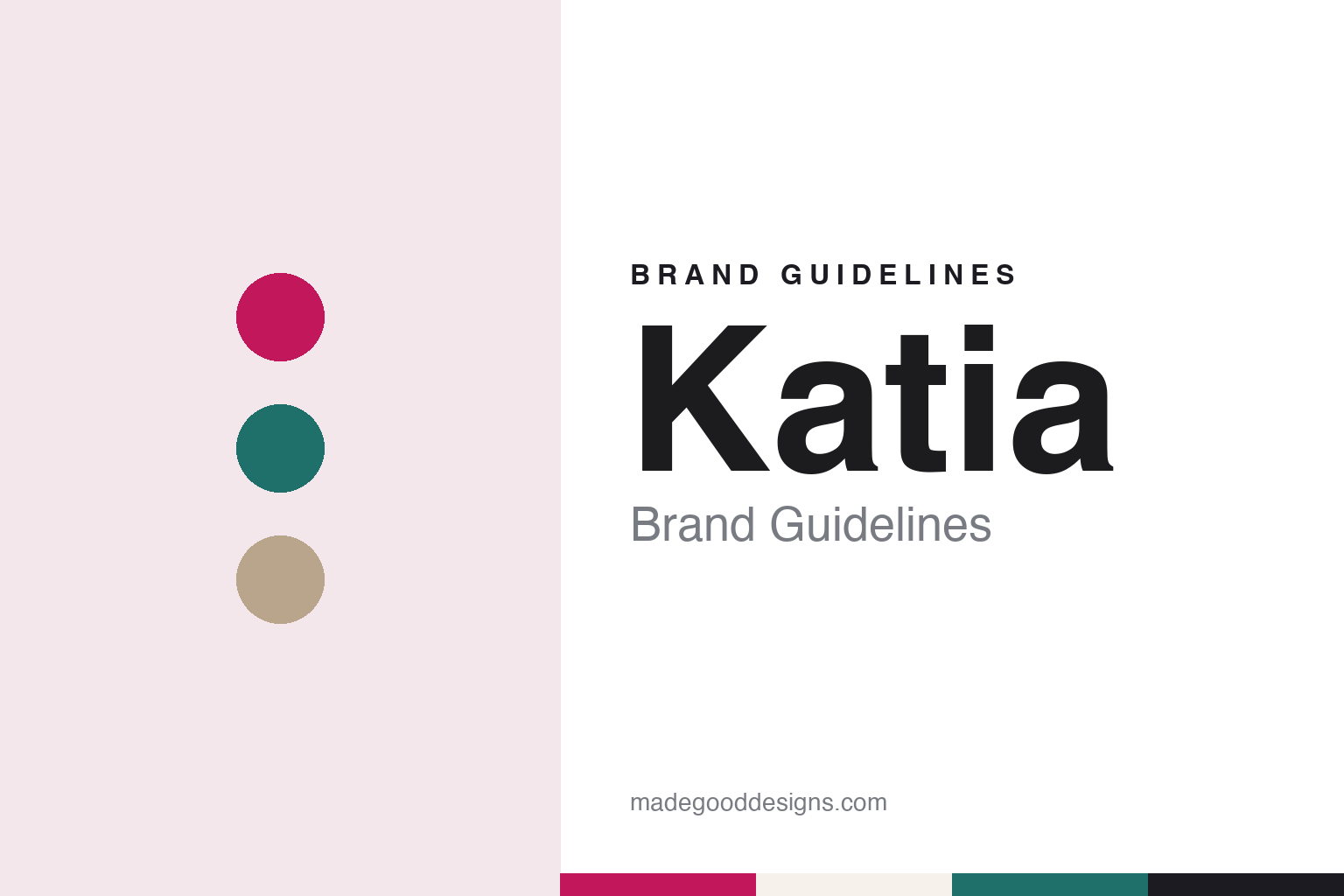
Two constants: a Katia magenta, teal and stone palette and a soft serif register. Abstract homage — not a Katia product or mark; no yarn, label or logo is reproduced.
Hilaturas Génesis
A wartime wool shop and a spinning business.
Katia tells its own story as a family one, and it is the company’s account that most of the early history rests on. It begins, the company says, with Pepita Vila, who ran a small yarn shop in Manresa, in the province of Barcelona, during the Spanish Civil War. Inspired by her, her husband Ramon Castelló founded Hilaturas Génesis, a hand-knitting yarn business, in 1950, according to Katia’s website; the business newspaper Economía 3, interviewing the company’s former chief executive in 2023, gave the founding year as 1951.
The couple’s sons built it up. In the 1960s, the company says, the eldest, Ramon Castelló Vila, took Génesis into the wider textile industry while keeping its hand-knitting yarns. In the 1970s those yarns became a separate branch under the name Katia, led by the third son, Josep Lluís Castelló Vila.
The name has a modest origin. Katia, the company says, was one of Génesis’s three best-selling yarns, alongside Manola and Fina; why that one was chosen for the brand, its website calls “a mystery.” From the start the brand set itself apart with what it calls fantasy yarns and unusual colourways — textured, multicoloured yarns quite different from plain wool — which it still describes as its hallmark.
Colour
Fires, a flood and a fresh start as Fil Katia.
Katia’s own timeline is unusually frank about setbacks. A fire destroyed its offices and warehouse in 1978; it carried on and began exporting to Europe and the Middle East. In the 1980s it moved into larger premises of 12,000 square metres, exhibited at trade fairs including Pitti Filati in Florence, and published its first pattern magazines, whose covers, the company says, featured the actresses Pastora Vega and Ángela Molina and a young Judit Mascó. A flood hit the offices and warehouse in 1983.
The 1990s were harder still. The company says the knitting trade went through a serious crisis, that it closed a Moscow branch, Katia International, after the rouble’s collapse, and that a second fire destroyed almost everything. In 1998 it re-formed as Fil Katia, S.A., with some staff joining as shareholders, and in 1999 it moved to its present headquarters at Castellbell i el Vilar, a village in the province of Barcelona below the mountains of Montserrat. The website’s legal notice names Fil Katia, S.A. of Castellbell i el Vilar as its owner.
The pattern magazine remains the brand’s main design voice: yarn, colour and garment are sold together, season by season. Over the 2010s, the company says, it added Concept by Katia, a higher-end yarn line with its own magazine; revived the Spanish brand Lanas Stop for baby yarns; moved into macramé; and launched Katia Fabrics for home sewing, with its own prints. A “Katia 100% YOU” branding followed, built around creativity, community and wellbeing. We did not find documentation of the logo’s typeface or official colours.
Typography
The seven brands in this group all sell yarn for hand knitting and crochet, but they work at very different scales and come from seven countries. Between them they cover most of the ways a ball or skein of yarn reaches a maker: from a mill on an island, from a small hand-dyeing studio, from a family distributor, and from names sold widely on the high street and in craft chains.
Four come from continental Europe. Phildar is French, Scheepjes is Dutch, Katia is Spanish and Isager is Danish, and each guide sets out who founded the brand, who owns it now and what it says about where its yarn is spun. Two are smaller and rooted in place: Jamieson’s of Shetland, from the islands north of mainland Scotland, and Hedgehog Fibres, an Irish hand-dyer. The last, Cascade Yarns, is an American family firm in Seattle that sources its yarn from partner mills abroad.
Each guide separates what independent sources record from what the company says about itself, and marks plainly what rests only on the company’s own word.
Aa
A soft serif for a colour-led catalogue brand. (Specimen set in Fraunces, a serif STAND-IN; NOT the Katia logo.)
Katia
A family company that went international.
The modern company was shaped by an outside manager. María Teresa Aurell became chief executive in March 2000 and stayed until March 2023, when she moved to the advisory board, Economía 3 reported in October 2023. Over that time, the paper said, revenue rose from about €10 million to €30 million in 2022, with Spain the largest market and France the second. The paper presented Katia as a family textile business that had become an international brand for creative hobbies, with Portugal, Germany, Italy, the Benelux countries and the United States among its other markets. Katia’s website adds that it built its own sales networks in Germany in 2007, the United Kingdom in 2008 and Belgium and the Netherlands in 2009, opened a short-lived shop in Beijing in 2005, and later entered Italy, Scandinavia, Mexico and Canada; it now says its products reach more than 50 countries. The third generation of the Castelló family joined in the 2010s, the company says, and it names Thomas Marin as general director in the 2020s.
During the pandemic, the company says, katia.com became an online sales platform for its stockists, and it later began selling directly online in the United States and launched WOW! by Katia, kits aimed at younger makers.
Where the yarns are made is less clear. Katia does not give a general country of origin on its website, which lists a “Purchasing and Production” team rather than a mill. Individual products carry their own claims: its Arles Merino, for example, is described as “100% wool made in France,” from merino sheep raised around Arles. The company also lists certifications for some yarns and fabrics, including the Global Recycled Standard, OEKO-TEX, GOTS and non-mulesing wool, and says it aims to use only recycled, plastic-free cardboard packaging by 2030. We give these as the company’s claims, and found no independent account of where most of its yarn is spun.
For a design guide, Katia shows a brand that sells colour and pattern as one package. Compare Phildar, a French yarn brand built on shops and catalogues, and Scheepjes. For this guide we use a magenta, a teal and a stone grey with a serif, an unofficial interpretation; no product or logo is reproduced.
Explore & save
Keep Katia’s identity on hand — save it to a board in the Made Good inspiration library.
Katia identity set
Pin the Katia magenta, teal and stone palette and the soft serif register to your own board.