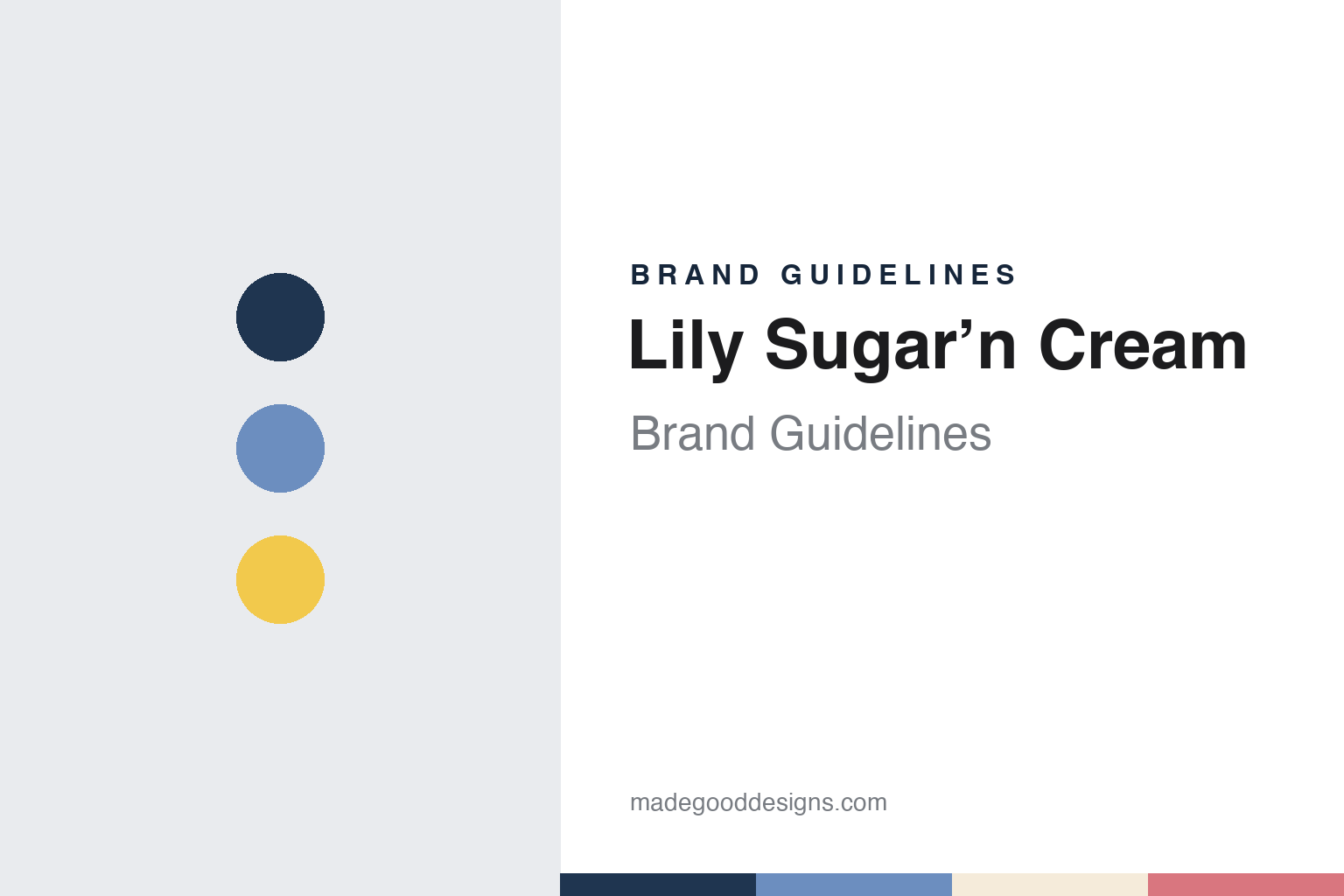
Lily Sugar’n Cream Brand Guidelines
The cotton dishcloth yarn, sold under one product number for a quarter of a century.
Aa
Two constants: a Sugar’n Cream navy, cornflower and cream palette and a homely serif register. Abstract homage — not a Lily Sugar’n Cream product or mark; no yarn, logo or ball band is reproduced.
Bernat’s Lily pages
A cotton yarn with a Canadian owner since at least 1998.
Lily Sugar’n Cream is a cotton yarn, and in North American craft shops it is closely tied to one job: the knitted or crocheted dishcloth. Its owner today describes it as “a fun, everyday essential cotton yarn,” sold for dishcloths, blankets, pillows and rugs. The brand’s published history is thin, and its owner does not give a launch year, so this guide starts with what the record shows.
The earliest documents we could check are the brand’s own web pages. In December 1998 the Sugar’n Cream website, sugarncream.com, opened on a “Welcome to Bernat” page and carried the line “©1998 Spinrite, Inc.” — the Canadian yarn company that owns the brand today. Its yarn section was headed “Welcome to Bernat’s Lily pages,” and it described Sugar’n Cream as “your favorite 4 ply, 100% cotton, knitting worsted craft yarn,” grown, it said, to 89 solids, ombrés and prints, with a sport-weight version in 34 shades and the slogan “Accept No Substitutes!”
Older history is harder to pin down. A Lily Mills Company of Shelby, North Carolina, published handweaving guides — Open Library lists one, by Irene Francisco, dated 1960 — but we could not document how that business connects to today’s yarn, or when the Lily name passed to Spinrite, so we leave the brand’s early history open.
Colour
One product number, a quarter of a century.
The yarn has changed remarkably little on paper. A February 1999 product page listed the solid shades as product number 102001, in 2.5-ounce balls of 120 yards, with ombrés as 102002 and one-pound cones as 103001, alongside a Christmas Sparkle version blended with metallic thread. In 2026 the listing for the original yarn on Yarnspirations still carries 102001 among its product tags. The cone, sold by the pound (454 grams) in 1999, is listed today at 400 grams, or 14 ounces. The fibre has not changed: the original is still sold as 100% cotton in a worsted weight, the thickness most American patterns for dishcloths call for. Machine washing and drying are part of the pitch: the current copy calls it “conveniently machine washable and dryable for easy care.”
By 2004 the website had become simply “Lily,” listing Sugar’n Cream beside Crafter’s Cotton, Sugar Babies and Antique, with free patterns, pattern books in English, French and Spanish, and a “Yarn Switcher” to help knitters substitute Lily yarns for other brands. Its contact page gave a head office in Listowel, Ontario, Spinrite’s home town, and its pages still pointed readers to “our friends at Bernat.”
Today the range is sold as The Original, Super Size, Ombres and Scrub Off, along with large cones, and the free patterns lean hard into the kitchen — scrubbers, dish mitts and tea towels, many with jokey titles, and all offered as free downloads written for the yarn. That pattern library does much of the brand’s work: the yarn is plain, and the patterns show what to make with it. The brand page sells colour and practicality together: a “huge range of shades you’ll want to use beyond the kitchen,” in its words, in soft, absorbent cotton. Its own headline, “From Dishcloths To Décor,” sums up the pitch: a yarn bought for the kitchen sink that the company hopes makers will carry into the rest of the house, as cushions, throws and rugs.
Typography
Design and documentation.
The seven brands in this group all make yarn for hand knitting and crochet, but they sit at opposite ends of the trade. Patons, Bernat, Caron and Lily Sugar’n Cream are the kind of names found on the shelves of big craft chains, while Sublime, Louisa Harding and Woolfolk present themselves as designer and premium labels, built around a name, a house style or a single fibre.
Craft-store yarn is a volume business, and its best-known names have often passed between larger groups. A brand can change owner, factory and even country of manufacture while the name on the ball band stays the same, so the label a knitter recognises says little about who makes the yarn today. Designer labels work the other way round: the name of a person, a fibre or a house style is the product, and the yarn is often spun by mills the brand does not own and may not name.
Each guide separates what independent sources record from what the company says about itself — who founded it, who owns it now and where its yarn is made — and marks plainly what rests only on the company’s own word.
Aa
A homely serif for a kitchen-table craft brand. (Specimen set in Lora, a serif STAND-IN; NOT the Lily Sugar’n Cream logo.)
Lily Sugar’n Cream
USA-grown cotton, a Canadian owner.
Spinrite, based in Listowel, says it was formed in 1952 by its founder, David Hay, on the site of Maitland Spinning Mills. It says it brought its online shops together under Yarnspirations.com in 2013, bought the Caron brand in 2011 and Coats & Clark’s craft business, with Red Heart, in 2019; the trade publication Craft Industry Alliance wrote in July 2025 that the private-equity firm Comvest Partners has owned Spinrite since 2018. Spinrite says it launched online shopping in 2010. It calls itself “the largest marketer of craft yarns and consumer sewing thread in North America,” which is its own description.
On Yarnspirations, Lily Sugar’n Cream has a brand page of its own beside Bernat, Caron, Patons and Red Heart. The old sugarncream.com address now forwards there, and the brand’s shop, patterns and customer accounts now sit on the shared site.
Where it is made needs care. The company’s claim is about the fibre: the brand page says the yarn is “made of soft, absorbent, 100% USA grown cotton,” and the product pages call it “a natural, 100% USA-grown cotton yarn.” That describes where the cotton is grown, not where it is spun or dyed. The product pages we checked give no country of manufacture, Spinrite says only that it has “several locations across North America,” and we found no independent source naming the mill that makes Sugar’n Cream, so we do not name one.
For a design guide, Lily Sugar’n Cream shows how a plain product, sold for one everyday use and kept under the same name and number for decades, can become a brand in its own right. Compare Bernat, the sister name its old website pointed to, and Red Heart, another Spinrite yarn. For this guide we use navy, cornflower and cream with a serif, an unofficial interpretation; no product or logo is reproduced.
Explore & save
Keep Lily Sugar’n Cream’s identity on hand — save it to a board in the Made Good inspiration library.
Lily Sugar’n Cream identity set
Pin the Sugar’n Cream navy, cornflower and cream palette and the homely serif register to your own board.