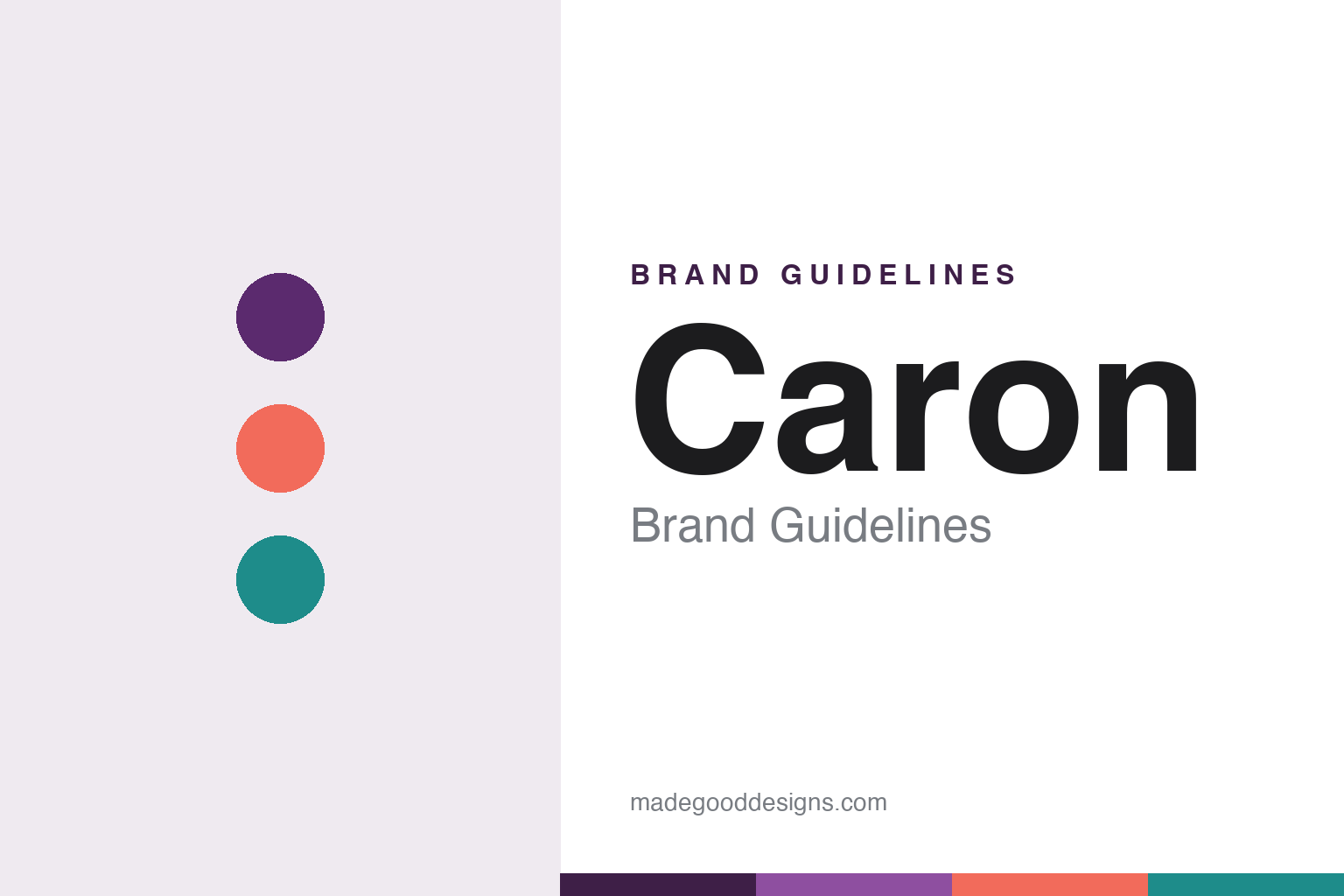
Caron Brand Guidelines
The Illinois yarn spinner of 1916, now a Canadian-owned acrylic brand.
Aa
Two constants: a Caron plum, coral and teal palette and a rounded sans register. Abstract homage — not a Caron product or mark; no yarn, logo or ball band is reproduced.
A spinner in Rochelle
Two family yarn businesses, one Midwestern and one from New York.
Caron is one of the older names in American craft yarn, and its earliest history comes from the company itself. In 1997 Caron International published a short history on its website under the heading “Who are we?” It said that “in 1916 Ovidas Joseph Caron started a small yarn spinning operation in Rochelle, Illinois,” a town west of Chicago. We found no independent account of the founding, so the date and the founder’s name are the company’s own.
The same page told a second story. Three years after Caron began, it said, Phillip Leff, soon joined by his brother Carl, started selling wool yarns in and around New York City, and their business, National Spinning, came to run a spinning and dyeing operation in Jamestown, New York. Both companies, the history said, began as wool spinners and dyers and made yarn for hand knitting as well as for machines. Synthetic fibres and a growing population after the Second World War, it added, created “a rich environment for growth.”
The two firms moved closer to the shop counter at about the same time. In 1977, the company said, National Spinning started a division called National Yarn Crafts to sell hand-knitting yarns and craft kits directly to retailers for the first time, and “shortly thereafter, Caron Spinning became strictly a consumer-products company,” adding craft kits to its yarns. In 1994 Caron and National, in the history’s words, “joined forces.”
Colour
Yarn, latch hook and licensed characters.
In the late 1990s Caron sold far more than yarn. Its 1997 home page described Caron International as “a leading supplier of yarns, kits, and other items catered toward home crafters,” sold mainly through retailers and catalogue companies in the United States and Canada, and called it “the predominant supplier of latch-hook kits.” It named licensed kits with Disney characters, Winnie the Pooh and Looney Tunes; those are the company’s own descriptions of its place in the market.
The archived website shows how wide the business had become by the early 2000s. Its news page reported that a Learn To Knit kit had been endorsed by The Knitting Guild of America in January 2002, that Caron had acquired CC Product Co./Bond America, a maker of knitting machines, in January 2003, and that it had added Sesame Street latch-hook kits the same month. In November 2003 it launched Jewel Box, a yarn it described as “an ultra-soft chenille with a luminous rayon wrap.” Its latch-hook ranges were sold under the WonderArt and Natura names, with licences that by 2004 also included NASCAR and Scooby-Doo. In 2004 the company gave its customer-service address as Washington, North Carolina.
The yarn that carries the name today is chiefly acrylic. In February 2004 the website announced new tropical “Brites” colours for Simply Soft, the worsted-weight yarn that its present owner calls “among the most popular and versatile” of its kind and sells on its “unique sheen.” One Pound is marketed on value — “one skein makes four scarves,” its copy says — and Caron Cakes is a self-striping yarn in a 200-gram skein whose colours change as it is worked.
Typography
Design and documentation.
The seven brands in this group all make yarn for hand knitting and crochet, but they sit at opposite ends of the trade. Patons, Bernat, Caron and Lily Sugar’n Cream are the kind of names found on the shelves of big craft chains, while Sublime, Louisa Harding and Woolfolk present themselves as designer and premium labels, built around a name, a house style or a single fibre.
Craft-store yarn is a volume business, and its best-known names have often passed between larger groups. A brand can change owner, factory and even country of manufacture while the name on the ball band stays the same, so the label a knitter recognises says little about who makes the yarn today. Designer labels work the other way round: the name of a person, a fibre or a house style is the product, and the yarn is often spun by mills the brand does not own and may not name.
Each guide separates what independent sources record from what the company says about itself — who founded it, who owns it now and where its yarn is made — and marks plainly what rests only on the company’s own word.
Aa
A rounded sans for a colour-led craft brand. (Specimen set in Nunito, a sans STAND-IN; NOT the Caron logo.)
Caron
From National Spinning to Spinrite.
The brand changed hands in 2011. Spinrite, the yarn company based in Listowel, Ontario, says on its website that it “purchased the Caron brand from National Spinning” that year, adding “new yarns and latch hook kits to its product portfolio.” Spinrite says it was formed in 1952 by its founder, David Hay, on the site of Maitland Spinning Mills. In 2013, it says, it brought its online shops together under Yarnspirations.com, and in 2019 it bought Coats & Clark’s craft business, adding Red Heart. The trade publication Craft Industry Alliance wrote in July 2025 that the private-equity firm Comvest Partners has owned Spinrite since 2018.
Caron no longer has a front door of its own. Its old address, caron.com, now forwards to Yarnspirations, and the brand is sold through a Yarnspirations brand page beside Bernat, Patons, Red Heart and Lily Sugar’n Cream, where it is presented as “premium acrylic Caron yarn” and sold on colour — “every shade of the rainbow,” in the page’s words. Its list of top sellers is led by Simply Soft, One Pound, Jumbo and All Day Cotton. WonderArt, the latch-hook name from Caron’s kit years, also appears among the site’s brands.
Where Caron yarn is made today is not stated on the pages we checked. The product pages for Simply Soft, One Pound and Caron Cakes give fibre content, weight and care instructions but no country of origin, and Spinrite says only that it has “several locations across North America.” We found no independent source naming the mill that spins Caron yarn now, so we do not name one.
For a design guide, Caron shows how a brand built by a family spinner can survive two mergers and become one label in a larger owner’s range, held together mainly by colour. Compare Red Heart, the acrylic yarn Spinrite added in 2019, and Lion Brand, an American yarn company that dates itself to 1878. For this guide we use plum, coral and teal with a rounded sans, an unofficial interpretation; no product or logo is reproduced.
Explore & save
Keep Caron’s identity on hand — save it to a board in the Made Good inspiration library.
Caron identity set
Pin the Caron plum, coral and teal palette and the rounded sans register to your own board.