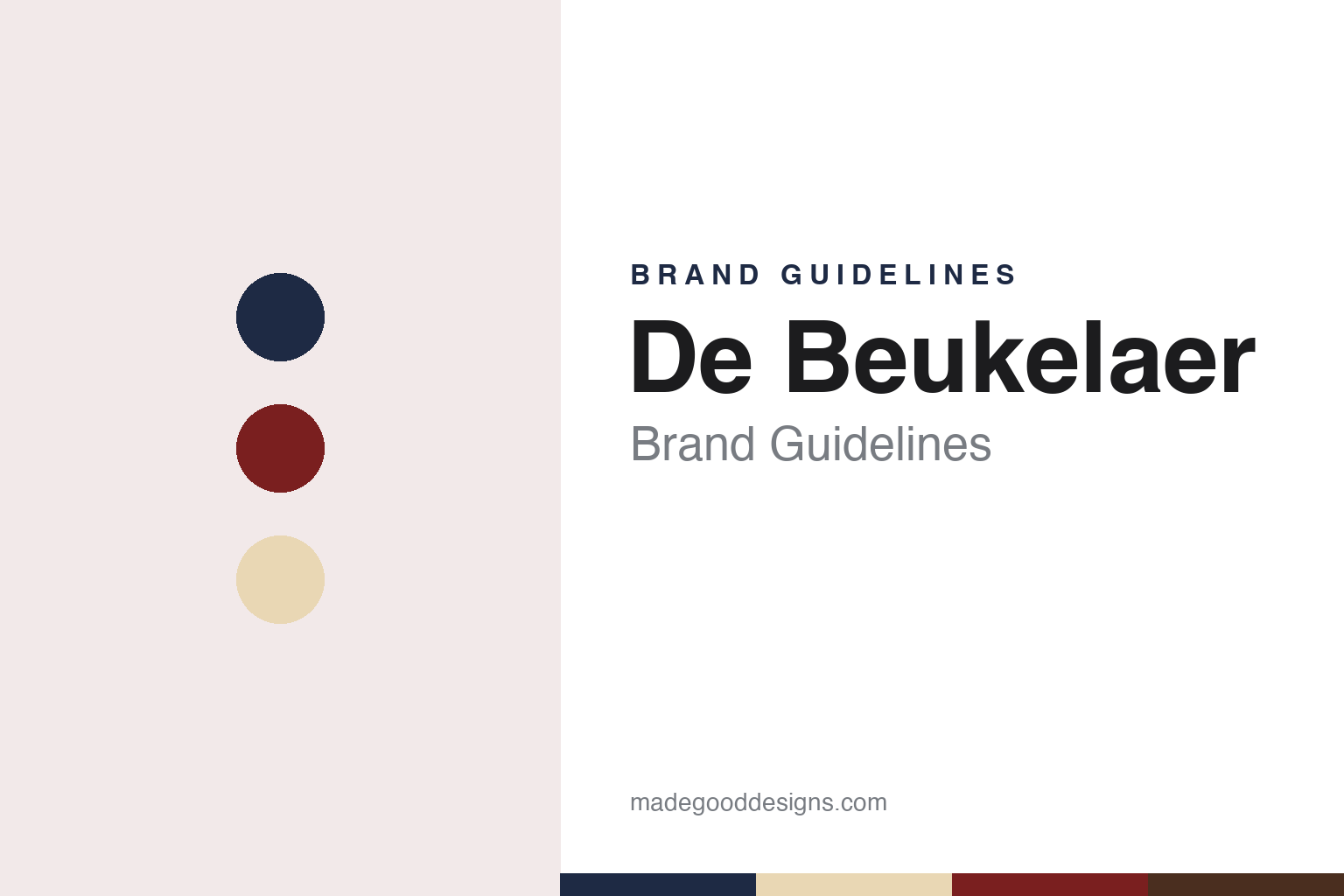
De Beukelaer Brand Guidelines
The Antwerp biscuit name behind the Prince double biscuit.
Aa
Two constants: a De Beukelaer navy, red and biscuit-gold palette and a Belgian display serif register. Abstract homage — not a De Beukelaer product or mark; no biscuit, pack, logo or prince emblem is reproduced.
An Antwerp bakery
A baker’s son, an English machine and a filled biscuit.
De Beukelaer is a Belgian name that now lives mostly in Germany. Its founder, Edouard de Beukelaer (1843–1919), was born in Hoevenen, near Antwerp, the son of a bread baker, according to German Wikipedia, which draws on a 1971 local history of Hoevenen. The present owner of the brand, the German company Griesson – de Beukelaer, says he began making biscuits in a small bakery in Antwerp in 1850, aiming for biscuits that would keep, and that he opened his first biscuit factory and founded his company in 1870. German Wikipedia gives the same two dates.
German Wikipedia says de Beukelaer learned from the English how to make biscuits that stay fresh, and that he worked with a semi-automatic biscuit machine brought from England, which it calls the first of its kind on the European mainland. It also says the factory, which began with around twenty workers, did well enough that he added a chocolate factory and a confectionery factory in 1889. The company exhibited at the Antwerp World’s Fair of 1894 and became a joint-stock company about six years later, German Wikipedia says, citing the trade paper Lebensmittel Zeitung. The brand’s own history says that by 1914 the firm was making 120 different biscuits and wafers.
Two businesses share the name in Antwerp. The liqueur distillery known as FX De Beukelaer, maker of Elixir d’Anvers, was founded by François-Xavier de Beukelaer and is a separate company, Dutch Wikipedia records; it has nothing to do with the biscuits.
Colour
Le Petit Prince fourré.
The product that carried the name furthest is a filled double biscuit: two round biscuits around a layer of cocoa cream. German and French Wikipedia both say de Beukelaer created it in Antwerp in 1870 as “Le Petit Prince fourré”, “the little filled prince,” in honour of Leopold II, who had spent some thirty years as heir to the throne and was known as the Prince of Belgium; French Wikipedia presents the royal connection as an anecdote. The De Beukelaer brand site tells a slightly different story, saying the first round double biscuit went on sale under the name “Prince Fourré” in 1946. We give both dates because the sources do not agree.
The prince is also the biscuit’s graphic device. German Wikipedia notes that the prince printed on both faces of the German biscuit has changed over time, from a traditional young prince with a plumed hat holding a biscuit to a younger, more dynamic figure, and that the maker treats the crest-like print as a seal of quality. The German pack is a roll, and the Prinzen Rolle site promotes a reclosable opening while noting that it cannot currently be produced consistently.
The biscuit split into two families. In France, French Wikipedia says, Prince biscuits were sold from 1948 and moved under the LU brand in 1980; LU Prince passed from Danone to Kraft Foods in 2007 and has belonged to Mondelēz International since Kraft’s 2012 split, and in Spain it is sold as Principe. In Germany, the founder’s son, Edouard de Beukelaer II, opened the “Flämische Keksfabrik E. de Beukelaer” (Flemish biscuit factory) in Kempen on the Lower Rhine in 1955, and from 1964 the double biscuit made there was called Prinzen Rolle, according to the brand’s own history and German Wikipedia.
Typography
Design and documentation.
The seven brands in this group all make biscuits, and they come from four countries: Kambly from Switzerland, Delacre from Belgium, Lambertz and Griesson from Germany, Lazzaroni and Matilde Vicenzi from Italy, and De Beukelaer, whose story runs through Belgium and Germany. Biscuit makers in general sit at many different points in the trade, from family bakeries that still carry a founder’s name to large groups that own several brands and plants, and a single name can move from one kind of owner to another over a century or more.
A biscuit brand’s identity is usually carried by a tin, a wrapper and a recipe it promises has not changed, while the company behind the name may have been sold, merged or renamed more than once, and the biscuits themselves may be baked a long way from the town on the packet. That makes the questions behind each name worth asking plainly: who started it, who owns it now, and where its biscuits are actually made.
Each guide separates what independent sources record from what the company says about itself — its founding story, its owners over time, its signature products and where they are baked — and marks plainly what rests only on the company’s own word.
Aa
A Belgian display serif — an unofficial register for a nineteenth-century Antwerp name. (Specimen set in DM Serif Display, a serif STAND-IN; NOT the De Beukelaer logo.)
De Beukelaer
From General Biscuit to Polch.
The Belgian company did not stay independent. German Wikipedia says the long-standing links between three large Belgian biscuit makers, De Beukelaer, Parein and Victoria, led to a merger in 1965 that created the General Biscuit Company, with plants in Belgium, Germany, Britain, Italy and what is now the Democratic Republic of the Congo; in 1986 it passed to BSN-Gervais-Danone, later the Danone group.
The German business went its own way. On 1 March 1999, German Wikipedia says, Danone’s General Biscuit Deutschland and General Biscuit Österreich (De Beukelaer) merged with the family biscuit maker Griesson of Polch to form Griesson – de Beukelaer GmbH & Co. KG, with the Gries family and Andreas Land holding 60 per cent and Danone 40 per cent; the families bought Danone’s remaining stake in 2007. The Prinzen Rolle trademark itself has been owned since April 2011 by Kraft Foods, now Mondelēz International, German Wikipedia says, and Griesson – de Beukelaer makes the biscuit under licence. The Kempen plant closed in 2020 and Prinzen Rolle production moved to Kahla in Thuringia. Today the De Beukelaer brand site, run by Griesson – de Beukelaer, lists ranges including Cereola, ChocOlé, Kex and Prinzen Rolle.
The name has also crossed the Atlantic. English Wikipedia describes Peter DeBeukelaer, who founded the DeBeukelaer Corporation in 1978 and makes Pirouline rolled wafers in Madison, Mississippi, as a descendant of the Belgian biscuit family. On 28 July 2026 Griesson – de Beukelaer announced it was acquiring that company; shareholder Andreas Land spoke in the announcement of “the historical coincidence of our shared name.”
For a design guide, De Beukelaer shows how a single emblem, a prince printed on a biscuit, can outlast changes of owner, country and even brand name. Compare LU, whose Prince grew from the same biscuit, and Lotus Biscoff, another Belgian biscuit name. For this guide we use Antwerp navy, Prince red and biscuit gold with a serif, an unofficial interpretation; no product or logo is reproduced.
Explore & save
Keep De Beukelaer’s identity on hand — save it to a board in the Made Good inspiration library.
De Beukelaer identity set
Pin the De Beukelaer navy, red and biscuit-gold palette and the Belgian display serif register to your own board.