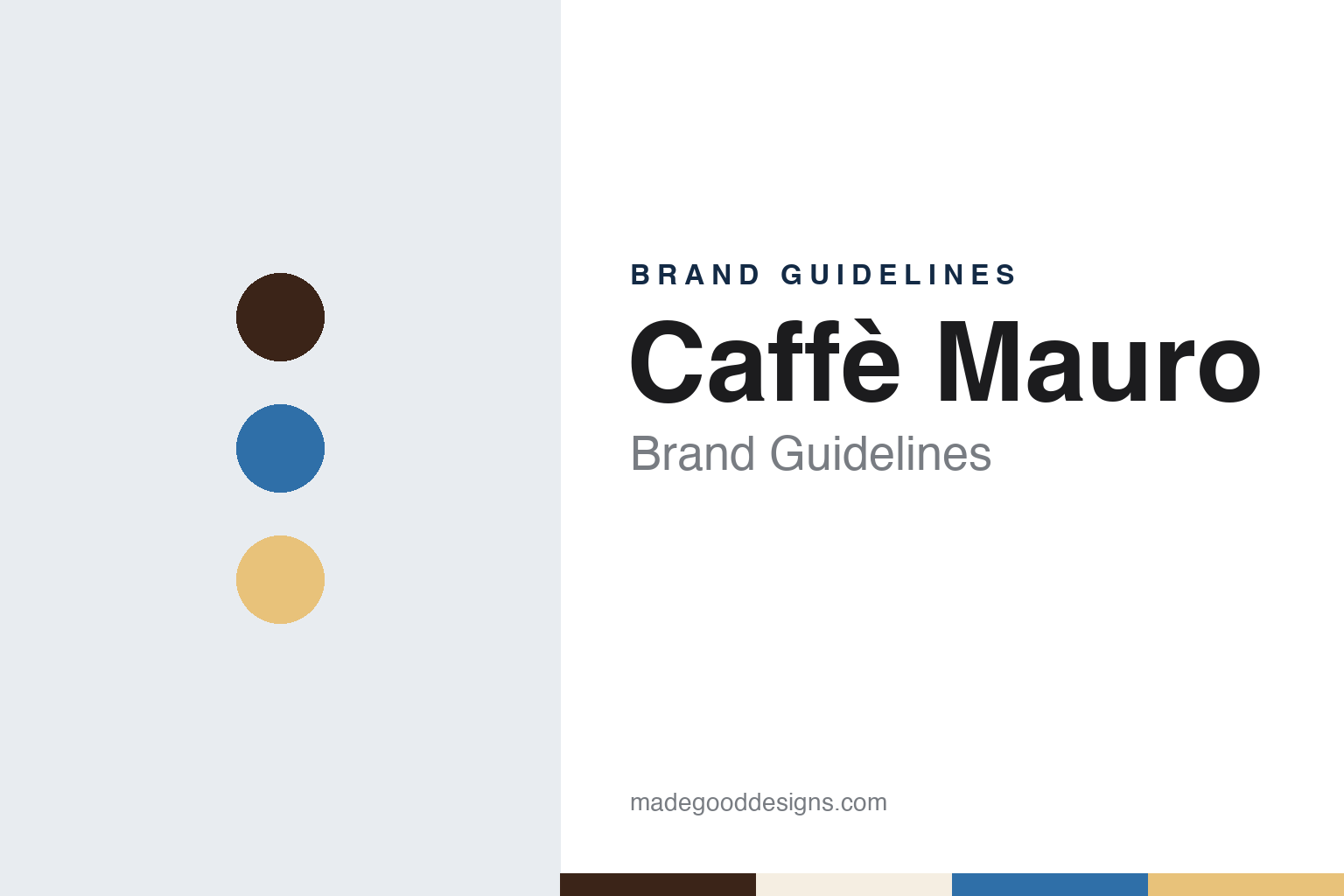
Caffè Mauro Brand Guidelines
The Reggio Calabria roaster on the Strait of Messina.
Aa
Two constants: a roast brown, Strait blue and crema gold palette and a Mediterranean display serif register. Abstract homage — not a Caffè Mauro product or mark; no pack, logo or cup is reproduced.
A sailor turns roaster
A ship on the Strait, an agency in Eritrea and a second-hand roaster.
Caffè Mauro is named after its founder, Demetrio Mauro, a native of Reggio Calabria, the city on the toe of Italy that faces Sicily across the Strait of Messina. His road to coffee was a long one. Italian Wikipedia says he went to work as a ship’s boy on the boats that crossed the Strait when he was ten, and later sailed on ships between the Americas and Europe; the company says it was on cargo ships to South America that he first learned about coffee. In 1930 he bought a ship of his own, the Salvatore Padre, known on the Strait as “Mauro’s boat”, and from 1936 he moved his interests to Italy’s African colonies, where he founded a travel agency operating between Massawa and Asmara, Italian Wikipedia says.
The Second World War ended that venture, and Mauro had to start again from nothing. Italian Wikipedia, citing the company’s own history and a 2011 company profile in the trade magazine Beverfood, says that after returning to Italy in 1945 he began roasting coffee in a basement in Milan with a second-hand roasting machine of 20 kilograms, and that in 1949 the same machine was installed on Via Florio in Reggio Calabria, which marks the birth of the business.
The company tells the founding the same way, dating it to 1949, when Mauro, then 44, installed his first roaster in a small warehouse by the port of Reggio Calabria. It says he wanted to make a blend that reflected the Mediterranean taste of his home region, and that the first roaster turned out about 3 quintals — some 300 kilograms — of roasted coffee a day.
Colour
Carosello, a medal and the second-biggest roaster in Italy.
Growth came quickly. The company says output had reached 15 quintals a day by 1957, when a new factory of 10,000 square metres was built on the northern edge of Reggio Calabria; Italian Wikipedia dates the move into the four-storey plant to the following year. The company adds that a further 5,000-square-metre building followed within two years, as daily output rose to 300 quintals.
Television made the name known across Italy. Caffè Mauro’s adverts on Carosello, the evening advertising programme that ran on Italian state television, starred two cartoon Mexicans, Chico and Manolo; Italian Wikipedia dates the first spot to 1964, while the company dates the brand’s Carosello debut to 1965 and recalls the jingle that went with it. The company also says it was an early adopter of in-store merchandising and personalised its fleet of delivery vehicles, that Demetrio Mauro received the Mercurio d’Oro business award in 1967, and that the actor Christian De Sica became the face of its advertising in 1979.
By the 1990s, Italian Wikipedia says, citing a 2014 article in Panorama, Caffè Mauro had become the second-largest coffee producer in Italy, helped by being among the first to sell ready-packed coffee in grocers’ shops and by building a dense distribution network across the country. The company says it was the official coffee of the 1990 World Cup in Italy and sponsored the football clubs Juventus, Reggina and Palermo; Italian Wikipedia records it as Reggina’s main sponsor from 1995 to 2003 and again from 2020.
In 1997, after the founder’s death, a new production site opened in the industrial zone at Villa San Giovanni, just north of Reggio, overlooking the Strait. The company puts the site at 32,000 square metres; Italian Wikipedia gives 37,000 square metres and places it in the Campo Calabro industrial zone. The company says its roastery still sits by the sea, where each variety of coffee is roasted separately and slowly before being blended.
Typography
Design and documentation.
The seven brands in this group all sell coffee, and they come from Britain, France, Switzerland, the United States and Italy: Kenco, Carte Noire, Percol, Nescafé, Caribou Coffee, Gloria Jean’s and Caffè Mauro. Coffee brands in general sit at many different points in the trade, from family roasters that still carry a founder’s surname to names that now belong to much larger food and drink groups, and a single brand can be sold everywhere from a café counter to a supermarket shelf.
A coffee brand’s identity is usually carried less by a single product than by a pack, a name and the cup it promises, because the company behind the name may have changed hands, moved its roastery or grown far beyond the town where it started. That makes the questions behind each name worth asking plainly: who started it, who owns it now, and where its coffee is actually roasted and packed.
Each guide separates what independent sources record from what the company says about itself — its founding story, its owners over time, where its coffee is made and how its packaging has changed — and marks plainly what rests only on the company’s own word.
Aa
A Mediterranean display serif for a roaster that calls its coffee “Emozione Mediterranea”. (Specimen set in DM Serif Display, a serif STAND-IN; NOT the Caffè Mauro logo.)
Caffè Mauro
From the Mauro family to the Capuas and Gruppo Gimoka.
The Mauro family’s ownership ended in the 2000s. Italian Wikipedia, citing Panorama, says the company, by then in debt to its banks and oversized, was bought in 2008 by the Capua family of Reggio Calabria, entrepreneurs who had bottled Coca-Cola in Calabria for 25 years and sold that business to Coca-Cola HBC the same year; it puts their initial stake at 60%, with the remaining 40% held by Maurizio Mauro, the founder’s grandson. The company’s own timeline dates the deal to 2009, saying Fabrizio Capua, through his holding Capua Investments, acquired all of the shares and renamed the business Caffè Mauro S.p.A. The new owners revised the logo and restyled the packaging, Italian Wikipedia says. A long restructuring followed, and the Corriere della Sera reported in February 2019 that it had closed with an agreement with the company’s creditor banks and a new plan that included small cafés, starting in Milan, and more capsules and pods made to fit other companies’ machines.
In May 2022 Caffè Mauro strengthened its position in Sicily by acquiring the Caffè Latella brand, Beverfood reported. Later that month, on 20 May 2022, Beverfood reported an agreement under which Caffè Mauro joined Gruppo Gimoka, a coffee roaster founded in the 1980s whose three production sites are all in the area of Andalo Valtellino, in Lombardy. Caffè Mauro entered the group through Capua Investments; Fabrizio Capua remained chairman of Caffè Mauro and joined Gimoka’s board, and Gimoka’s chairman Ivan Padelli said the deal fitted the group’s strategy of reaching the end consumer. The same report described Caffè Mauro as the best-known roaster in Calabria, selling in about 60 countries and exporting 45% of its output, with particular strength in bars, hotels and restaurants.
A new look followed two years later. In June 2024, Beverfood reported, Caffè Mauro launched a new logo, new packaging and new advertising created by the strategic-creative agency Absoluta, with the payoff “Emozione Mediterranea” carried in the logo and on every new pack, and repositioned the brand as an ambassador of a “Mediterranean way of life”. The relaunch covered ground and whole-bean coffee as well as capsules made to fit Nespresso, Dolce Gusto and A Modo Mio machines, and targeted supermarkets in central and southern Italy, where the brand had long been strongest.
For a design guide, Caffè Mauro shows how a regional roaster can carry its home coast — the Strait of Messina — through more than seventy-five years, changes of ownership and a full rebrand. Compare Kimbo, the Neapolitan espresso brand, and Lavazza, the Turin roaster. For this guide we use roast brown, a Strait blue and a crema gold with a display serif, an unofficial interpretation; no product or logo is reproduced.
Explore & save
Keep Caffè Mauro’s identity on hand — save it to a board in the Made Good inspiration library.
Caffè Mauro identity set
Pin the Caffè Mauro roast brown, Strait blue and crema gold palette and the Mediterranean display serif register to your own board.