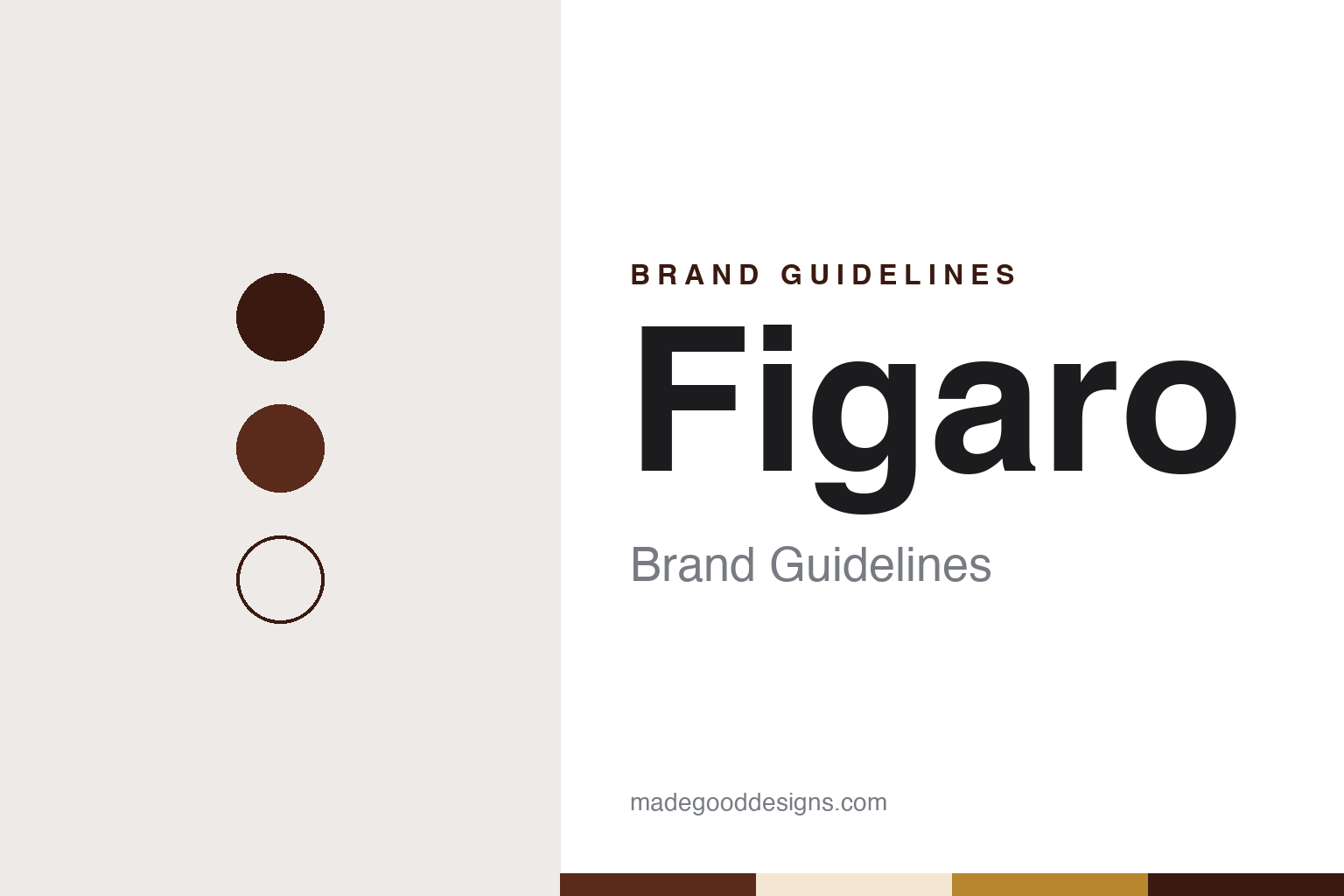
Figaro Brand Guidelines
The Slovak chocolate name with two hometowns.
Aa
Two constants: a cocoa, cream and gold palette and a theatrical serif register. Abstract homage — not a Figaro product or mark; no wrapper, logo or nameplate is reproduced.
Two towns
A Trnava name on a Bratislava factory.
The name Figaro began in Trnava, a town north-east of Bratislava. The Slovak Wikipedia history of the town says a chocolate and confectionery works called Figaro joined its sugar refinery and breweries at the start of the 20th century. I.D.C. Holding, which owns the Trnava plant today, says the factory was founded in 1906 by Adolf Fischer, a merchant from Vrbové, and became known as Figaro in the 1920s; Czech Wikipedia, citing a chocolate-museum history, names Ján Fischer as the owner of the Trnava Figaro works, so the sources differ on which Fischer is meant.
The chocolate sold as Figaro today comes from a second, older factory. In 1896 the German chocolate maker Stollwerck opened a branch factory on Račianska cesta in Bratislava, then Pressburg. Slovak Wikipedia, citing a 1926 supplement of the Prague daily Národní listy, calls it the largest factory of its kind in the Kingdom of Hungary, making chocolate, cocoa and sweets largely for export to western Europe and the Balkans, with between 400 and 900 workers, mostly women. Some of its original buildings survive.
After 1948 the Bratislava works were taken into a nationalised Slovak chocolate and confectionery enterprise. In 1958, according to Czech Wikipedia and the Slovak trade magazine Tovar & Predaj, the plant was merged with the Figaro works in Trnava and Piešťany and renamed Figaro, and in 1963 it became part of Československé čokoládovny, the group that brought together Czechoslovakia’s confectionery factories. Slovak Wikipedia says the Bratislava company carried the Figaro name from 1958 to 1993, while the Trnava works, part of the Bratislava enterprise from 1958 to 1989, kept it as well.
Colour
Tablets, Siesta and Tatiana.
Under Mondelēz the Figaro name covers a family of everyday chocolate rather than one bar. The brand’s Slovak website lists plain tablets in milk, dark and a 65 per cent extra-dark, a milk coating and a chocolate for cooking and baking, and the Čokopiškoty sponge biscuits with fruit-jelly fillings and a chocolate coat. It also groups under Figaro the Siesta bars, the Tatiana bars, a nougat, the Rumba bar and milk caramels.
The site leans on the brand’s age and on family memory rather than on any one design. Figaro chocolates and boxed sweets “from Mondelez have been with us for many decades,” it says, adding that “our grandmothers loved them, our mothers loved them, and today we enjoy them.” Its current line is “Figaro ťa odmení!” — “Figaro will reward you!” — and the copyright line names Mondelez Europe Services GmbH, through its Slovak branch.
What the factory makes is a wider question than what the brand sells. Tovar & Predaj reported in September 2017 that the Bratislava plant processes cocoa beans itself, makes chocolate mass and cocoa liquor as well as pralines, bars and tablets, and sends about nine-tenths of its output abroad, to other EU countries and as far as China and Canada; the magazine said 2016 had been a production record. The best-known foreign name to arrive there came later. In June 2022 Reuters reported that Mondelēz would begin making some Toblerone in Bratislava, ending the bar’s exclusive production in Bern; in March 2023 The Guardian reported that, under Swiss rules on national origin, the Toblerone pack would drop the Matterhorn for a streamlined mountain and say “created in Switzerland.”
Typography
Brands of two countries, one shelf.
The seven brands in this group all make food or drink, and all of them come from the Czech Republic or Slovakia: Opavia, Budvar, Kozel, Mattoni, Horalky, Figaro and Zlatý Bažant. Czech and Slovak food and drink brands in general sit at many different points in the trade, from names that still belong to the town or company where they began to names that now belong to much larger international groups, and a single brand can be sold everywhere from a village shop to a supermarket shelf abroad.
A food or drink brand’s identity is usually carried less by a single product than by a pack, a name and the taste or moment it promises, because the company behind the name may have changed hands, moved production or grown far beyond the place where it started. That makes the questions behind each name worth asking plainly: who started it, who owns it now, and where its products are actually made and packed.
Each guide separates what independent sources record from what the company says about itself — its founding story, its owners over time, where its products are made and how its packaging has changed — and marks plainly what rests only on the company’s own word.
Aa
A high-contrast serif for an operatic name. (Specimen set in Playfair Display, a serif STAND-IN; NOT the Figaro logo.)
Figaro
Jacobs Suchard, Kraft, Mondelēz.
The Bratislava factory left state hands soon after 1989. Czech Wikipedia and Tovar & Predaj say that in 1992, in privatisation, a joint-stock company named Figaro was formed and Jacobs Suchard took 67 per cent of its shares. In 1993 Jacobs Suchard was combined with Kraft General Foods Europe, and when Kraft Foods split its business in 2012, the factory went with the snacks company Mondelēz International. Slovak Wikipedia says the Bratislava company has been called Mondelez Slovakia since 2013; the Figaro name lives on as its chocolate brand.
The Trnava half of the story took a different road. In 1993 the Slovak sweet maker I.D.C. Holding privatised the state enterprise Figaro Trnava, I.D.C. says, and Slovak Wikipedia says the plant has worked since then as “Figaro Trnava,” a branch of I.D.C. In January 2025 I.D.C., the maker of Horalky, was bought by the Irish food group Valeo Foods, according to a press release issued in London. So the name now belongs on one side to a chocolate brand of an American multinational and on the other to a factory in the town where it began.
The Bratislava brand sits in a large Czech and Slovak portfolio. Czech Wikipedia lists Figaro among Mondelēz’s key brands in the two countries, alongside Milka, the biscuit umbrella Opavia, Kolonáda and BeBe, and says the group’s one Slovak factory is in Bratislava.
For a design guide, Figaro shows how a factory name from one town can become a household chocolate brand in another, and outlast three owners. Compare Opavia, Mondelēz’s Czech biscuit name, and Côte d’Or, a Belgian chocolate brand in the same group. For this guide we use cocoa brown, cream and gold with a serif, an unofficial interpretation; no product or logo is reproduced.
Explore & save
Keep Figaro’s identity on hand — save it to a board in the Made Good inspiration library.
Figaro identity set
Pin the Figaro cocoa, cream and gold palette and the theatrical serif register to your own board.