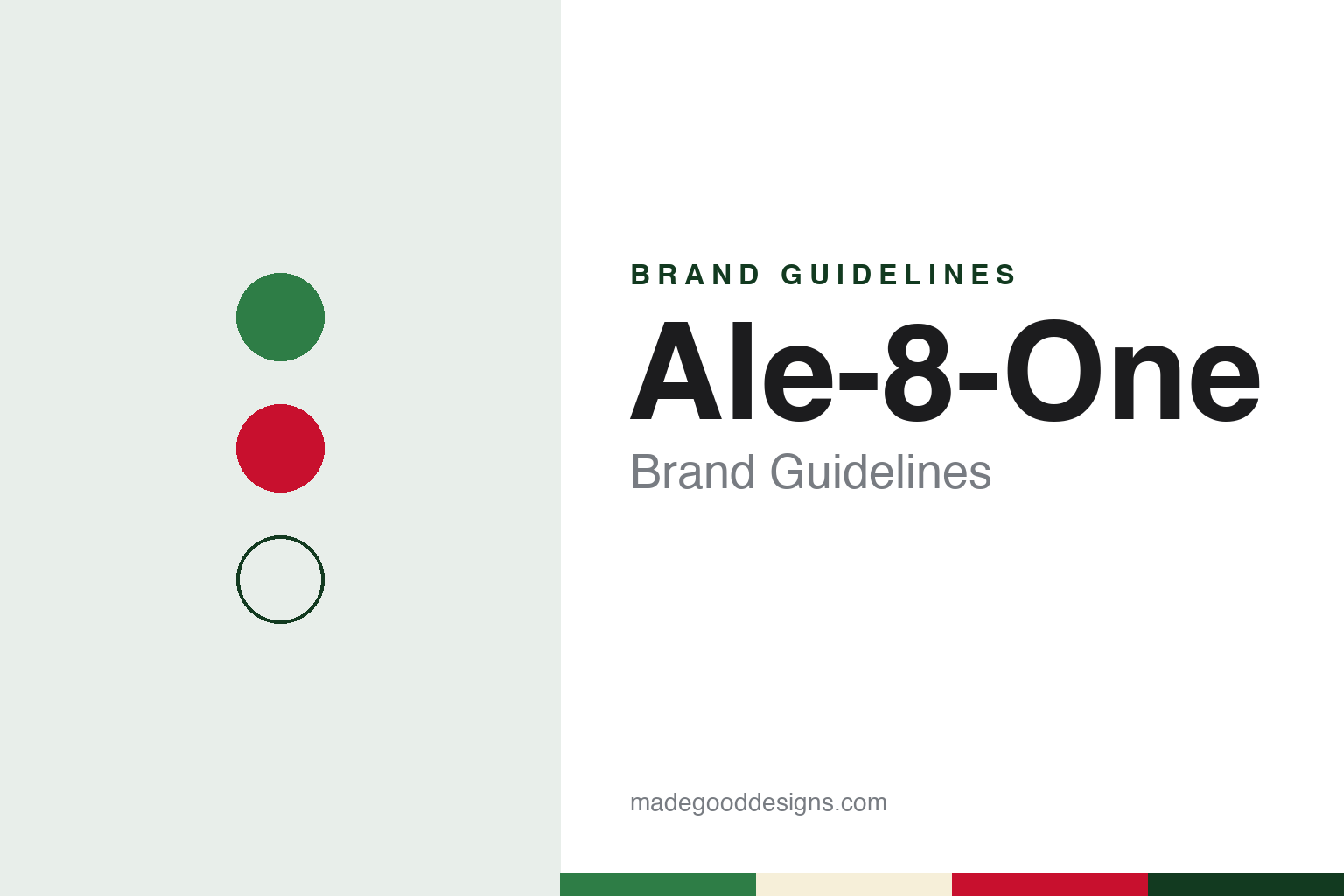
Ale-8-One Brand Guidelines
Kentucky’s “latest thing” in a green glass bottle.
Aa
Two constants: a bottle green, label red and cream palette and a sturdy slab serif register. Abstract homage — not an Ale-8-One product or mark; no bottle, label or logo is reproduced.
A Late One
A Winchester bottler, a cola and a ginger idea.
Ale-8-One comes from Winchester, Kentucky, a small town east of Lexington, and it has never really left. Its creator was George Lee Wainscott, usually written G.L. Wainscott. The Kentucky Encyclopedia (1992), as cited by English Wikipedia, says he had been in the soda business in Winchester since 1902. The company says he started out after seeing a carbonation machine, and that he first bottled distilled water and fruit-flavoured sodas from a building on North Main Street.
His first recipe of his own was a cola. The company says Roxa-Kola, launched in 1906, was named after his wife, Roxanne, and that the Coca-Cola Company sued over the name, a case it says Wainscott won, along with the appeal. While that fight went on, the company says, Wainscott looked for other flavours and found ginger beer on a trip to northern Europe; the encyclopedia also says he drew on ginger recipes he had learned there. He toned down the heat of the ginger and paired it with citrus.
The new drink went on sale in 1926, and its name came from the public. The company says Wainscott introduced it at the 1926 Clark County Fair with a contest to name it, and that the winning entry, from a young fairgoer, was “A Late One” — 1920s slang for the latest thing. Shortened and spelled with a numeral, it became Ale-8-One; locally the drink is simply called Ale-8. In 1935, the encyclopedia says, Wainscott bought a livery stable in Winchester and turned it into a bottling plant to make more of it.
Colour
From a founder to a family, generation by generation.
Ownership passed sideways before it settled. According to The Kentucky Encyclopedia, in 1944 half of Wainscott’s company stock went to his wife and the other half was shared among his employees. In 1954 her stake went to her brother, Frank A. Rogers. In 1962 Rogers bought the remaining stock and incorporated the Ale-8-One Bottling Company, with his son, Frank Rogers Jr., as manager. The encyclopedia dates a new plant in Winchester to 1965; the company gives the move to its current home as 1966.
The Rogers family then narrowed the business to a single drink. The encyclopedia says the company stopped making Roxa-Kola in 1968 and had dropped all its other drinks by 1974 to concentrate on Ale-8-One. The company says it has been privately owned since 1902. In October 2009, it says, Wainscott’s great-great-nephew Fielding Rogers became president at 28, the youngest in its history and the fourth generation to lead it; he was later named owner and chairman of the board.
The recipe is part of the brand story. The company says the formula has been kept within the family for four generations, and that Fielding Rogers mixes it himself, batch by batch, in a locked batching room, working from his great-great-uncle’s handwritten notes and a specially blended ginger. The Kentucky food site A Taste of Kentucky reported in 2017 that only Fielding and his father, the former president Frank A. Rogers III, knew the exact recipe. Every bottle of Ale-8 sent out, it says, starts from those small batches. The company describes the drink as coming in green glass.
Typography
Design and documentation.
The seven brands in this group are all soft drinks from different regions of the United States: Cheerwine, Moxie, Faygo, Vernors, Big Red, Ale-8-One and Sun Drop. American regional soft-drink brands in general sit at many different points in the trade, from family firms that still carry a founder’s name to names that now belong to much larger drinks groups, and a single brand can be sold everywhere from a corner shop to a supermarket shelf.
A soft-drink brand’s identity is usually carried less by a single product than by a bottle or can, a name and the flavour it promises, because the company behind the name may have changed hands, moved its production or grown far beyond the place where it started. That makes the questions behind each name worth asking plainly: who started it, who owns it now, and where its drinks are actually made and bottled.
Each guide separates what independent sources record from what the company says about itself — its founding story, its owners over time, where its drinks are made and how its packaging has changed — and marks plainly what rests only on the company’s own word.
Aa
A sturdy slab serif for a small-town bottler with a long memory. (Specimen set in Alfa Slab One, a serif STAND-IN; NOT the Ale-8-One logo.)
Ale-8-One
One drink for half a century, then new flavours and a revived cola.
For decades Ale-8-One was a drink of central and eastern Kentucky. English Wikipedia says that in April 2001 the company extended distribution into southern Ohio and southern Indiana through an agreement with Coca-Cola Enterprises, and later into East Tennessee and western Virginia. In March 2016, the Louisville broadcaster WDRB reported that Cracker Barrel would carry Ale-8 in its stores nationwide.
After almost eighty years with one product, the range began to grow. English Wikipedia says a diet version arrived in 2003, the company’s first new drink since 1926, and was renamed Ale-8 Zero Sugar in 2020. Cherry Ale-8 followed in 2018, first at soda fountains and then in bottles, The Cincinnati Enquirer and WDRB reported; an orange cream flavour followed in 2019, according to the Lexington station LEX 18, which also reported a seasonal peach in 2023. In 2006, for the company’s 80th anniversary, an Ale-8-One salsa grew out of a cooking contest won by a Sullivan University student, The Harrodsburg Herald reported. The biggest return was the oldest: in September 2023 the Lexington station WTVQ reported that, 55 years after it was dropped, the company was bringing back Roxa-Kola, Wainscott’s first cola; English Wikipedia says a limited release in November 2023 was followed by a longer run in 2024.
For a design guide, Ale-8-One shows how a fair-ground naming contest, a family recipe and a green bottle can carry a one-town soft drink for a century. Compare Cheerwine, another family-owned Southern soda, and Vernors, the Detroit ginger ale; our earlier note on the Ale-8-One lettering looks at its type. For this guide we use a bottle green, a label red and a cream with a slab serif, an unofficial interpretation; no product or logo is reproduced.
Explore & save
Keep Ale-8-One’s identity on hand — save it to a board in the Made Good inspiration library.
Ale-8-One identity set
Pin the Ale-8-One bottle green, label red and cream palette and the sturdy slab serif register to your own board.