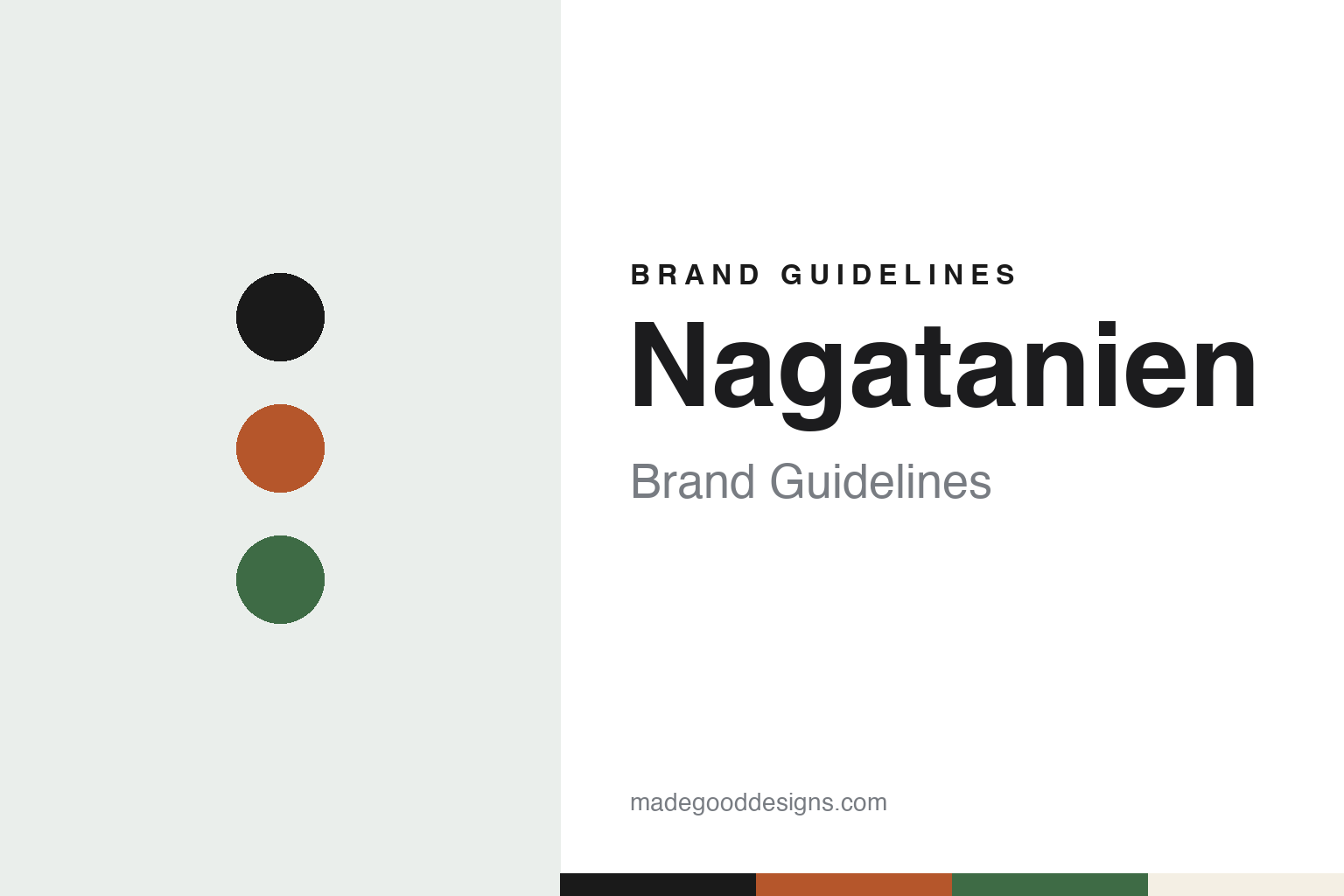
Nagatanien Brand Guidelines
The tea family’s ochazuke in a kabuki-curtain pack.
Aa
Two constants: a curtain black, persimmon and green palette and a brush-era Japanese serif register. Abstract homage — not a Nagatanien product or mark; no pack, logo or sachet is reproduced.
From tea to ochazuke
An Edo tea family, a drink of nori and a post-war sachet.
Nagatanien traces its name to tea. Japanese Wikipedia says the company’s roots go back to the Edo period and to Nagatani Sōshichirō, later known as Nagatani Sōen, who developed a method of making sencha green tea in the village of Yuyadani in Yamashiro Province, today Ujitawara in Kyoto Prefecture. According to the 2009 cookbook I Love Ochazuke 365, cited by Japanese Wikipedia, the ninth head of the family, Nagatani Musashi, later devised “nori-cha,” finely cut nori seaweed mixed with matcha and salt, which was dissolved in hot water and drunk.
His son Yoshio Nagatani, the tenth generation, turned that drink into a meal. Born in Tokyo, he served in the Second World War and afterwards set out to rebuild the family tea business, which had burned in the war, Japanese Wikipedia says. His answer was Edo-fūmi Ochazuke Nori, a sachet of nori, tiny arare rice crackers and a granulated matcha salt that turns a bowl of rice into ochazuke with nothing more than hot water. It went on sale in 1952. The company says he wanted people to be able to eat at home a dish then found mostly in restaurants. The arare were borrowed from bubuzuke, the Kyoto version of the dish, and also helped keep the contents dry; at first the firm struggled to keep the nori crisp and tried double bags, the same cookbook says.
The company followed the product. Nagatanien Honpo was founded in Tokyo in April 1953, and the product took the name Nagatanien no Ochazuke Nori in 1956, Japanese Wikipedia says. The firm became plain Nagatanien in October 1992. A run of instant Japanese staples followed, which the company dates as a matsutake-flavoured clear soup in 1964, salmon ochazuke in 1970, pickled-plum ochazuke in 1972 and Asage instant miso soup in 1974. Japanese Wikipedia credits Nagatanien with the industry’s first freeze-dried instant miso soup. By 2016, the business site Biz Compass reported, more than 15 billion servings of Ochazuke Nori alone had been produced.
Colour
A theatre curtain, a kabuki mask and a sound logo.
The pack is the brand’s best-known design. According to I Love Ochazuke 365, Yoshio Nagatani designed it himself, taking as his reference the jōshiki-maku, the striped stage curtain of the kabuki theatre. The book says the design had barely changed between the launch and 2009. Nagatanien itself describes a package chosen to evoke the atmosphere of old Edo. The founder also chose to write “ochazuke” with the softer kana spelling お茶づけ rather than the usual 茶漬け, Japanese Wikipedia says.
Kabuki runs through the company’s marks. Japanese Wikipedia says Nagatanien has registered as a trademark the sujiguma, one of the bold kumadori make-up patterns of kabuki, and that its name has been written in brush lettering since the founding. In 2004 the company introduced what it calls a brand statement design: the slogan “Aji hitosuji Nagatanien”, roughly “single-minded about flavour,” combined with a dynamic letter N, the initial of the English name. Japanese Wikipedia says the slogan itself has been in use since 1979, and the company now treats it as its corporate philosophy. The company says it puts the design on its packaging and many other materials.
Sound followed in 2005, when Nagatanien added a sound logo to its television advertising. The company describes it as the brand statement design jumping out of an Ochazuke Nori sachet, with sound, at the start of each commercial; Japanese Wikipedia likens the sound to the shake of ochazuke being sprinkled. Television has long carried the brand. Japanese Wikipedia lists sumo wrestlers among its advertising faces, from Takamiyama to Endō, and says the company sponsors prize banners at grand sumo tournaments. Character tie-ins began with Little Twin Stars ochazuke in November 1977, which sold poorly and was soon withdrawn, and took off with Super Mario Bros. furikake and ochazuke in July 1986, according to a 2001 business book from Toyo Keizai cited by Japanese Wikipedia.
Typography
Design and documentation.
The seven brands in this group are all food and coffee names from Japan: Marukome, Hagoromo, Nagatanien, Sapporo Ichiban, UCC, Boss and Georgia. Japanese food and coffee brands in general sit at many different points in the trade, from family firms that still carry a founder’s name to names that now belong to much larger food and drink groups, and a single brand can be sold everywhere from a corner shop to a supermarket shelf.
A food or drink brand’s identity is usually carried less by a single product than by a pack, a name and the meal, snack or drink it promises, because the company behind the name may have changed hands, moved its production or grown far beyond the place where it started. That makes the questions behind each name worth asking plainly: who started it, who owns it now, and where its products are actually made and packed.
Each guide separates what independent sources record from what the company says about itself — its founding story, its owners over time, where its products are made and how its packaging has changed — and marks plainly what rests only on the company’s own word.
Aa
A brush-era Japanese serif for a name written by hand since 1953. (Specimen set in Shippori Mincho, a serif STAND-IN; NOT the Nagatanien logo.)
Nagatanien
A listed company, a holding structure and a buyout.
Nagatanien spent almost five decades on the stock market. Its shares were listed in Tokyo from December 1976 and moved to the first section in April 1983. In October 2015 the company reorganised into a holding structure: the old Nagatanien became Nagatanien Holdings, and a new operating company called Nagatanien took over the food business, according to the company’s 2015 announcements. In 2024 the founding family teamed with an investment fund linked to Mitsubishi Corporation for a management buyout, Reuters and the Yomiuri Shimbun reported; the buyout company acquired 73.16% of the shares through a tender offer, and Nagatanien Holdings left the Tokyo Stock Exchange’s Prime market on 27 September 2024.
The group has grown through acquisitions. Nagatanien bought 51% of the noodle maker Fujiwara Seimen in September 2008 and, in April 2013, all of Muginoho Holdings, the company behind the Beard Papa cream-puff shops, according to company announcements cited by Japanese Wikipedia, which also lists overseas subsidiaries including Nagatanien USA and Chaucer Foods in France and China. The head office is in Nishi-Shimbashi, Tokyo. In 2021 the company set up Nagatanien Foods and brought its own factories and those of its production subsidiaries together in it; the company names plants in Ibaraki and Okayama among them. For the 60th anniversary of Ochazuke Nori in 2012, it registered 17 May as “Ochazuke Day” with the Japan Anniversary Association.
For a design guide, Nagatanien shows how a theatre curtain, a brush-lettered name and one small sachet can carry a food brand for more than seventy years. Compare House Foods, another Japanese maker of instant staples, and Kewpie, the Tokyo mayonnaise maker. For this guide we use a curtain black, a persimmon and a deep green with a Japanese serif, an unofficial interpretation; no product or logo is reproduced.
Explore & save
Keep Nagatanien’s identity on hand — save it to a board in the Made Good inspiration library.
Nagatanien identity set
Pin the Nagatanien curtain black, persimmon and green palette and the brush-era Japanese serif register to your own board.