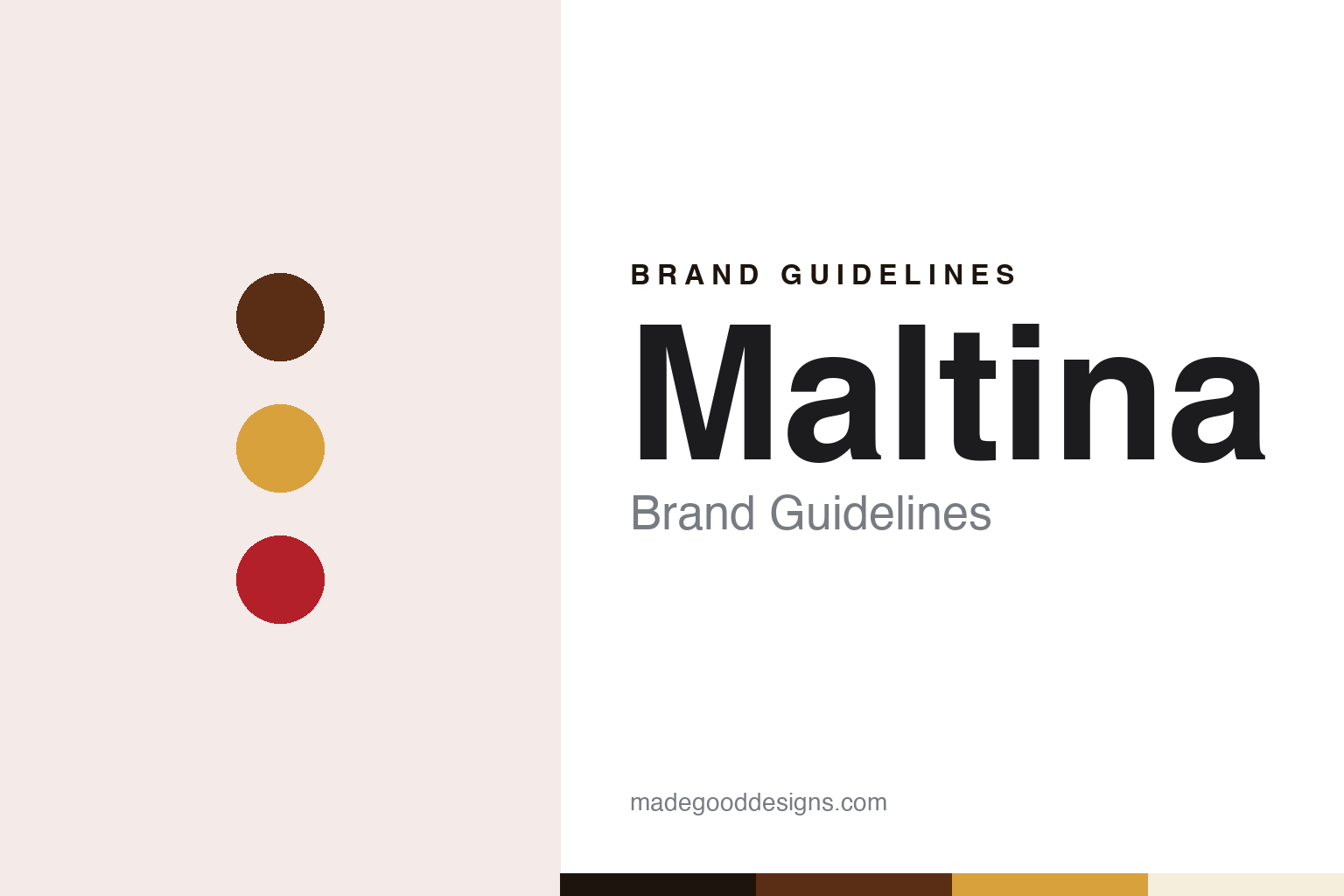
Maltina Brand Guidelines
Nigerian Breweries’ 1976 malt drink.
Aa
Two constants: a malt brown, gold and red palette and a display serif register. Abstract homage — not a Maltina product or mark; no bottle, can, label or logo is reproduced.
Iganmu
A Lagos brewer adds a drink without alcohol.
Maltina is a malt drink — a brewed, non-alcoholic drink made from malted grain — sold in Nigeria by Nigerian Breweries, which calls itself Nigeria’s pioneer and largest brewing company. The company dates its own beginning to November 1946, when the trading house United Africa Company and the Dutch brewer Heineken signed a contract to incorporate Nigerian Brewery Limited in Lagos. The idea of a Lagos brewery had first been promoted before the Second World War by Frank Samuel of UAC, English Wikipedia says, and other trading houses, among them John Holt, SCOA, CFAO and UTC, took stakes in the venture. Its first beer, Star, came off the bottling line at Iganmu, Lagos, in June 1949; the firm took the name Nigerian Breweries Limited in 1957, and launched the lager Gulder in 1970.
Maltina followed in 1976, according to the company’s published timeline; the Lagos newspaper ThisDay, in a September 2026 feature, also dated its launch in Nigeria to 1976. English Wikipedia describes it as originally launched as a classic malt drink.
The company describes Maltina Classic as brewed from malted barley and hop extract. Two flavoured versions sit beside it, Maltina Pineapple and Maltina Vanilla, according to the company’s brand page, which uses the line “Share the happiness.” Nigerian Breweries later added a second malt drink, Amstel Malta, in November 1994, and the soft drink Fayrouz in 2006.
Maltina was not the firm’s first venture outside beer. English Wikipedia, citing a 1972 issue of Drum magazine, says Nigerian Breweries had earlier sold mineral and flavoured drinks under a Rainbow brand, among them Krola and Tip Top tonic water, and sold that non-alcoholic franchise in 1972 — four years before Maltina appeared.
Colour
A Heineken-led brewer with breweries across Nigeria.
Nigerian Breweries is a public company listed in Lagos, and Heineken has been part of it from the start. By the company’s account, Heineken took over control of Nigerian Breweries in 2000. Its December 2013 results, as cited by English Wikipedia, listed Heineken Brouwerijen as the largest single shareholder, with a further stake held by Distilled Trading International; Wikipedia describes Heineken as the leading shareholder behind the company’s 2014 merger with Consolidated Breweries, maker of 33 Export.
The company has grown through new breweries and purchases. It commissioned breweries at Aba in 1957, Kaduna in 1964, Ibadan in 1982 and Enugu in 1993, and opened the Ama brewery in Enugu State in 2003. When the federal government banned barley imports in 1988, the company converted its plants with Heineken’s technical help and set up a grain farm in Niger State, according to Patrick Utomi’s 1998 book Managing Uncertainty, as cited by English Wikipedia. In 2011 it bought Sona Breweries; its current footprint lists plants at Lagos, Aba, Ama, Ibadan, Ijebu-Ode, Kudenda in Kaduna and Ota, with its head office at Iganmu in Lagos.
Packaging has followed the market. English Wikipedia says most of the company’s drinks are sold in returnable glass bottles, that all are now available in cans, and that Maltina is one of the few also sold in PET plastic bottles. In March 2026 the company said Maltina was available in 25cl and 50cl PET bottles, sizes it presented as easy to carry in a school bag.
Maltina is not only a Nigerian name. English Wikipedia lists a Maltina among the products of Sierra Leone Brewery and of Brarudi in Burundi, two other African brewers.
Typography
African and Middle Eastern drink brands.
The seven brands in this group are all drink names from Africa and the Middle East: Tusker, Maltina, Stoney, Almaza, Kassatly, Zamzam and Barbican. African and Middle Eastern drink brands in general sit at many different points in the trade, from family firms that still carry a founder’s name to names that now belong to much larger drinks groups, and a single brand can be sold everywhere from a corner shop to a supermarket shelf.
A drink brand’s identity is usually carried less by a single product than by a bottle, a can, a name and the refreshment it promises, because the company behind the name may have changed hands, moved its production or grown far beyond the place where it started. That makes the questions behind each name worth asking plainly: who started it, who owns it now, and where its drinks are actually made and bottled.
Each guide separates what independent sources record from what the company says about itself — its founding story, its owners over time, where its drinks are made and how its packaging has changed — and marks plainly what rests only on the company’s own word.
Aa
A warm display serif for a malt drink in its 50th year. (Specimen set in DM Serif Display, a serif STAND-IN; NOT the Maltina logo.)
Maltina
Dance, school games and a teachers’ prize.
Maltina’s name is attached to several long-running programmes. The best known is Maltina Dance All, a family dance contest on Nigerian television. English Wikipedia’s pages on its presenters and contestants say the director Tope Oshin presented it in 2008, that the filmmaker Kemi Adetiba hosted three consecutive seasons, and that the singer Ayra Starr finished second on the show as a child. ThisDay named Dance All in 2026 as one of the ways Nigerians came to know the brand.
Schools are the other pillar. The Maltina Teacher of the Year competition, run by the Nigerian Breweries-Felix Ohiwerei Education Trust Fund to reward secondary school teachers, opened entries for its 12th edition in June 2026, the company said. Wikipedia’s page on the sprinter Kanyinsola Ajayi records his wins at the 2021 Maltina School Games.
In 2026 the brand marked its 50th year. In February the company launched a Maltina Nourishment Tour of schools, starting in Lagos, with science demonstrations run with STEM Africa Fest; a company manager described it as part of Maltina’s 50th-anniversary activity, and the media personality Kiekie joined a visit to her old school in Ibadan. The actress Rahama Sadau has also served as a brand ambassador, according to English Wikipedia. In April 2025 the company opened a Maltina Skills Acquisition Centre at Kakuri, in Kaduna, and its newsroom has reported Maltina Ramadan iftar events and a Christmas light-up in Lagos and Abuja.
For a design guide, Maltina shows how a malt drink can build its name through television, schools and anniversaries. Compare Star, the 1949 lager from the same brewer, and Golden Morn, Nestlé Nigeria’s maize-and-soya cereal. For this guide we use malt brown, gold and red with a serif, an unofficial interpretation; no product or logo is reproduced.
Explore & save
Keep Maltina’s identity on hand — save it to a board in the Made Good inspiration library.
Maltina identity set
Pin the Maltina malt brown, gold and red palette and the display serif register to your own board.