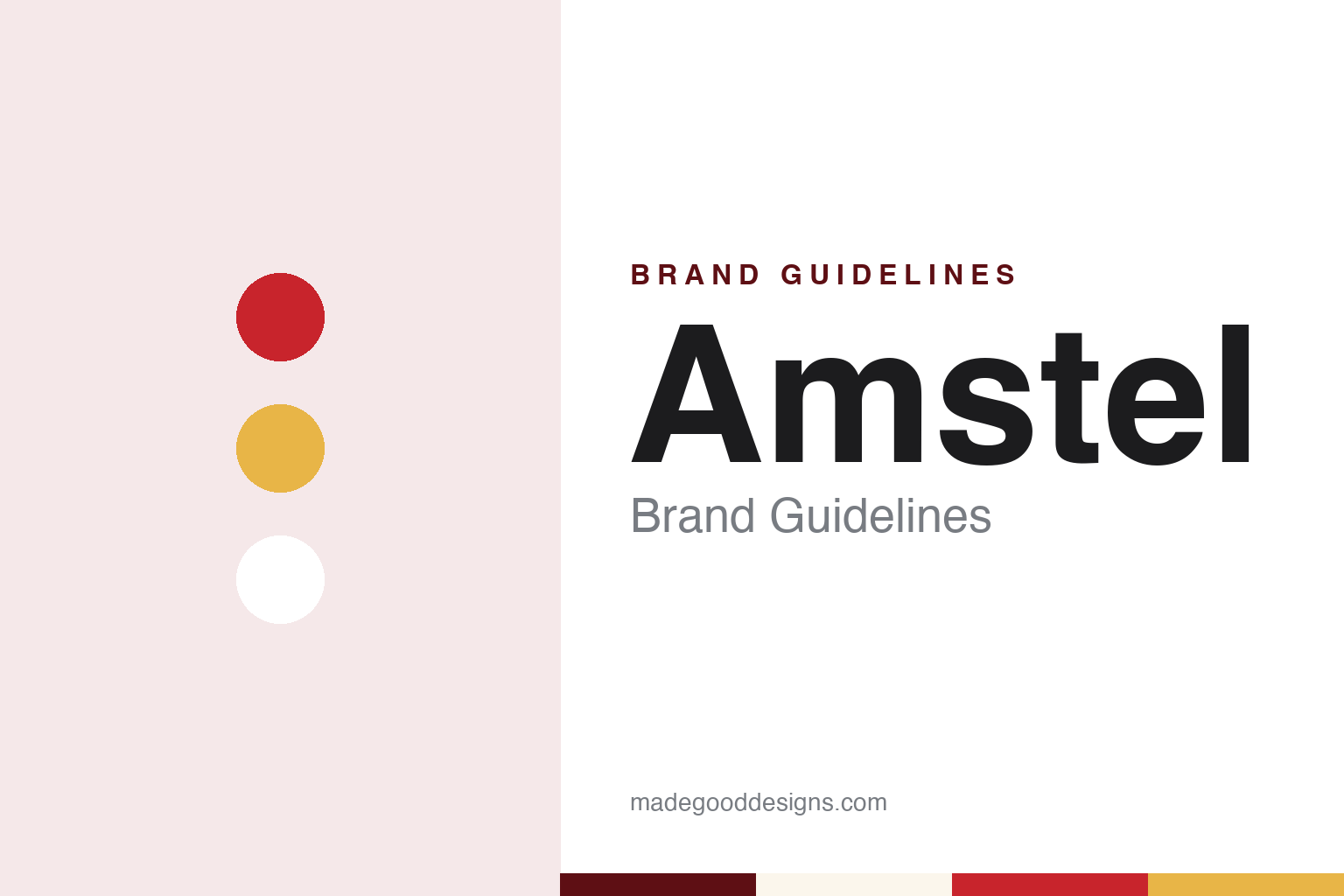
Amstel Brand Guidelines
The Amsterdam lager brewed since 1870.
Aa
Two constants: an Amstel red, lager gold and foam white palette and a classic brewery serif register. Abstract homage — not an Amstel product or mark; no bottle, label or logo is reproduced.
De Amstel
Two brothers-in-law, a river and a Bavarian-style beer.
Amstel takes its name from the river that gave Amsterdam its name, and it began on the city’s Mauritskade in 1870. The company tells the story as one of friendship: its brewery, it says, was founded by two friends and brothers-in-law, Charles de Pesters and Johannes van Marwijk Kooy, who set out to brew a new lager in the Bavarian style. English Wikipedia, citing Peter Zwaal’s 2010 history of the brewery, names a third founder, Willem Eduard Uhlenbroek, whose father owned a small sugar refinery in Amsterdam, and says De Pesters and Van Marwijk Kooy came from wealthy Amsterdam families.
The dates come from the same history. The first stone was laid on 11 June 1870, the first brew was finished on 25 October 1871, the first beer reached customers on 9 January 1872, and the brewery opened officially on 15 January 1872. Its trading name was Beiersch Bierbrouwerij De Amstel, the Bavarian Beer Brewery De Amstel, and in its first year it brewed about 10,000 hectolitres. Dutch Wikipedia says Amstel Bock was among the beers made that first year and that pilsner followed about a decade later. To keep its bottom-fermented beer cold, the brewery cut winter ice from the canals and stored it in double-walled cellars.
At first the beer was drunk mainly in Amsterdam. English Wikipedia says its spread across the Netherlands followed the growth of the Dutch railways, with agents appointed in towns along the new lines. On 1 January 1891 the firm, until then De Pesters, Kooy & Co., became a public limited company.
Colour
Exports, cans and a bicycle race.
Amstel looked abroad early. From 1883 its beer went to Britain and to the Dutch East Indies, and in 1884 the company built a separate export bottling plant where “tropical” beers for overseas markets were pasteurised and filled into metal kegs, English Wikipedia says. By 1915 output had grown twentyfold, and in 1926 Amstel accounted for a third of all Dutch beer exports. A 1922 advertisement for “Amstel super Stout” survives from those years. In 1941 Amstel and Heineken together bought the Amsterdam brewery Van Vollenhoven, which closed in 1961.
After the Second World War the brewery built abroad. Both Wikipedias record a brewery in Suriname from 1954, a first beer from an associated brewery in Jordan in 1958, the Antilliaanse Brouwerij on Curaçao in 1960 and new breweries in Puerto Rico and Greece in 1963; Dutch Wikipedia adds that the Almaza brewery in Lebanon began brewing Amstel under licence in the early 1960s. Amstel was also, both say, the first Dutch brewery to export beer in cans, in the mid-1950s.
Its best-known piece of sponsorship came in 1966. That year the promoters Ton Vissers and Herman Krott, who ran a company called Inter Sport, created the Amstel Gold Race, a one-day classic in the province of Limburg, and Amstel has been its title sponsor since the first edition, English Wikipedia says. Krott had worked as a sales representative for the brewery and used his contacts there to find the money. The first race, planned to start in Amsterdam and finish in Maastricht, was won by the Frenchman Jean Stablinski. The race still carries the brand’s name, and amstel.nl hosts its own section for it.
Typography
Design and documentation.
The seven brands in this group are all beer brands from the Netherlands, France and Italy: Amstel, Grolsch, Bavaria, Hertog Jan, Kronenbourg, Birra Moretti and Menabrea. Dutch, French and Italian beer brands in general sit at many different points in the trade, from family firms that still carry a founder’s name to names that now belong to much larger brewing groups, and a single brand can be sold everywhere from a corner bar to a supermarket shelf.
A beer brand’s identity is usually carried less by a single product than by a label, a name and the drink it promises, because the company behind the name may have changed hands, moved its brewing or grown far beyond the town where it started. That makes the questions behind each name worth asking plainly: who started it, who owns it now, and where its beer is actually brewed and packed.
Each guide separates what independent sources record from what the company says about itself — its founding story, its owners over time, where its beer is brewed and how its labels have changed — and marks plainly what rests only on the company’s own word.
Aa
A classic brewery serif for a lager named after a river. (Specimen set in Playfair Display, a serif STAND-IN; NOT the Amstel logo.)
Amstel
Heineken, new breweries and a family of brand extensions.
In 1968 Amstel was bought by its Amsterdam rival Heineken, a date given by English Wikipedia, citing The Oxford Companion to Beer, and by Dutch Wikipedia. The Mauritskade brewery was shut down in 1982 and then demolished, Dutch Wikipedia says; only the former head office, built in 1930, still stands, and it is now part of the Amsterdam University of Applied Sciences. Its facade carries sculpture by Gerarda Rueter.
Since Heineken also closed its own Stadhouderskade brewery in September 1988, Amstel beers have been made entirely outside Amsterdam, according to Dutch Wikipedia: pilsner at Heineken’s brewery in Zoeterwoude, in South Holland, and speciality beers such as bock in ’s-Hertogenbosch and later in Wijlre. Abroad, Heineken used the name for other breweries. It renamed a brewery it bought in Hamilton, Ontario, in 1981 as Amstel Canada, selling it again in 1991, and from 1994 ran a Hungarian brewery in Komárom as Amstel Sörgyár until it closed in 2003.
Under Heineken, Amstel has become a family of beers rather than a single lager. The company’s international site lists extensions including Amstel Light, Amstel Bright, Amstel Radler and Amstel Ultra, and the Dutch site adds Amstel 0.0%, Amstel Blond and a seasonal Amstel Bock. Amstel Radler, a mix of lager and lemonade, is sold in several countries, Fortune reported in 2014. Through all of it the brand keeps its birthplace in view: Amstel says it trademarks the line “European quality, born in Amsterdam” wherever it can, and it describes “togetherness and friendship” as the values that run from its two founders to its sponsorships today. Its Dutch website carries the line “Gebrouwen sinds 1870,” brewed since 1870. A separate guide covers the font Amstel uses.
For a design guide, Amstel shows how a river, a founding year and a cycling classic can keep a lager tied to one city long after it stopped being brewed there. Compare Zagorka, a Bulgarian brewery whose majority owner is Heineken, and Bavaria, another Dutch lager. For this guide we use an Amstel red, a lager gold and a foam white with a classic serif, an unofficial interpretation; no product or logo is reproduced.
Explore & save
Keep Amstel’s identity on hand — save it to a board in the Made Good inspiration library.
Amstel identity set
Pin the Amstel red, lager gold and foam white palette and the classic brewery serif register to your own board.