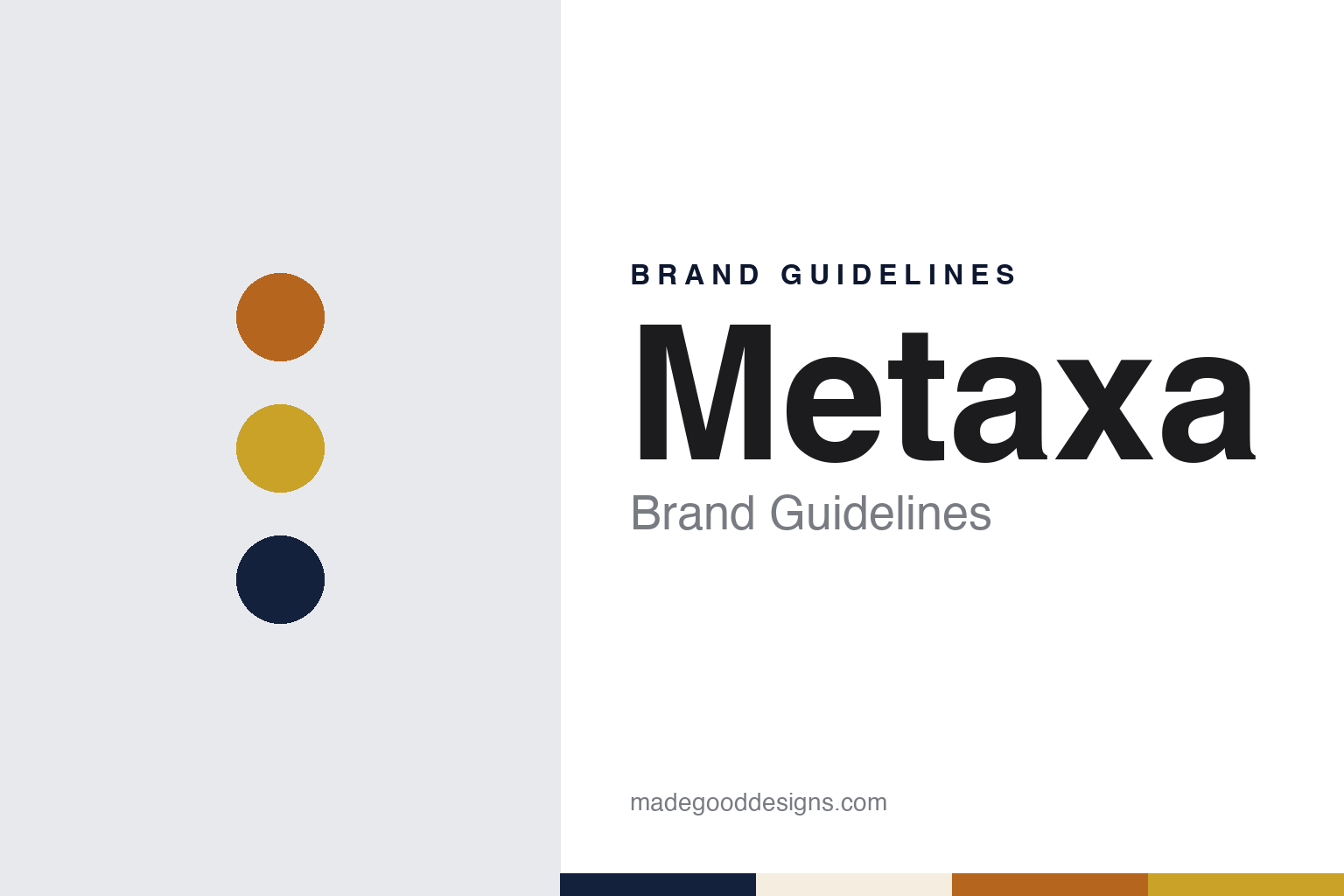
Metaxa Brand Guidelines
The Piraeus spirit of Muscat wine, stars and an amphora bottle.
Aa
Two constants: an amber, navy and gold palette and a classical inscriptional serif register. Abstract homage — not a Metaxa product or mark; no bottle, label, emblem or logo is reproduced.
A Piraeus distillery
A silk-trading family, an old still and a recipe.
Metaxa is the name of a Greek spirit as much as a house. English Wikipedia describes it as a line of amber blends of spirits and Muscat wine, aged in oak barrels. Its founder, Spyros Metaxa, was born in 1848 on the island of Euboea, the company says; Greek Wikipedia places his birth in Chalkida, the island’s main town, and says the family took the name Metaxas from its trade in silk, the Greek word for which is metaxi. English Wikipedia likewise describes a family of silk merchants.
The company dates its beginning in two steps. In 1885, it says, Spyros invested in an old distillery in Piraeus, the port of Athens, planning to make a spirit of his own, and in 1888 he created Metaxa, which it now calls “the Original Greek Spirit.” His recipe, the company says, married sweet Muscat wines with aged wine distillates. Greek Wikipedia adds that his brother Ilias was a partner in the Piraeus distillery on Aristidou Street, near Karaiskaki Square, and that the firm traded under the brothers’ initials. English Wikipedia, citing the company, says Spyros owned a tavern when he created the drink.
The house mark has a story of its own. The emblem known as the “Salamina Warrior” was inspired by an ancient medallion Spyros found while building the Piraeus distillery in 1888, English Wikipedia says, citing the company; Greek Wikipedia describes it as an ancient coin found while the foundations of the Aristidou Street factory were being laid. English Wikipedia also says the drink was labelled first as a cognac and then as a brandy, until naming rules ended that, which is why it is sold simply as Metaxa.
Colour
Exports, medals and an amphora.
The spirit travelled early. Greek Wikipedia says exports to the Ottoman Empire and Egypt began in 1892, the year the firm first advertised in the Piraeus newspaper Sfaira, and that a gold medal followed at an international exhibition in Bremen in 1895. The company dates its first exports to America to 1900. Greek Wikipedia adds that a Grand Prix at the 1915 San Francisco exposition was marked by a commemorative label on the neck of the bottle, a detail it says was dropped in a recent brand renewal. In 1909, according to the company’s timeline, Spyros’s wife Despina and their sons Angelos, Andreas and George carried the business on.
The best-documented design moment is the bottle. In 1963, the company says, Yiannis Tseklenis designed the “Amphora” bottle for Metaxa 7 Stars, a shape it calls an important trademark ever since. For the centenary in 1988 it launched a Metaxa Centenary, which it describes as its first collectible, together with a new 5 Stars International bottle, and in 1992 it gave the 5 Stars new packaging in Greece.
The range is organised by stars. English Wikipedia says the numbers indicate, according to different sources, the age of the blend, the number of spirits and wines in it, or simply a quality level; Greek Wikipedia ties 3, 5, 7 and 12 Stars to minimum years of ageing. Forbes, in an article by Joseph Micallef in October 2022, named 5 Stars, 7 Stars, 12 Stars and Private Reserve as the main export products. The company dates Private Reserve to 1992, when Constantinos Raptis became the fifth Metaxa Master, and 12 Stars to 2011. Greek Wikipedia says that for the 120th anniversary in 2008 the house released Metaxa AEN in 1,888 numbered bottles.
Typography
Design and documentation.
The seven brands in this group are all spirit names from Mexico, France, Greece and Spain: José Cuervo, Patrón, Ricard, Pernod, Metaxa, Ouzo 12 and Licor 43. Spirit brands in general sit at many different points in the trade, from family firms that still carry a founder’s name to names that now belong to much larger drinks groups, and a single brand can be sold everywhere from a neighbourhood bar to a duty-free shelf.
A spirit brand’s identity is usually carried less by a single bottle than by a label, a name and the drink or ritual it promises, because the company behind the name may have changed hands, moved its production or grown far beyond the place where it started. That makes the questions behind each name worth asking plainly: who started it, who owns it now, and where its spirits are actually made and bottled.
Each guide separates what independent sources record from what the company says about itself — its founding story, its owners over time, where its spirits are made and how its bottles and advertising have changed — and marks plainly what rests only on the company’s own word.
Aa
Cinzel is a STAND-IN chosen for its Roman inscriptional capitals, which echo the idea of an ancient medallion; it is NOT the Metaxa logo or label lettering.
Metaxa
From Piraeus to Kifissia, Samos and Rémy Cointreau.
Production moved north in 1968, when, the company says, its move from Piraeus to Kifissia, the northern Athens suburb, was finalised; in 1990 it says the Kifissia distillery was modernised and its capacity doubled. Forbes reported in 2022 that Metaxa uses sweet Muscat wines from the island of Samos, aged for several years, and that its base brandies come mostly, about 80 per cent, from Spain and Italy, with the rest from Greece. The components are aged separately and combined in Limousin oak casks, and Mediterranean botanicals, including May rose, are added in finishing, the same report said.
Samos has since moved closer to the centre of the story. The company says it bought a vineyard on the island in 2017 and began converting it to organic farming, and that in 2021 it revealed Metaxa Liknon on Samos, which Rémy Cointreau describes as the house’s home on the island. The blending role is personal: the company says Konstantinos Kalpaxidis became the sixth Metaxa Master in 2024, and that in 2023 its Private Reserve Orama carried the signatures of two Masters on the bottle.
Ownership changed twice. English Wikipedia says the business stayed in private hands until it was sold to Grand Metropolitan in 1989, and Greek Wikipedia also says the family no longer owned it from 1989. Rémy Cointreau says Metaxa joined its portfolio in 2000. In 2024 the company said the spirit is sold in more than 40 countries.
For a design guide, Metaxa shows how a single emblem, a bottle shape and a numbered system can carry a brand through more than a century and two changes of owner. Compare Ouzo 12, another Greek spirit whose bottle is part of its story, and Loux, a Greek drinks maker from Patras. For this guide we use amber, deep navy and gold with a classical serif, an unofficial interpretation; no product or logo is reproduced.
Explore & save
Keep Metaxa’s identity on hand — save it to a board in the Made Good inspiration library.
Metaxa identity set
Pin the Metaxa amber, navy and gold palette and the classical inscriptional serif register to your own board.